Reliable lighting is critical for parking lots at night. However, if these lights aren’t switched off during daylight hours, they can waste energy. Manual switches and fixed timers can help but are not fully effective.
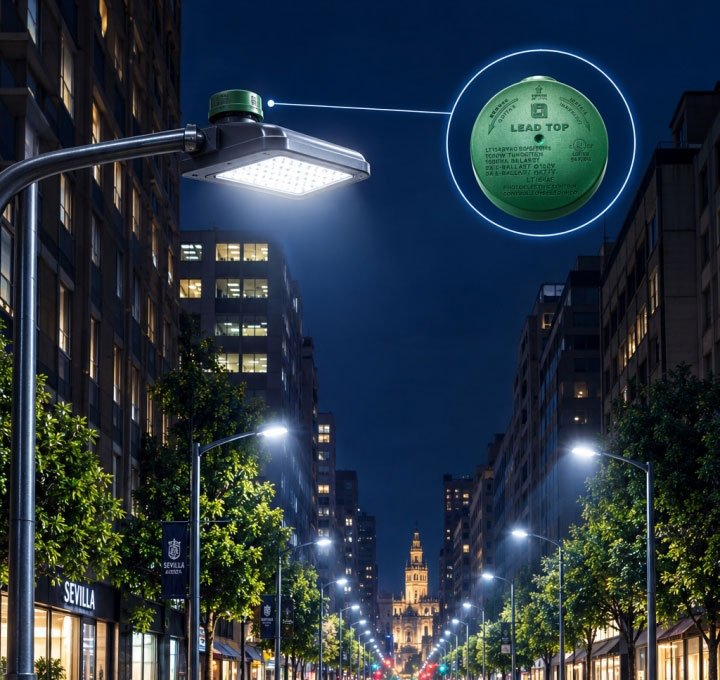
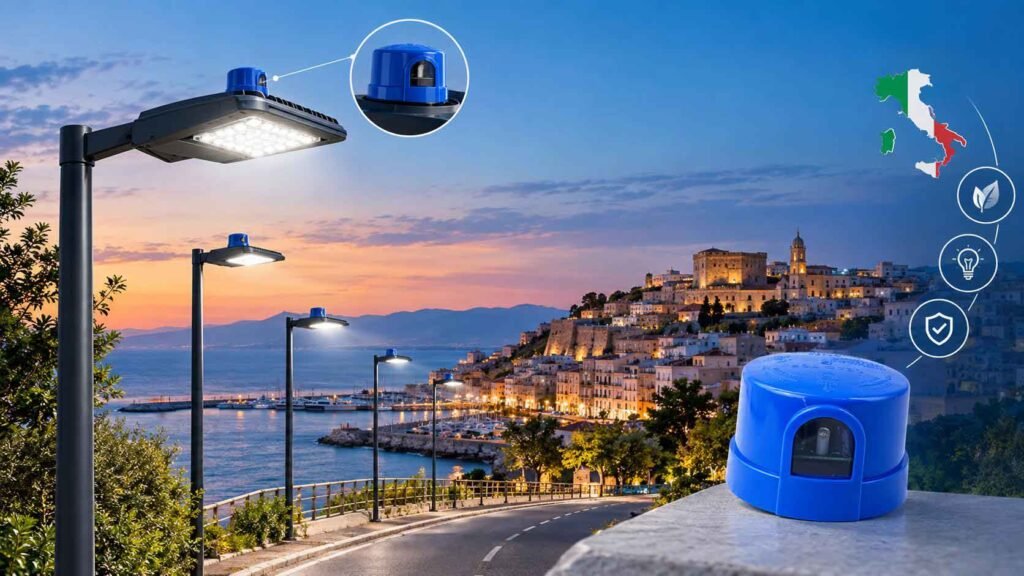
A 光センサーフォトセルスイッチ offers a simple solution.
It automates switching and reduces unnecessary daytime operation. A photo sensor can also work with dimming and smart controls to create a more flexible and efficient lighting system for larger parking lots.
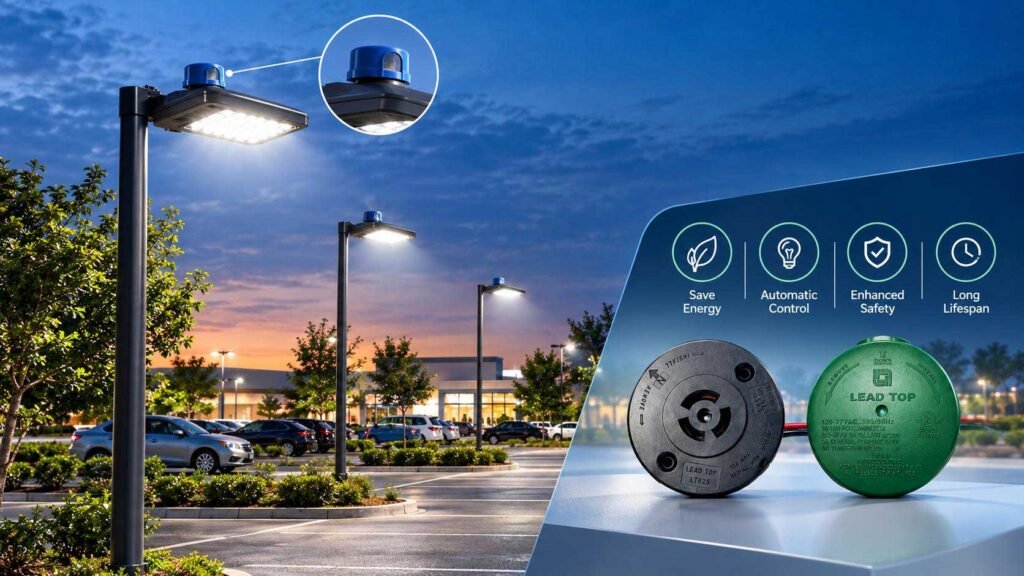
What Problems Do Traditional Parking Lot Lights Have?
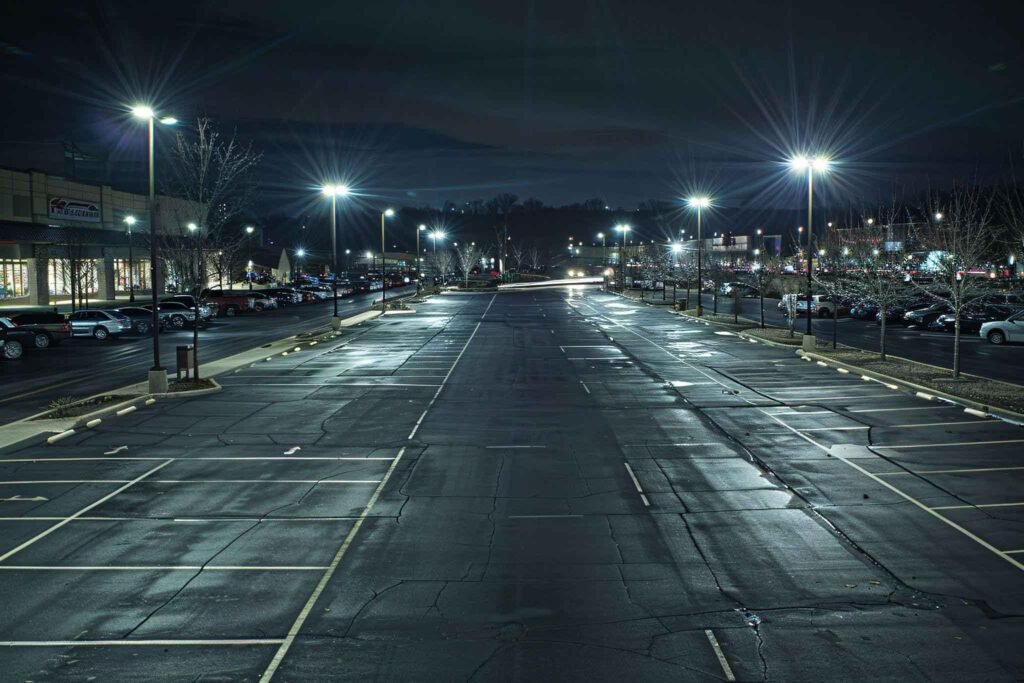
Parking lot lights need to operate when visibility is low. The problem starts when they keep operating after daylight returns. Without automatic daylight control, this can create unnecessary operating hours and energy use. DOE identifies this condition as “dayburning.”
Where Do the Problems Come From?
Manual switching depends on staff and changing sunrise and sunset times. It becomes harder to manage across large commercial sites, warehouses, schools, and municipal lots.
Fixed timers offer better automation but follow programmed schedules. They do not directly measure actual daylight conditions.
Maintenance can also become difficult. A practical control system should allow the photocontrol to be inspected or replaced without unnecessary fixture replacement.
These limitations make automatic outdoor lighting control useful for parking lot applications.
どのように 光センサースイッチ Solve These Parking Lot Lighting Problems?
A 光電センサー solves the basic control problem by responding to ambient daylight. DOE describes photosensors as devices that detect sufficient or insufficient daylight and switch the luminaire accordingly.
When daylight falls below the operating threshold, the photocell activates the lighting. When sufficient daylight returns, it switches the lighting off.
The basic cycle is simple:
- Daylight → Lights OFF
- Dusk → Photocell activates → Lights ON
- Night → Lights remain ON
- Dawn → Photocell detects daylight → Lights OFF
This removes daily manual switching. It also helps prevent unnecessary daytime operation. For parking lots, a replaceable photocontrol paired with a compatible receptacle provides a practical approach to automatic dusk-to-dawn control. ANSI C136.10 covers the physical and electrical interchangeability of locking-type photocontrols and mating receptacles.
Why Should You Combine LED Parking Lot Lights with Photocells?
LEDs and 光制御レセプタクル solve two different lighting problems. LED parking lot lights reduce the power needed to produce illumination. A photocell controls when that lighting operates. DOE guidance identifies photocells as a common static control for parking lot luminaires. They detect daylight and switch the lighting accordingly.
What Does the Combination Improve?
Using both technologies can provide:
- 自動点灯・消灯
- Less unnecessary daytime runtime
- Reduced dependence on manual switching
- Consistent nighttime operation
- Easier lighting management
This combination is especially useful during an LED retrofit. The LED upgrade improves the fixture’s efficiency. The parking lot photocell manages its operating hours.
For larger sites, the same system can later incorporate dimming or occupancy controls for additional energy savings. DOE projects have also demonstrated LED systems combined with advanced controls such as occupancy-based dimming.
How Is a Lighting Control Sensor Different From a Motion Sensor?
A 光制御 and a motion sensor respond to different conditions. A photocell detects ambient light. A motion sensor detects activity from people or vehicles. They therefore solve different control problems.
Photocell vs. Motion Sensor
| コントロール | Detects | 主な機能 |
| 光電池 | Daylight level | Turns lighting ON or OFF according to ambient light |
| Motion sensor | Movement or occupancy | Adjusts lighting according to activity |
A photocell can keep parking lot lights off during daylight. After dark, a motion sensor can reduce or increase output based on activity. DOE field demonstrations have used occupancy sensors with LED parking lighting to adjust output when movement is absent.
For basic automatic parking lot lighting, a photocell may be enough. Larger sites can combine both controls for more responsive lighting management.
Why Does the NEMA Receptacle Matter in Parking Lot Lighting?
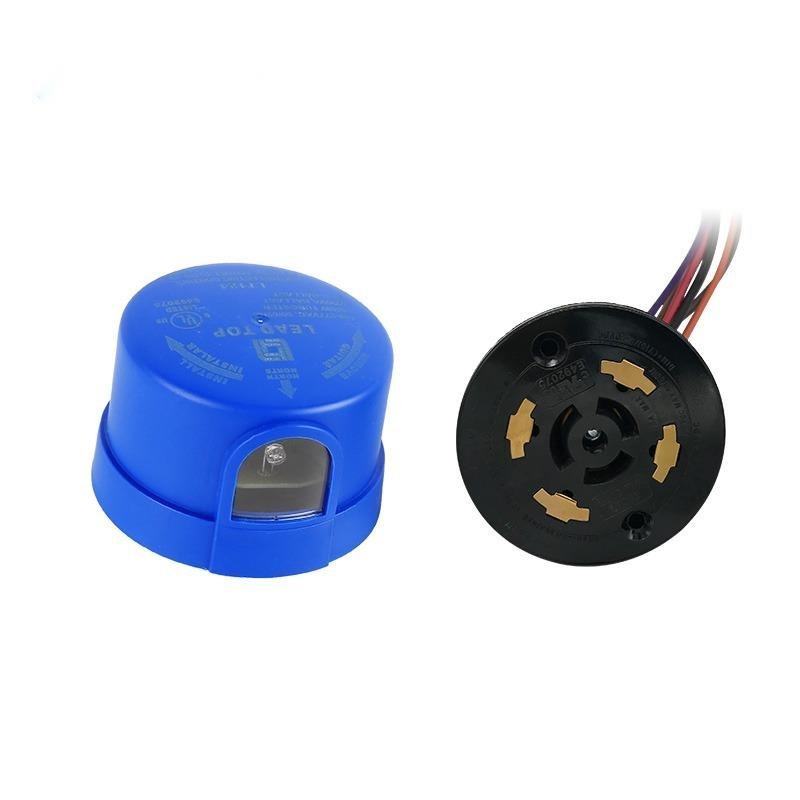
A photocell needs a suitable interface with the LED luminaire. This is where a ネマ receptacle becomes important. ANSI C136.10 covers locking-type photocontrols and their mating receptacles. The standard is designed around physical and electrical interchangeability within defined operating values.
For large parking lots, a standardized receptacle can simplify control-component service. You can remove and replace a compatible photocell without rewiring the entire fixture. This can make maintenance more practical across hundreds of lighting points.
What Can a Suitable Receptacle Improve?
- Easier photocell installation
- 部品交換の迅速化
- More consistent system configuration
- Simpler maintenance
- Better support for future control upgrades
Therefore, the photocell and receptacle should be specified as a matched combination. The correct interface helps ensure the control component fits the intended lighting system.
Which Lead-Top Solution Fits Standard LED Parking Lot Lighting?
For standard LED parking lot lighting that needs automatic dusk-to-dawn operation, Lead-Top recommends the LT124 + LT625 combination.
| 成分 | 製品 | 関数 |
| 光制御 | LT124 | Standard Zero-Crossing Twist-Lock Photo Control Automatic ON/OFF control |
| 容器 | LT625 ANSI C136.10 3-Pin Receptacle | 3-pin photocontrol interface |
The LT124 provides the photocontrol function. The LT625 provides the corresponding 3-pin interface. This pairing is suited to parking lots that need straightforward automatic lighting control without adding unnecessary system complexity.
It can fit applications such as:
- Commercial parking lots
- Warehouse parking areas
- Apartment communities
- School parking areas
- Retail properties
- 産業施設
- Municipal parking areas
For a standard LED retrofit, LT124 + LT625 offers a practical starting point for automatic outdoor lighting control.
When Does a Parking Lot Need Dimming Control Instead of Simple ON/OFF Control?
A simple photocell can automate lighting based on day and night. But some sites do not need full light output throughout the night. A commercial lot may be busy in the evening and much quieter after midnight. In such cases, LED lighting control can reduce output instead of keeping every fixture at full power. DOE research notes that LED systems can support dimming and time-of-night control.
When Is Dimming Useful?
Dimming becomes useful when a project requires:
- 0–10V control
- ダリ コントロール
- Scheduled lighting levels
- Reduced output during low-demand periods
- Integration with other smart controls
This moves the system beyond basic ON/OFF operation toward more adaptive parking lot lighting.
How Can Lead-Top Support Smart Parking Lot Lighting?
For parking lots that need dimming or a path toward smarter control, Lead-Top recommends the LT154E + LT635 combination.
| 成分 | Lead-Top Product | 主な機能 |
| Dimming photocontrol | LT154E | Dimming and photocontrol |
| Dimming receptacle | LT635 | ANSI C136.41インターフェース |
The LT154E is designed for applications using 0–10V or DALI-based dimming control. ANSI C136.41 defines the interface requirements for external locking-type controls and mating receptacles used for dimming functions.
The system can support different lighting levels throughout the night. For example, lights can operate at higher output during busy evening hours and reduce output later when activity falls. DOE projects have demonstrated parking-lot lighting systems using advanced controls and occupancy-based dimming.
This gives parking lot owners a practical path from basic photocontrol to smarter lighting management.
Why Does Photocell Installation Location Matter?
A 光電センサー must detect representative ambient light. Poor placement can make the control respond to the wrong light source. Direct light from the fixture can cause unwanted switching. Reflections from walls, signs, or nearby surfaces can also affect detection.
What Should You Avoid?
- Direct LED fixture light
- Strong reflected light
- Nearby artificial lighting
- Heavy shadows
- 車のヘッドライト
DOE guidance notes that photosensors are typically mounted on the luminaire or near a small group of luminaires. It also highlights proper sensor siting as an important consideration.
Correct positioning helps maintain consistent operation. It can also reduce problems such as daytime operation, delayed activation, or repeated switching.
How Should Photocells Be Maintained in Large Parking Lots?
DOE notes that photosensor materials can become less sensitive over time. This can cause earlier evening activation and later morning shutoff. Thus, proper maintenance is critical.
For large parking lots, maintenance teams should periodically inspect:
- Photocell condition
- Receptacle condition
- 電気接続
- センサーの向き
- Sensor window cleanliness
- Unexpected daytime operation
- Delayed nighttime activation
- Repeated switching
A replaceable photocell also makes service more practical. The control component can be inspected or replaced without automatically replacing the complete LED fixture.
How Can Parking Lot Lighting Evolve Into Smart Outdoor Lighting?
Parking lot lighting can develop in stages. It does not need to become a complex smart system immediately. A basic system can start with automatic 光制御. Later, additional controls can manage light output and occupancy.
| ステージ | Control Approach | 主な機能 |
| 1 | マニュアル | Staff-controlled operation |
| 2 | タイマー | Scheduled ON/OFF |
| 3 | LED + フォトセル | 夜明けから夕暮れまでの自動制御 |
| 4 | 調光制御 | Reduced output during low demand |
| 5 | スマートコントロール | Networked and adaptive management |
DOE projects have demonstrated parking-lot systems using advanced controls for scheduling and occupancy-based dimming.
This makes the photocell a useful starting point for a broader smart parking lot lighting strategy.
What Should You Consider When Choosing a Parking Lot Photocell?
The right choice depends on the lighting system and project requirements. Start with the application. A standard commercial lot may only need automatic ON/OFF control. A larger project may require dimming or future smart controls.
Check These Factors
● Electrical requirements
Match the photocell to the lighting system.
● Receptacle type
Confirm the required 3-pin, 5-pin, or 7-pin interface.
● Control function
Choose ON/OFF or dimming control.
● Environment
Consider rain, UV exposure, temperature changes, and surges.
● Future upgrades
Consider whether dimming or networked control may be added later.
DOE recommends evaluating control objectives and system capabilities before selecting a lighting-control architecture.
Which Lead-Top Photocell Combination Is Right for Your Parking Lot?
The best Lead-Top combination depends on how much control the parking lot requires. For standard LED applications, provides a straightforward photocell and receptacle combination.
| Parking Lot Requirement | Lead-Top Combination |
| Standard LED lighting | LT124 + LT625 |
| Basic control | LT124 + LT625 |
| Large LED retrofit | LT124 + LT625 |
| Dimming required | LT154E + LT635 |
| 0–10V / DALI applications | LT154E + LT635 |
| Future smart-lighting integration | LT154E + LT635 |
The key is to match the control architecture to the project. LT124 + LT625 suits basic automatic operation. LT154E + LT635 is better suited to projects moving toward dimming and more advanced lighting management.
よくある質問
1. Do LED parking lot lights need photocells?
Not every light requires a light sensor, but photocells provide automatic control. They help prevent unnecessary daytime operation and reduce manual switching.
2. What does a photocell do on a parking lot light?
They detect ambient light and control the lighting accordingly.
3. What is the advantage of a NEMA photocell receptacle?
A NEMA receptacle provides a standardized interface for a compatible photocell. It can simplify installation and maintenance without rewiring the entire fixture.
4. Should you choose a 3-pin or 5/7-pin photocell system?
A 3-pin system is suitable for basic control. Projects requiring dimming or more advanced controls can use 5/7-pin ANSI C136.41 interfaces.
5. What is the difference between LT124 and LT154E?
LT124 is designed for standard automatic photocontrol. LT154E is a dimming photocontrol for applications using more advanced lighting control.
6. Can photocells reduce energy waste in parking lot lighting?
Yes. Photocells can prevent lights from operating unnecessarily during daylight hours. This reduces avoidable runtime and supports more efficient parking lot lighting.
7. Can a parking lot photocell work with smart lighting controls?
Yes. A photocell can serve within a more advanced system. It can work alongside dimming and networked lighting controls.
結びの言葉
Parking lot lighting needs the right balance of visibility and efficiency. Photocells help reduce unnecessary operation and provide reliable switching. For dependable parking lot control, リードトップ offers practical photocontrol and NEMA receptacle combinations for both standard and advanced lighting needs.


 Japanese
  English
  Portuguese (Brazil)
  Spanish
  Russian
  Dutch
Dutch  Portuguese (Portugal)