In contemporary outdoor lighting systems Фотоэлементы are the main components, and they permit automatic control depending upon the environmental light levels. Photocells are here to play key role in enhancing energy efficiency, providing convenience and system reliability from simple domestic structures to the innovative and advanced smart urban networks.
However all the photocells are not the same. The choice between 3-pin, 5-pin, and 7-pin photocells has a significant impact on how a lighting system works. All have different level of functionality as theyboffer different wiring complexity and control capability.
By having a knowledge about such differences engineers , buyers, and contractors will have a better idea to get to know which solution is right for them. whether it is a small ground light or a big metropolitan lighting network.
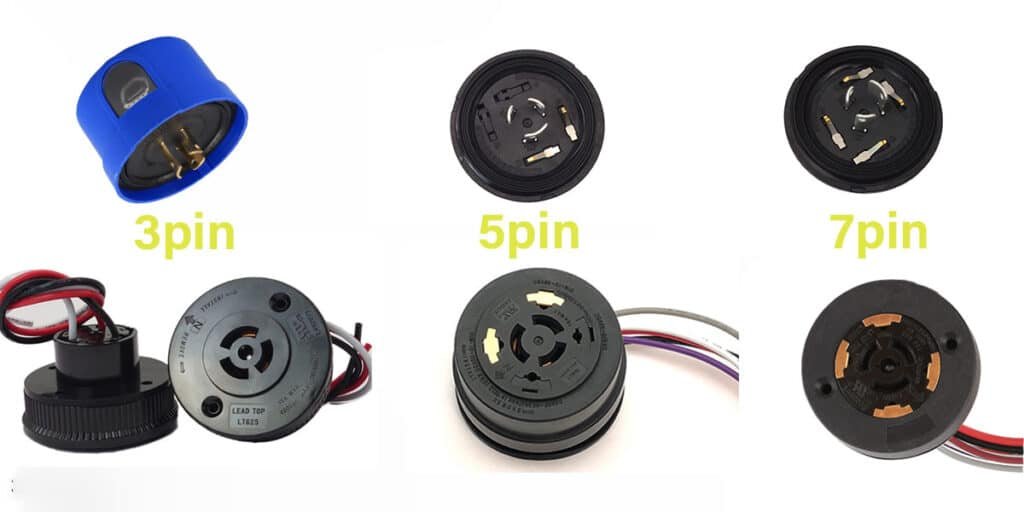
What Is a Photocell and How Does It Work?
Also named as фотоэлектрический датчик, this device has the main purpose to switch illumination system on or off without manual involvement, just by sensing the amount of outdoor light. The photocell turns ON the lighting circuit when the daylight falls below a certain level. When light of day returns, it turns the lights off.
This simple mechanization eradicates the need for physical switching and make sure that lights work only when required.
Photocells are being used widely in outdoor illumination applications, counting:
- Street illumination systems
- Освещение газонов и ландшафта
- Освещение парковочной зоны
- Hoarding and signage illumination
Attaining the best performance and compatibility with the illumination system for sure depends upon the selection of right photocell.
What Are the Features and Applications of 3-Pin Photocells?

How Is a 3-Pin Photocell Configured?
А 3-pin photocell is the most simple type, made for simple on/off illumination control. Its pin configuration includes:
- Live (Line)
- Нейтральный
- Load
This simple design makes installation fast and stress-free.
Where Are 3-Pin Photocells Typically Used?
3-pin photocells are normally used in:
- Domestic street lights
- Lawn lamps
- Basic outdoor fittings
They are best for applications where progressive control is not compulsory.
What Are the Advantages and Limitations of 3-Pin Photocells?
- Simple wiring and installation
- Небольшая стоимость
- Dependable basic operation
- No dimming ability
- Restricted functionality
- Not appropriate for smart illumination systems
When it is about cost efficiency or simplicity in the lighting projects, 3-pin photocells will remain a prominent option.
What Are the Features and Applications of 5-Pin Photocells?
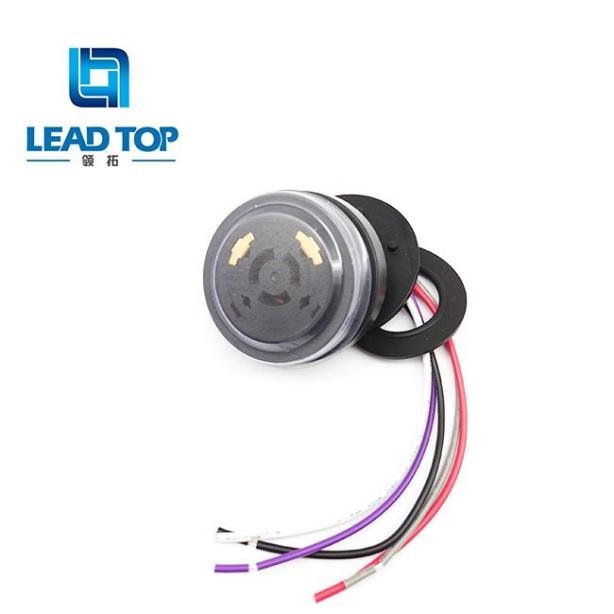
How Does a 5-Pin Photocell Differ in Configuration?
А 5-pin photocell offers improved functionality related to the 3-pin variety. Its configuration normally includes:
- Live
- Нейтральный
- Load
- Photocell control input
- Auxiliary or control output
This added wiring permits for more progressive illumination control.
Where Are 5-Pin Photocells Commonly Used?
5-pin photocells are extensively used in:
- Commercial illumination systems
- Intelligent street illumination
- Multi-zone illumination setups
They are appropriate for projects that need more than simple on/off functionality.
What Are the Advantages and Limitations of 5-Pin Photocells?
- Supports dimming circuits
- Allows multiple illumination levels
- Better flexibility in system design
- Needs more multifaceted wiring
- A little higher installation cost
5-pin photocells strike a balance between functionality and intricacy, making them best for mid-scale projects.
What Are the Features and Applications of 7-Pin Photocells?

What Makes 7-Pin Photocells Advanced?
А 7-pin photocell is made for innovative illumination control systems. It comprises extra pins for:
- Data communication
- Monitoring functions
- Programmable control
This permits incorporation with networked illumination systems.
Where Are 7-Pin Photocells Used?
7-pin photocells are normally used in:
- Industrial illumination networks
- Urban infrastructure projects
- Smart metropolitan illumination systems
These atmospheres need progressive control and actual monitoring abilities.
What Are the Advantages and Limitations of 7-Pin Photocells?
- Supports networked control
- Allows programmable schedules
- Compatible with IoT-based systems
- Greater cost
- Multifarious installation
- Needs technical expertise
7-pin photocells are best for wide-ranging, future-ready lighting systems.
What Are the Key Differences Between 3-Pin, 5-Pin, and 7-Pin Photocells?
Table 1: Full Comparison of 3-Pin vs 5-Pin vs 7-Pin Photocells
| Особенность | 3-Pin Photocell | 5-Pin Photocell | 7-Pin Photocell |
| Wiring Complexity | Simple | Середина | Complex |
| Функциональность | On/Off only | On/Off + Dimming | Networked control |
| Расходы | Низкий | Середина | Высокий |
| Наилучшее использование | Residential | Commercial | Industrial/Smart City |
How Do These Differences Affect Real-World Performance?
- To have simple and cost efficient installations 3-pin photocells are the best option to have.
- 5-pin photocells bring improved control and tractability for commercial applications.
- When it is about intelligent and connected illumination systems 7-pin photocells provide innovative features.
How Do You Choose the Right Photocell for Your Project?
Selecting the correct photocell includes assessing numerous important factors:
- Type of illumination system (domestic, commercial, manufacturing)
- Required level of control (basic, dimming, or networked)
- Installation intricacy
- Budget restraints
- Ecological circumstances
Best performance and system dependability can be assured when selection of appropriate photocell is made.
In this modern era, illumination systems increasingly using LED technology because it is energy efficient and have prolonged lifetime. Certifying that your photocell is compatible with LED loads is important.
Can Photocells Work with LED Lighting Systems?
Yes. Most contemporary photocells, counting 3-pin, 5-pin, and 7-pin models, are made to work with LED illumination systems.
Though, it is essential to verify:
- Грузоподъемность
- Driver compatibility
- Inrush current handling
Problems like flickering or abridged lifecycle can be faced if fail to match these specifications.
Table 2: Photocell Selection Guide by Application
| Тип приложения | Recommended Photocell | Ключевое требование |
| Residential lighting | 3-Pin | Simple on/off control |
| Commercial lighting | 5-Pin | Dimming and flexibility |
| Industrial projects | 7-Pin | Advanced control and monitoring |
| Smart city systems | 7-Pin | Network integration |
Часто задаваемые вопросы
What is a photocell used for?
It is made to control lighting without needing manual operation by automatically turning lights on when the ambient light falls and off during the day.
How do 3-pin, 5-pin, and 7-pin photocells differ?
They have slightly different pin configuration, wiring complexity, operation, and usage scenarios, ranging from basic domestic use (3-pin) to advanced smart city systems (7-pin).
Can I get customized photocells?
Yes. Manufacturers like Lead Top offer OEM photocells tailor-made for retail, wholesale, and urban projects, with accreditations such as UL, CE, and ANSI.
How can you ensure high-quality photocells?
In order to get constant quality, and acquiescence with global principles, association with a specialized manufacturer that bids reliable products is important.
Conclusion: Which Photocell Type Is Best for Your Needs?
Choosing amongst 3-pin, 5-pin, and 7-pin photocells depends on your project requirements.
- 3-pin photocells are best when priority is the simplicity with economical solution.
- For improved control and tractability, 5-pin photocells offer a composed option.
- When priority is highest level of functionality than 7-pin photocells offers advanced, future-ready systems.
When objective is to get reliable and efficient lighting control, than by thoughtfully evaluating system needs, compatibility, and long-standing goals, you can select the most suitable photocell.
Call to Action (CTA)
- Get Free Sample – Test 3-pin, 5-pin, or 7-pin photocells before ordering
- Contact Lead Top – Discuss custom configurations or bulk requirements
- Request Price List – Relate pricing for extensive and urban projects
Ссылки:
- https://leaditop.com/product-2/?_gl
- https://en.wikipedia.org/wiki/American_National_Standards_Institute
- https://leaditop.com/nema-connector/
- https://leaditop.com/product-category/product/nema-connector/nema-3-pin-receptacle/
- https://leaditop.com/product-category/product/nema-connector/nema-5-pin-receptacle/
- https://leaditop.com/product-category/product/nema-connector/nema-7-pin-receptacle/
- https://en.wikipedia.org/wiki/Photoelectric_sensor

 Russian
  English
  Portuguese (Brazil)
  Spanish
  Dutch
Dutch  Japanese
  Portuguese (Portugal)