Three complaints are most common in winter from cold-climate sites:
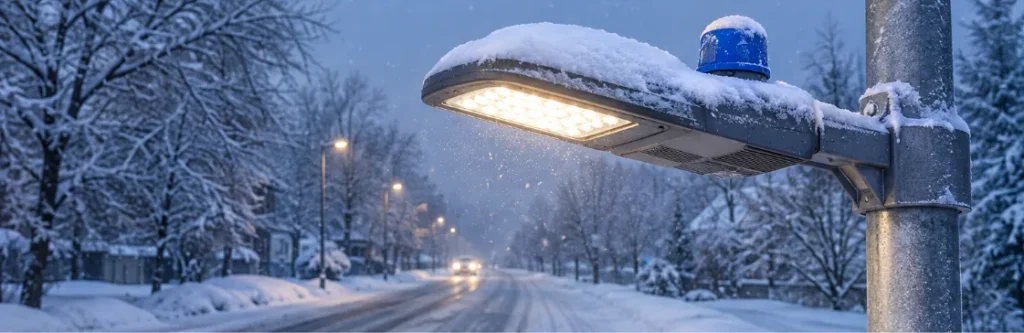
- The lights stayed on all day. Snow buried the sensor.
- The lights came on late. A bright, snow-covered evening left streets dark at rush hour.
- The unit failed in January. It was three years into a five-year warranty, and the returned sample shows no water and no burn marks.
None of these is necessarily a temperature problem. The rating of −40°C to +70°C simply means the range in which the controller is designed to work. It does not cover:
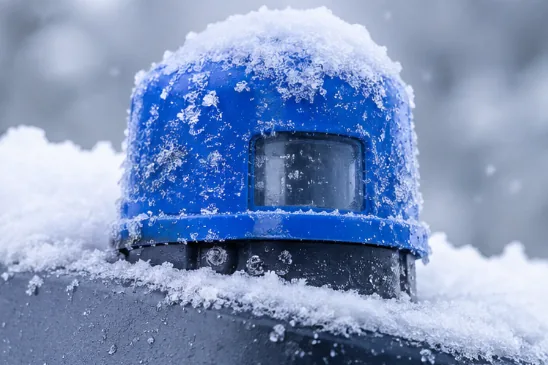
- Snow on the sensor window
- Light reflected from the ground
- Moisture from freeze–thaw cycles
- How the unit was installed and maintained
This guide covers each mechanism, the specification decisions that counter it, and how to match a Lead-Top photoelectric sensor model to the site.
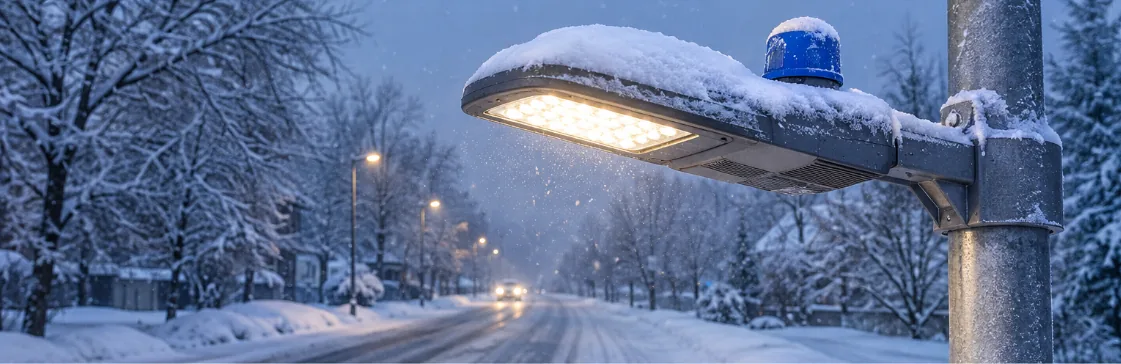
What Does a −40°C Rating Actually Cover?
Start here, because the rating is often misread.
It is an operating range
It is not a guarantee of every material property or of extended performance in all winter conditions.
Materials still matter
Even at −40°C, the housing, sealing, wire, and electrical components will be designed for low temperatures, not just rated for them.
Impact needs its own data
Where plough strikes or falling ice are a risk, ask for low-temperature impact data.
It doesn’t stop snow and ice
The rating does not mean that snow, condensation, or other moisture will not damage the photocontrol receptacle or the housing.
Sensor type is a separate question. The LT104 and LT310A-DC use IR-filter phototransistor sensing. Contrarily the LT110 thermal series uses a CDSセル. Current product information names the sensor types but gives no comparative low-temperature threshold data. So don’t claim one technology is categorically more stable at −40°C without test results.
One more case
In the polar night above the Arctic Circle, the supply of light may continue for weeks. For additional information, contact the manufacturer.
Why Does Snow Cause False Triggering In Light Photocell Sensors?
Winter complaints map to three mechanisms. Diagnose which one you have first. The fixes differ accordingly.
| Mechanism | 症状 | What’s happening | First fix |
| Snow on the sensor | Lights stay on all day | The photo switch sensor can’t see the sky and reads permanent darkness | Mounting position, maintenance |
| Snow albedo | Lights switch on late or off early | Reflected ground light reaches the sensor | Orientation, position, ON/OFF ratio |
| Ice or frost on the lens | Gradual, less obvious switching shifts | Moisture freezes on the light sensor control window and changes the light received | Inspect and clean before blaming the threshold |
A few details on each:
Albedo
Fresh snow is highly reflective of the incident light, although the proportion depends on the age, moisture content, and quality of the surface. Don’t quote 80–90% as universal. Reflected glow can further delay switching.
オン/オフ比
Controls use one for exactly this reason. The LT104-DC lists a 10–16 ルクス turn-on level and a 1:1.5 ratio, and other models differ. But a ratio does not remove the effect of a snowfield.
Ice
If switching drifts later week by week, inspect the window for frost, ice, or dirt before concluding the threshold has drifted. Product data doesn’t establish a predictable ice-driven shift.
How Do You Specify a Lighting Control for Cold Climates?
Six decisions do most of the work.
1. Mounting position
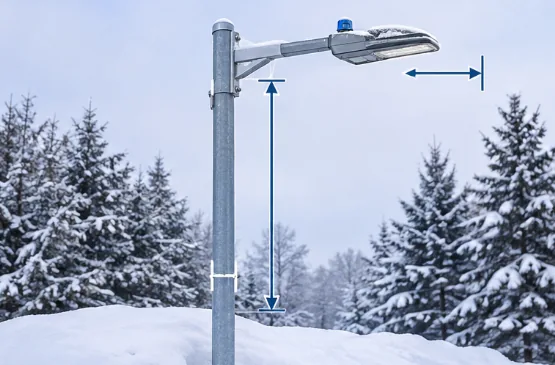
This is the primary defence. None of it appears on a datasheet.
- Face the sensor away from the equator. However, it is not a universal rule. Multiple other parameters like road layout and local sun path also matter.
- Mount above expected snow depth. A control at 4m on a 6m pole faces a different risk than one a snowdrift can reach.
- Avoid roof edges, plough spray zones, ice-shedding areas and nearby reflective surfaces.
2. Time delay
A delay filters brief events like headlight glare or a reflective flash. It cannot correct a sustained change, such as snow covering the sensor.
- LT104: 3–10 seconds
- LT124: 3–6 seconds
- LT110 thermal series: 30–180 seconds
- LT310A-DC: 3–15 seconds
Don’t generalise these across a family. The right delay is a site decision.
3. Sensor type
For a snowfield, focus on the specified turn-on level, ON/OFF ratio, orientation, and reflected light. In case the low-temperature threshold stability is of great importance, ask for the comparative test data before making the choice.
4. Fail mode
When a control fails in January, fail-ON leaves the road lit, and the complaint is wasted energy. Fail-OFF leaves it dark, and the complaint is an incident report. For public lighting, fail-ON is worth evaluating, but the right choice depends on the application, safety requirements, and control design.
The LT110 light sensor photocell switch catalogue lists Fail Mode ON. The LT104, LT124, LT134, and LT154 list ON/OFF. Confirm the configuration when ordering.
5. Maintenance accessories
Plan for the day a crew has to test a circuit with the sensor removed. The catalogue lists the LT1SC Short Circuit Cap and the LT1OC Open Circuit Cap.
安全上の考慮事項
- Neither cap replaces electrical isolation or makes live work safe.
- Confirm compatibility with the receptacle.
- Get qualified personnel.
- Follow isolation procedures.
6. Low-voltage tolerance and inrush
Long rural feeders and winter peaks can pull voltage down. Check the actual voltage at the control.
- LT124 operates down to 80VAC
- LT124L operates down to 90VAC
- LT104 operates down to 95VAC
These are model-specific figures. They don’t fix an undersized feeder. Below the specified range, the control can’t be expected to operate normally.
LEDドライバー may draw high currents when inrush occurs, based on the design of the LED driver. Zero-crossing switching involves the closure of the contact when the AC wave passes through the zero point, and this could be applied to the right loads to minimize switching stress. The LT124 is an example of such a device.
Which Lead-Top Models Fit Cold Climates?
Specifications differ by model. Don’t assume every unit has the same IP等級 or housing. Confirm the exact configuration before specifying.
| 要件 | モデル | Key points |
| Snowfield, IR sensing | LT104 twist-lock | 赤外線フィルターフォトトランジスタ 2A Eバラスト 3–10s delay down to 95VAC IP65 standard, IP66/IP67 options |
| Zero-cross, low-voltage tolerance | LT124 / LT124L twist-lock | IR sensing LT124: zero-cross, down to 80VAC, 2–5s delay, 5A E-Ballast. LT124L: down to 90VAC, 3–10s delay, 2A E-Ballast |
| Heavy load, long nights | LT134 / LT154 twist-lock | 8A E-Ballast, zero-cross, 15,000+ ON/OFF operations at rated load LT154 lists programmable functions IP66, IP67 optional |
| Thermal, fail-ON, long delay | LT110 series | CDS sensor, thermal switching, 30–180s delay, Fail Mode ON, IP66 |
| Luminaire-integrated wire-in | LT310A / C / D / F | Electronic wire-in family; check each model’s sensor, voltage, delay, load, and IP rating |
| Heavy wire-in load | LT210A series | Thermal wire-in; 5A E-Ballast; 1800W/1800VA at 120V, 2000W/2000VA on listed 240V and 208–277V versions |
| Solar or off-grid | LT104-DC | 12/24VDC, IR sensing, 10–16 lux, 3–10s delay, −40°C to +70°C, IP65 standard, IP66/IP67 options |
選考ノート
The LT310A-DC is a separate DC model (12–48VDC, applicable range 10–50VDC, 10A load, 10–16 lux, 3–10s delay, IR sensing, −40°C to +70°C, IP66). Don’t use its figures for the AC LT310A family.
よくある質問
Why do my street lights stay on all day in winter?
Primarily, this is due to snow buildup. Clear the sensor window regularly to avoid such issues.
Why do the lights switch off too early on winter evenings?
Snowfield reflection can make the sensor see more light than the road does. A longer delay helps with brief disturbances but not persistent reflection. Position and orientation matter more.
Do photocells actually work at −40°C?
Yes, where the model is specified for that range and installed within its rated conditions. The rating doesn’t stop snow or ice from covering the sensor.
Is CDS or IR better for cold climates?
That depends on the unit and project specifications. The available specifications give no comparative low-temperature data. You should ask for testing results if this parameter determines your decision.
What is a shorting cap, and do I need one?
This photocell component suits a specific type of twist lock interface. Its primary purpose is maintenance and troubleshooting.
Can the switching delay be adjusted on site?
その photoelectric switch LT154 is programmable. Ask Lead-Top which parameters are configurable. Standard models have fixed delay windows.
結びの言葉
Cold-climate photocontrol selection involves more than a −40°C rating. Various factors should be considered. These include:
- Snow
- 反射光
- Ice buildup
- 取り付け位置
リードトップ offers reliable photocontrollers for demanding outdoor lighting conditions. Share your site conditions and load requirements to get a suitable model recommendation and relevant technical documentation.

 English
 Portuguese (Brazil)
 Spanish
 Russian
 Dutch
 Japanese
 Portuguese (Portugal)