Extreme weather conditions can take a heavy toll on outdoor lighting equipment. This guide explains how IP66 and IK09 help address these risks.
IP66 protects against dust and powerful water jets. IK09 provides mechanical impact protection. But these ratings are not the only things to consider. Other important measures include:
- Material quality
- Sealing
- Temperature range
- Electrical ratings
- Compatibilidade de instalação
Understanding each specification can help you choose a more suitable outdoor lighting connector for demanding smart lighting applications.
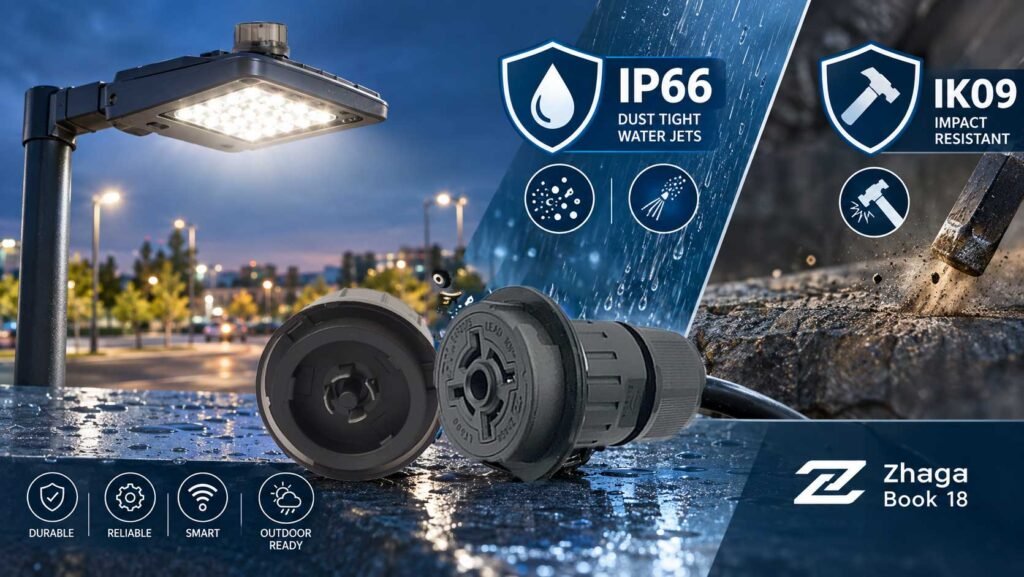
What Does IP66 Mean for a Zhaga Connector?
Classificação IP describes an enclosure’s protection against solid particles and water under CEI 60529. Here, the first 6 means the enclosure is dust-tight. The second 6 means it is protected against powerful water jets.
Why does this matter for a Zhaga connector? Outdoor luminaires face dust, rain, and direct water exposure. A properly sealed IP66 Zhaga connector helps limit these environmental risks at the connector assembly.
The two digits have different jobs:
- 6 — Dust: No dust ingress under the applicable test conditions.
- 6 — Water: Protection against powerful water jets.
IP66 therefore addresses ingress protection. It does not describe mechanical impact resistance. That is covered separately by the IK rating.
What Does IK09 Mean for an Outdoor Conector Zhaga?
These regulations describe protection against external mechanical impacts under IEC 62262. But why does this matter for an outdoor Zhaga connector?
O receptáculo de fotocontrole may experience physical stress during installation, servicing, handling, or operation. A higher IK classification indicates that the enclosure has been tested for a defined level of mechanical impact.
For an IK09 Zhaga connector, buyers should verify the manufacturer’s documented rating and test basis. The IK rating should be considered separately from IP protection.
Why Should IP66 and IK09 Be Considered Together?
Both regulations answer two different questions. IP66 asks how well the enclosure resists dust and water. IK09 asks how well it withstands mechanical impact. Neither rating replaces the other.
This distinction matters when selecting an outdoor lighting connector. An IP66 rating does not specify impact resistance. An IK09 rating does not indicate dust or water protection. For a Zhaga socket exposed on an outdoor luminaire, buyers should therefore check both ratings.
| Rating | Protection Focus | Main Risk |
| IP66 | Dust and water | Dust ingress and powerful water jets |
| IK09 | Mechanical impact | External physical impacts |
This combined view gives buyers a clearer picture of the connector’s environmental protection.
What Else Should Buyers Check Before Choosing an Outdoor Zhaga Connector?

IP66 and IK09 are important, but they are not the whole specification. Zhaga Book 18 defines the interface for outdoor luminaires and sensing or communication modules. Buyers should also check how the connector is built and installed.
Before selecting an outdoor lighting connector, verify these points:
● Housing material
Check whether the material suits outdoor temperatures and long-term use.
● Sealing gasket
Confirm the gasket design and material support reliable environmental sealing.
● UV resistance
Check suitability for prolonged sunlight exposure.
● Operating temperature
Match the rated range with the project’s climate and luminaire conditions.
● Electrical rating
Verify voltage, current, insulation, and dielectric requirements.
● Certification
Check applicable Zhaga certification when interoperability is required.
● Installation structure
Confirm mounting dimensions, sealing surfaces, and mechanical fit.
● Compatibilidade
Make sure the connector matches the intended luminaire, sensor, or communication module.
These checks help buyers evaluate the complete connector, not just its protection ratings.
Buyer checklist table
| Especificação | Por que isso importa | O que verificar |
| Material de construção | durabilidade externa | Material type and temperature suitability |
| Gasket | Environmental sealing | Gasket material and construction |
| UV resistance | Long-term exposure | UV-resistant material |
| Temperatura | Reliable operation | Rated operating range |
| Electrical rating | Compatibilidade do sistema | Voltage, current, dielectric rating |
| Instalação | Mechanical reliability | Mounting and interface structure |
How Does the Lead-Top LT600 Zhaga Connector Meet Outdoor Protection Requirements?
The Lead-Top LT600 Zhaga sensor fotocélula de luz combines several specifications relevant to outdoor installations. Its catalog specifications include Zhaga Book 18, IP66, and IK09. These ratings address dust, water, and mechanical impact protection.
The construction also includes materials selected for outdoor use:
- High-temperature PBT housing
- Junta de silicone
- Aluminum mounting ring
- 10KV dielectric withstand to the mounting surface
The silicone gasket supports the sealing structure. The PBT housing provides a high-temperature material option. The aluminum mounting ring provides a rigid mounting component. Together, these details give buyers more information than an IP or IK rating alone.
For projects using Zhaga-based sensing or communication modules, the interface specification also matters because Book 18 defines mechanical, electrical, and communication aspects.
| Especificação | LT600 | Especificação | LT600 |
| Interface | Zhaga Livro 18 | Habitação | High-temperature PBT |
| Proteção de entrada | IP66 | Gasket | Silicone |
| Impact Protection | IK09 | Mounting Ring | Aluminum |
| Rigidez dielétrica | 10KV to mounting surface |
Which Outdoor Lighting Applications Can Benefit From Protected Zhaga Connectors?
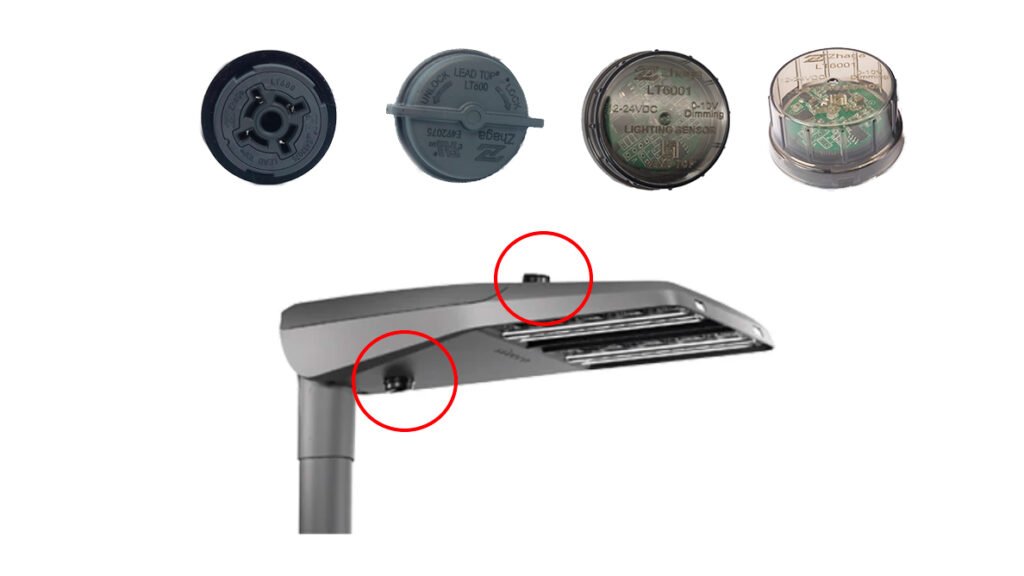
Protected Zhaga sensores de interruptor fotográfico are useful where luminaires operate outdoors and may need sensing or communication modules. Zhaga Book 18 is specifically designed for this interface. It supports modular connections between outdoor luminaires and smart nodes.
Aplicações típicas incluem:
- Iluminação pública inteligente: Connect sensors or communication nodes to outdoor luminaires.
- Iluminação pública municipal: Support control upgrades without changing the complete fixture.
- Iluminação de estacionamento: Provide an interface for smart control and sensing equipment.
- Public-area lighting: Support connected lighting in exposed outdoor locations.
- Smart-city projects: Enable modular sensing and communication functions.
The protection rating should still match the actual installation environment. Buyers should also verify the connector’s mounting structure, electrical interface, and compatibility with the intended luminaire or module. Current Zhaga listings show Book 18 being used across a broad range of certified outdoor luminaires and control devices.
Perguntas frequentes
1. What does IP66 mean?
This means the connector is completely dust-tight. It is also protected against powerful water jets from different directions.
2. What does IK09 mean?
This indicates a defined level of mechanical impact protection under the IK rating system.
3. What is the difference between IP and IK?
IP measures protection against dust and water. IK is the standard for protection against mechanical impact.
4. Why does an outdoor Zhaga connector need impact protection?
Impact protection helps the connector withstand physical stresses during installation and outdoor operation.
5. Is IP66 enough for outdoor lighting?
Not necessarily. Buyers should also check:
- IK protection
- Materials
- Sealing
- UV resistance
- Temperature endurance
- Electrical ratings
- Compatibilidade
Palavras Finais
IP66 protects against dust and water, while IK09 addresses mechanical impact, making both important for outdoor Zhaga connector reliability. Chumbo-Top’s LT600 combines IP66, IK09, PBT housing, silicone sealing, and aluminum mounting components for demanding outdoor applications. For reliable outdoor lighting connectors and photocontroller solutions, contact Lead-Top to review the right Zhaga specifications for your project.


 Portuguese (Brazil)
  English
  Spanish
  Russian
  Dutch
Dutch  Japanese
  Portuguese (Portugal)