Two calls reach maintenance teams again and again.
One circuit works all day but trips the moment the photocell switches the lights on at dusk. Another trips straight after reset, even with a new photocell switch fitted.
These symptoms can have different causes:
- Switching-related inrush
- Sobrecarga
- Wiring faults
- Umidade
- Damaged photocontrol
Swapping the lighting sensor without diagnosing the circuit wastes time and money. It can leave a real fault in place.
This guide gives a simple approach: read the trip pattern, inspect the circuit safely, use a shorting cap where appropriate, and decide the next step.
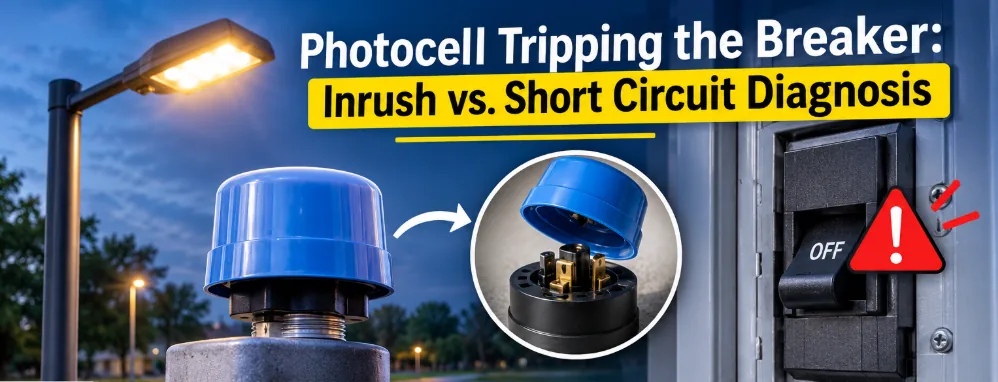
When Does the Breaker Trip?
A breaker trip is a symptom, not a diagnosis. However, below is the detailed table answering the question.
| Trip behaviour | Possible cause | What to check |
| At dusk, when lights switch on | LED driver inrush or a switching-related fault | Fixture count, driver inrush data, switching conditions |
| Immediately after every reset | Short circuit, ground fault, or another persistent fault | Stop resetting; have an electrician inspect the circuit |
| Only after rain or wash-down | Moisture leakage or a short | Receptacle, wiring, cable entry, sealing |
| After a storm, on a circuit that worked for years | Possible surge damage or another fault | Photocontrol condition, MOV, wiring |
| After running for some time | Sustained overload, loose connection, or thermal issue | Measured current, breaker condition, terminals |
Inrush versus overload
Inrush occurs at the moment of switching on. Overload builds when current stays too high over time.
Trip timing is a clue, not proof. A qualified electrician should confirm the cause.
Why Does the Breaker Trip When the Lights Turn On?
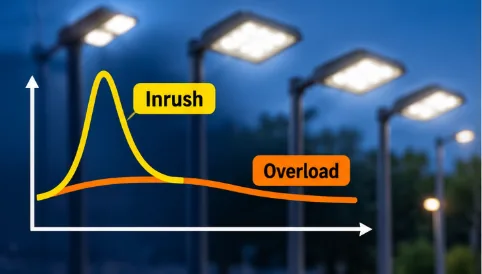
LED drivers draw high current at start-up
Because they contain input capacitors that draw charging current when power is first applied. When many drivers switch together, their inrush adds up. The peak depends on:
- Driver de LED projeto
- Supply conditions
- The switching point
- Circuit impedance
So a circuit can run happily after start-up and still trip at the instant of switching.
Breaker response to inrush
A breaker has two trip elements:
- Thermal: responds to sustained overcurrent.
- Magnetic: responds to high instantaneous current.
Breaker curves set the magnetic threshold. Under the common IEC convention:
| Curve | Instantaneous trip range |
| B | 3–5 × rated current |
| C | 5–10 × rated current |
| D | 10–20 × rated current |
The actual performance should be compared to the manufacturer’s ratings and the appropriate code. You cannot just assume that any rating fits your circuit.
The problem is intermittent
Inrush peaks vary with the point on the AC waveform where switching happens. Supply voltage, driver characteristics, and the number of fixtures switching together matter too. That is why a circuit can trip on some evenings and not others.
How does zero-cross switching help?
This setup closes the contact when the AC waveform crosses zero volts, where the instantaneous voltage is lowest. That can reduce switching-related inrush. The Lead-Top LT124 light sensor photocell switch is a zero-cross twist-lock photocontrol for this kind of application.
It does not eliminate every inrush or overload problem. Driver selection, circuit loading, and the switching arrangement still need checking.
Short Circuit, Ground Fault and Other Problems: When Should You Stop Resetting Photosensor?
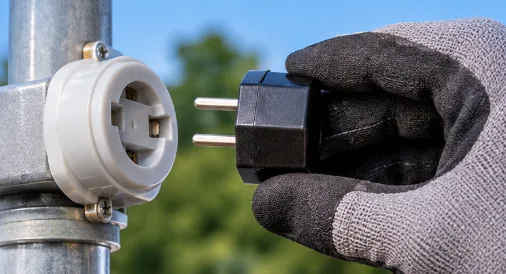
Surge damage to the photocontrol
An MOV will restrict any transient overvoltage. Once there is an overload on the device due to a surge, the MOV can get damaged in various ways. Among them is low-resistance failure.
This is one way in which a continual trip can occur. However, the presence of a storm alone does not indicate that this happens.
Moisture and ground faults
Water in any of the photoelectric sensor components can cause leakage or a short.
MCB trip
Typically overcurrent or short circuit.
RCD/GFCI trip
May indicate leakage to earth. The actual fault must be found through testing.
A new photocontrol receptacle won’t fix a damaged receptacle, cable, or enclosure.
Wiring and installation faults
- Incorrect line/load connections
- Damaged conductors or insulation
- Loose or overheated terminals
- Incorrect or shared neutrals
These need inspection by a qualified electrician.
When to stop troubleshooting
- The breaker trips immediately on reset.
- Há:
- Danos visíveis
- A burning smell
- Abnormal heat
- Water ingress
- Exposed conductors are present. Don’t attempt live repairs.
The circuit should be isolated and tested. Never install a high-voltage breaker as a stopgap approach.
How Does the Shorting-Cap Test Work?
A shorting cap sits in a compatible ANSI C136.10 receptacle in place of the photocontrol. It contains no electronics. So it lets you test the circuit with the photocontrol bypassed.
| Accessory | Função |
| LT1SC | Connects line and load so the circuit stays ON |
| LT1OC | Leaves the circuit OFF |
Confirm model functions and ratings against the accessory specification.
Considerations to run the test safely
- Isolate the circuit at the breaker level and make sure that there is no power flowing.
- Remove the photocontrol and check the receptacle for damage and moisture.
- Insert the proper shorting cap according to the guidelines.
- Reconnect the circuit safely and then turn it ON.
- Observe whether the circuit is tripped or not. Then break the circuit again.
Reading the result
| Resultado | What it may indicate | Next step |
| Holds with the ON cap fitted | Circuit can run with the photocontrol bypassed under this test | Look at the photocontrol and switching inrush; don’t assume the light photocell sensor is faulty |
| Still trips with the ON cap | Problem may be in the receptacle, wiring, or load | Inspect the downstream circuit |
| Trips only when the photocontrol switches | Switching inrush or a control/load interaction is possible | Check driver inrush, switching characteristics, and loading |
| Trips after rain | Moisture leakage or an environmental fault is possible | Inspect sealing, wiring, receptacle, enclosure |
Limitations to remember:
- It is a bypass test, not a full diagnosis.
- It doesn’t identify a failed MOV or prove the photocontrol is the only problem.
- A continuously energised load doesn’t reproduce the start-up event of drivers being switched on together.
- Don’t leave a bypass in place as a permanent repair without checking the site’s operating and safety requirements.
How Do You Fix It Without a Bigger Breaker?
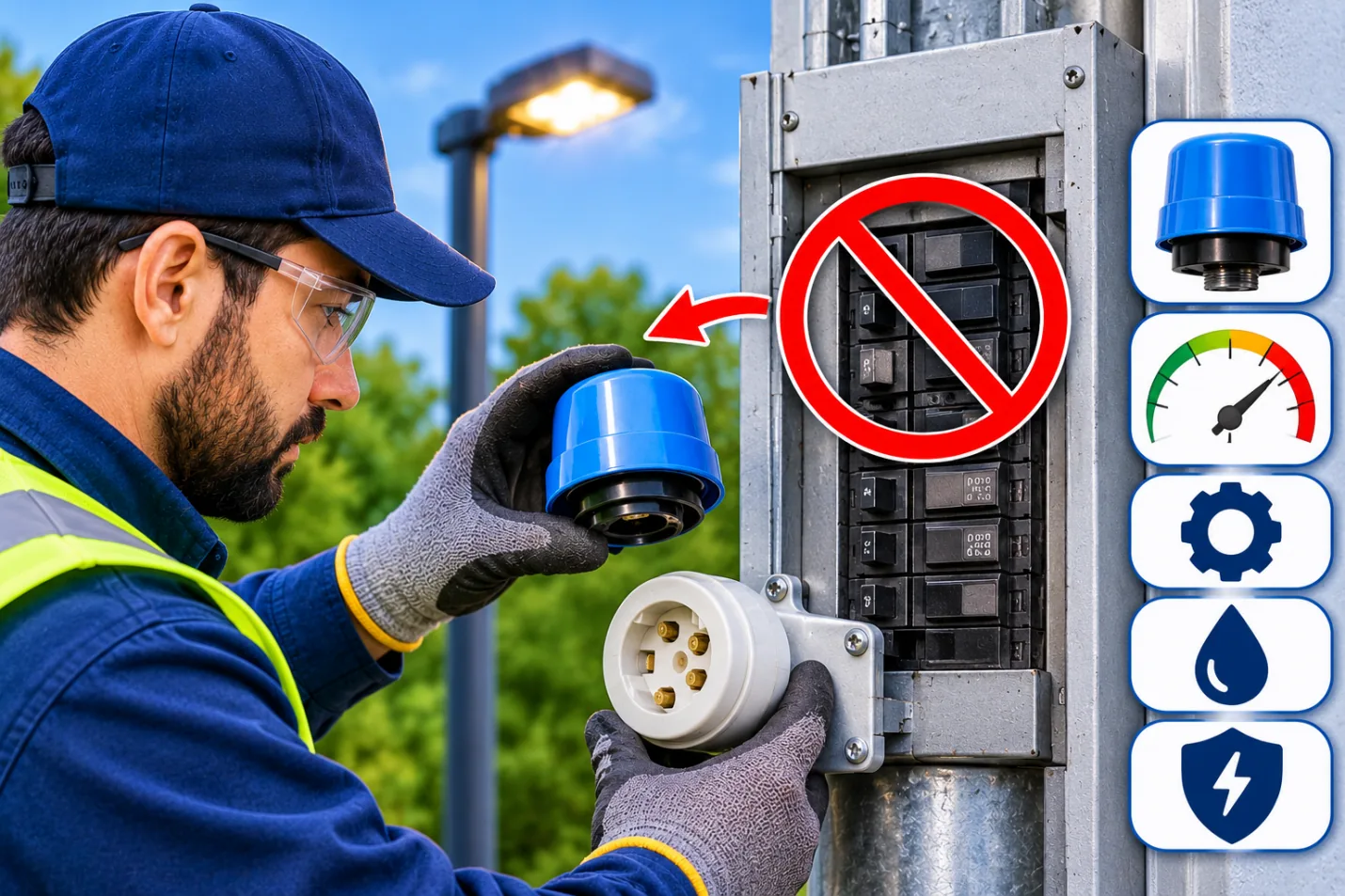
Change the sensor
Use a cruzamento zero light sensor control where switching inrush is suspected. Match the LT124’s voltage and load ratings to the installation.
Match the load rating
Grouped fixtures and multiple drivers need careful evaluation. Do not check the wattage alone. Compare the ballast rating and driver requirements. The LT134 outdoor automatic daylight sensor switch is an 8A E-Ballast option.
Review the circuit design
Have an electrician verify:
- Breaker type
- Curve
- Rated current
- Cable protection
Consider splitting large groups where the control system supports it.
Correct moisture and wiring faults
Replace damaged parts. Never fit a replacement photo switch sensor into a damaged or wet receptacle.
Review surge protection
Compare product specifications against project needs. MOV joule ratings are not a guarantee of service life or surge immunity.
Which Lead-Top Lighting Control Should You Consider?
| Recurso | LT124 Photo Electric Light Control Switch | LT134 Daylight Sensor Switch | LT154 (optional) |
| Tensão nominal | 120–277 V | 120–277 V | 120–277 V |
| Classificação LED | 5A E-Balast | 8A E-Ballast (120V / 277V) | 8A E-Balasto |
| Carga nominal | 1000W / 1800V | 1000 W / 1800 VA | 1000 W / 1800 VA |
| Alternando | Cruzamento zero | Design de longa duração | Zero-cross, high-inrush protection |
| MOV opções | 475J/950J /1425J | 475J/950J /1425J | 475J / 525J / 950J |
| Endurance | >10,000 operations at rated load | >15,000 operations at rated load | >20,000 operations at rated load |
| Usar | Circuits where switching inrush is a concern | Grouped loads needing an 8A rating | Heavy-duty requirements |
The LT1SC and LT1OC shorting caps suit maintenance and troubleshooting where a temporary bypass is appropriate. Confirm accessory ratings and installation instructions for your circuit.
Perguntas frequentes
Why does my photocell trip the breaker only at dusk?
That is when the load switches on. Multiple LED drivers can draw high inrush at start-up. Wiring and control faults should be checked too.
It trips every time I reset it. Is the photocell faulty?
Possibly. But this behaviour can also mean a short or ground fault. It’s advised to have an electrician inspect the circuit.
Can a shorting cap show whether the photocell is the problem?
It can help narrow the fault by bypassing the light sensor. It can’t identify the failed component or reproduce a normal switching event.
Can I just install a bigger breaker?
No. It only protects the cable. Increasing its size without first examining the cable and the design could have dangerous consequences.
Does zero-cross switching eliminate inrush?
No. It can reduce switching-related inrush under suitable conditions. The result depends on:
- Motorista
- Circuit
- Carregar
Why does the photocell trip after rain?
There could be two primary reasons:
- Water in the receptacle and enclosure
- Wiring can cause leakage
Inspect and test before replacing the photocontrol.
What’s the difference between LT124 and LT134?
LT124 has zero-cross detection and a 5A E-Ballast rating. LT134 has an 8A E-Ballast rating for higher electronic-ballast loads. The right choice depends on:
- Tensão
- Motoristas
- Carga total
Palavras Finais
A tripped breaker tells you something is wrong, not what. There could be multiple factors responsible. Send Chumbo-Top the following:
- When the breaker trips: at dusk, on reset, after rain, or after running
- Fixture and LED driver count
- Photocontrol model and rated voltage
- Breaker rating and type
- Whether an electrician ran a shorting-cap test, and the result
Chumbo-Top can help review the photocontrol selection and identify which specifications to check.


 English
 Portuguese (Brazil)
 Spanish
 Russian
 Dutch
 Japanese
 Portuguese (Portugal)