In an ANSI C136.41 lighting control system, the receptacle is the fixed half of the connection. It carries power to the control and returns the dimming signal lines to the driver.
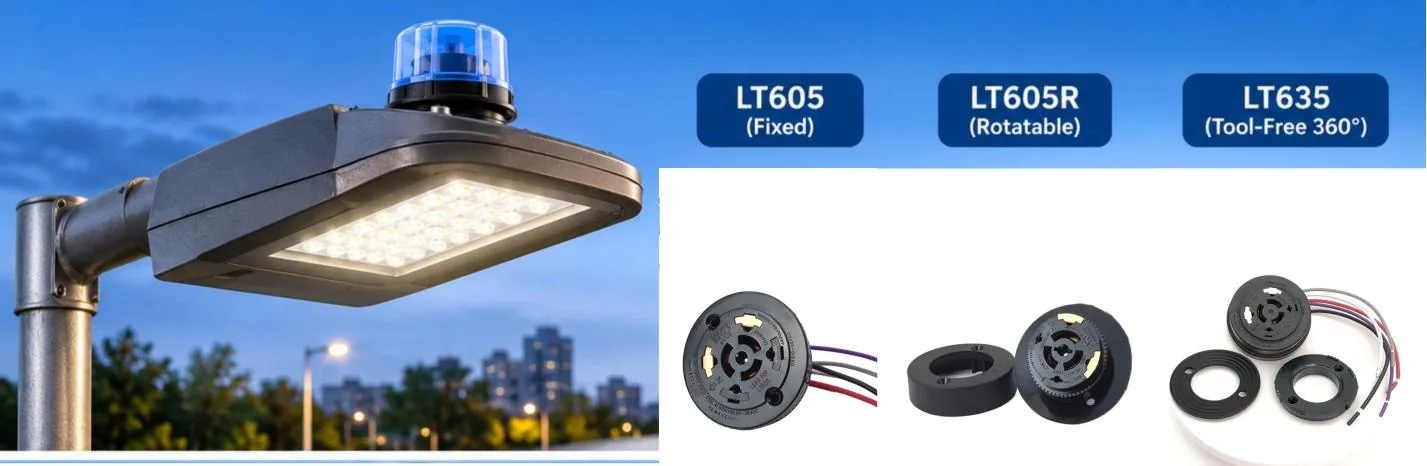
The Lead-Top LT605, LT605R, and LT635 share the same electrical interface in 5-pin and 7-pin versions. They differ in one decision that luminaire manufacturers face on every design:
- How the receptacle is oriented
- How much work it takes to change that orientation
This guide compares them so you can match the right one to your luminaire the first time.
What Does an ANSI C136.41 Dimming Receptacle Provide?
This receptacle is the socket side of the twist-lock interface. It does two jobs:
- Power connection
Three power contacts rated 480V / 15A. This is the same on all three models.
- Dimming and signal connection
- The extra pins (2 on a 5-pin, 4 on a 7-pin) carry the 0–10 В или ДАЛИ signal at 30V / 0.25A, wired to the driver’s dimming input.
All three are receptacles, the socket mounted in the luminaire. They are not light sensor switches or smart controllers. The control that twists into them is a separate product line.
What do the three models share?
| Shared feature | Detail |
| Signal pins | Phosphor bronze, gold-plated |
| Герметизация | силиконовая прокладка |
| Lead wires | UL1015, 105°C / 600V |
| Изоляция | 3,000V |
| Operating range | от −40°C до +70°C |
What differs is not the electrical interface. It is the structure: fixed, rotatable, or tool-free 360° rotatable.
What Is the LT605, the Standard Fixed Receptacle?
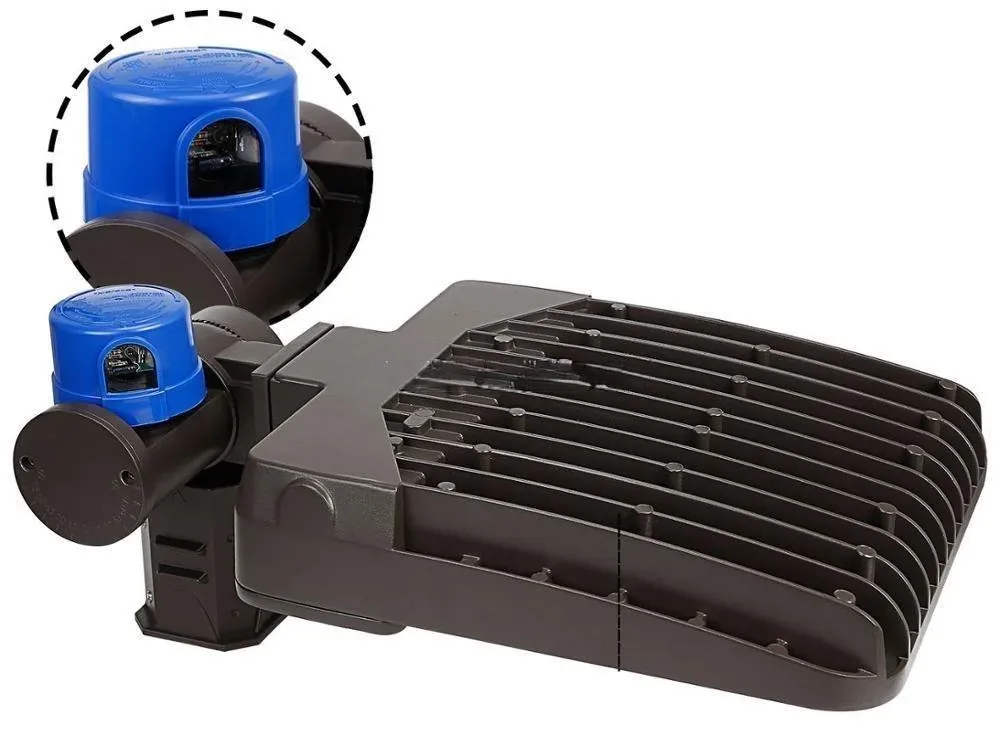
The LT605 is oriented at installation and stays that way. It is the simplest, most repeatable build for luminaire production lines.
Наилучший вариант
Luminaires where the sensor direction matches the mounting orientation by design, which covers most standard street and area luminaires.
Confirm before specifying:
- Luminaire opening
- Fixed orientation relative to the road or area being lit
- Wiring space behind the receptacle
- Whether the driver’s dimming input is 0–10V (5-pin) or DALI-capable (7-pin)
Standard spec line
ANSI C136.41, 5-pin and 7-pin versions, 480V / 15A power contacts, 30V / 0.25A signal pins.
What Is the LT605R, the Rotatable Receptacle?
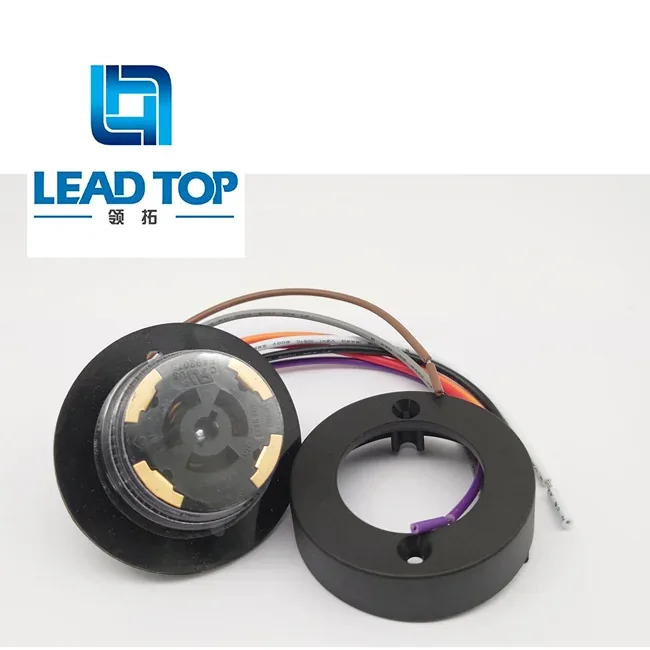
This product has the same electrical interface as the LT605. Its structure adds a rotatable body, so the receptacle direction can be adjusted to suit the luminaire’s actual mounting layout.
Why does orientation matter?
The photoelectric sensor twisted into the receptacle should face the area it senses. On pole-mounted and wall-mounted luminaires, the natural installation orientation doesn’t always put the sensor where it needs to look.
When does the LT605R fit?
- One housing is mounted in several orientations.
- The production line needs adjustment without changing the part number.
Installation notes
- Adjust and secure the orientation before final torquing.
- Confirm the locking method against the LT605R structure drawings.
What Is the LT635, the Tool-Free 360° Photocontrol Receptacle?
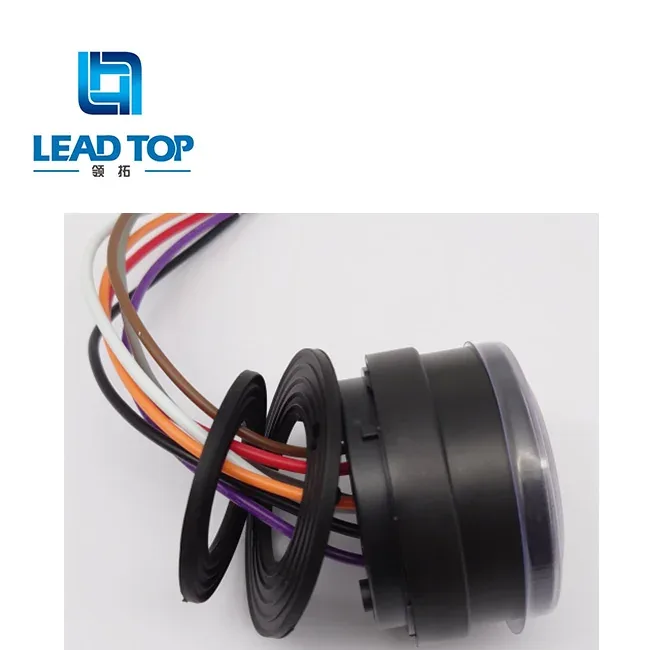
The LT635 is a distinct design, not just another rotatable part. Its orientation can be adjusted 360° without tools, by hand, at any point in the product’s life.
That pays off at three moments:
- Luminaire production: orientation is set on the assembly line without a fixture or torque tool.
- Field installation: the crew corrects sensor direction on the pole without returning to the workshop.
- Maintenance: re-aiming after a pole swap, road widening needs no part replacement.
The electrical interface matches the LT605 and LT605R: 480V / 15A power, 30V / 0.25A signal, in 5-pin and 7-pin versions.
How Do the Three Receptacles Compare?
| Особенность | LT605 NEMA Photocell receptacle | LT605R Smart Photoelectric Light Switch | LT635 360 Degree Rotatable Photocontrol |
| Стандарт | ANSI C136.41 | ANSI C136.41 | ANSI C136.41 |
| Structure | Зафиксированный | Rotatable | Tool-free 360° |
| Pin options | 5-pin / 7-pin | 5-pin / 7-pin | 5-pin / 7-pin |
| Power contacts | 480V / 15A | 480V / 15A | 480V / 15A |
| Signal pins | 30V / 0.25A | 30V / 0.25A | 30V / 0.25A |
| Orientation set | At installation | Adjusted per variant | By hand, at any time |
| Лучше всего подходит для | Repeatable single-orientation builds | Multi-orientation product ranges | Field and maintenance adjustment |
What Installation Differences Should Luminaire Manufacturers Consider?
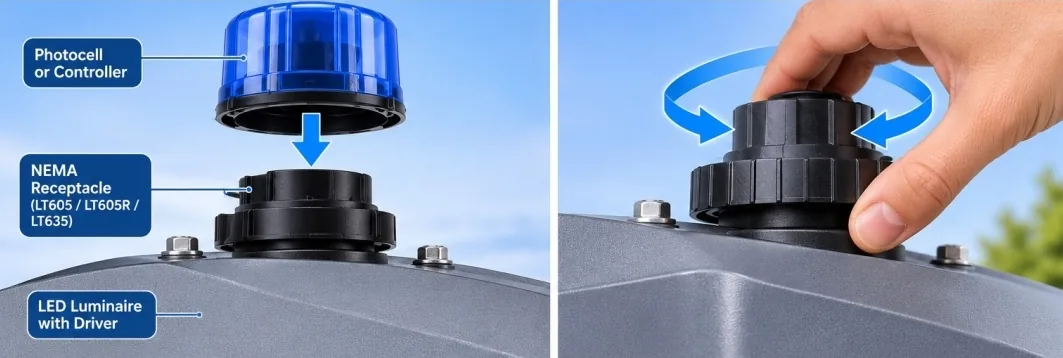
Mounting structure
The installation methods are identical across all three products. The choice doesn’t force a redesign.
Регулировка ориентации
- LT605: repeatable single-orientation builds.
- LT605R: where the line adjusts per variant.
- LT635: where field crews and maintenance teams need adjustment without tools.
Проводка
- Power contacts go to the driver’s AC input.
- Signal pins go to the dimming input.
- 5-pin serves 0–10V. 7-pin is for where extra signal lines are specified.
- Confirm pin assignment against the wiring diagram, not against pin count.
Обслуживание
Ask how often orientation will change after installation. If the answer is "possibly," the tool-free model changes the cost of that change from a truck roll to a hand adjustment.
Which Should You Choose?
| Требование | Model to consider |
| Standard fixed installation, repeatable production | LT605 |
| Orientation adjusted per variant at the factory | LT605R |
| Tool-free 360° adjustment on the pole or in maintenance | LT635 |
| 0–10V dimming interface | 5-pin version of the chosen model |
| DALI or extra signal lines | 7-pin version of the chosen model |
5-pin vs. 7-pin: is one better?
No. Pin count is a driver-compatibility decision, not a quality ranking. The two exist because drivers differ. Always verify pin assignment against the wiring diagram and the driver’s control input before ordering.
Which Lead-Top Photo Switch Sensor Should You Consider?
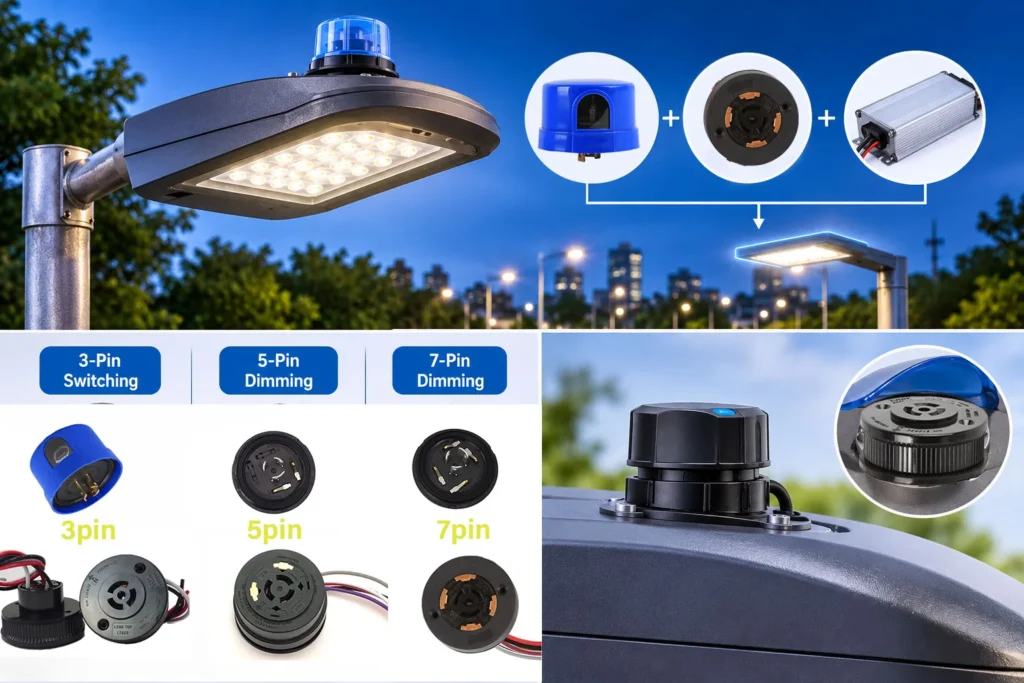
The LT605, LT605R, and LT635 are ANSI C136.41 dimming receptacles that have 5-pin and 7-pin variants featuring 480V / 15A power connection and gold-plated signal connections. Structure your product according to your luminaire and service.
Lead-Top also makes the dimming light photocell sensor and Жага controllers that twist into them, so the complete interface can come from one factory.
Часто задаваемые вопросы
What is an ANSI C136.41 dimming receptacle?
- It is the socket side of the НЕМА-style twist-lock interface.
- An ANSI C136.41 dimming receptacle is a standardized photocontrol socket used in outdoor lighting systems to connect photocells or smart controllers to LED luminaires.
- It provides line-voltage connections for switching and additional contact terminals for 0–10V dimming signals.
What is the difference between LT605, LT605R, and LT635?
Only the structure. The LT605 is a fixed, the LT605R allows for rotational adjustment during installation, while the LT635 can be adjusted 360° after installation without the need for any tools.The electrical interface and 5-pin / 7-pin options are the same.
Do I need 5-pin or 7-pin?
Match the driver. 5-pin carries two signal lines for 0–10V dimming. 7-pin adds further signal pins where the control system specifies them. Confirm the pin assignment with the wiring diagram rather than assuming from the driver brand.
Can I adjust the receptacle direction after the luminaire is installed?
With the LT635, yes. Its tool-free 360° design allows re-orientation on the pole without tools. With the LT605 and LT605R, re-orientation after installation should follow the installation instructions.
Are these receptacles compatible with any photocell?
They accept ANSI C136.41-compatible locking controls. Electrical compatibility still needs confirming:
- Напряжение питания
- Нагрузка
- The control’s dimming output matches the driver’s input
Send Lead-Top the driver specification, and the team will confirm the pair.
Заключительные слова
LT605, LT605R, and LT635 are provided in different mounting options but use the same electrical connectivity. Select the appropriate product based on the type of luminaire and driver you have. Share your project with Свинцовый-Топ. The team will confirm the suitable configuration and provide the relevant datasheet.



 English
 Portuguese (Brazil)
 Spanish
 Russian
 Dutch
 Japanese
 Portuguese (Portugal)