info@leaditop.com

メッセージを残す

+86 13391004727

専門家に相談する

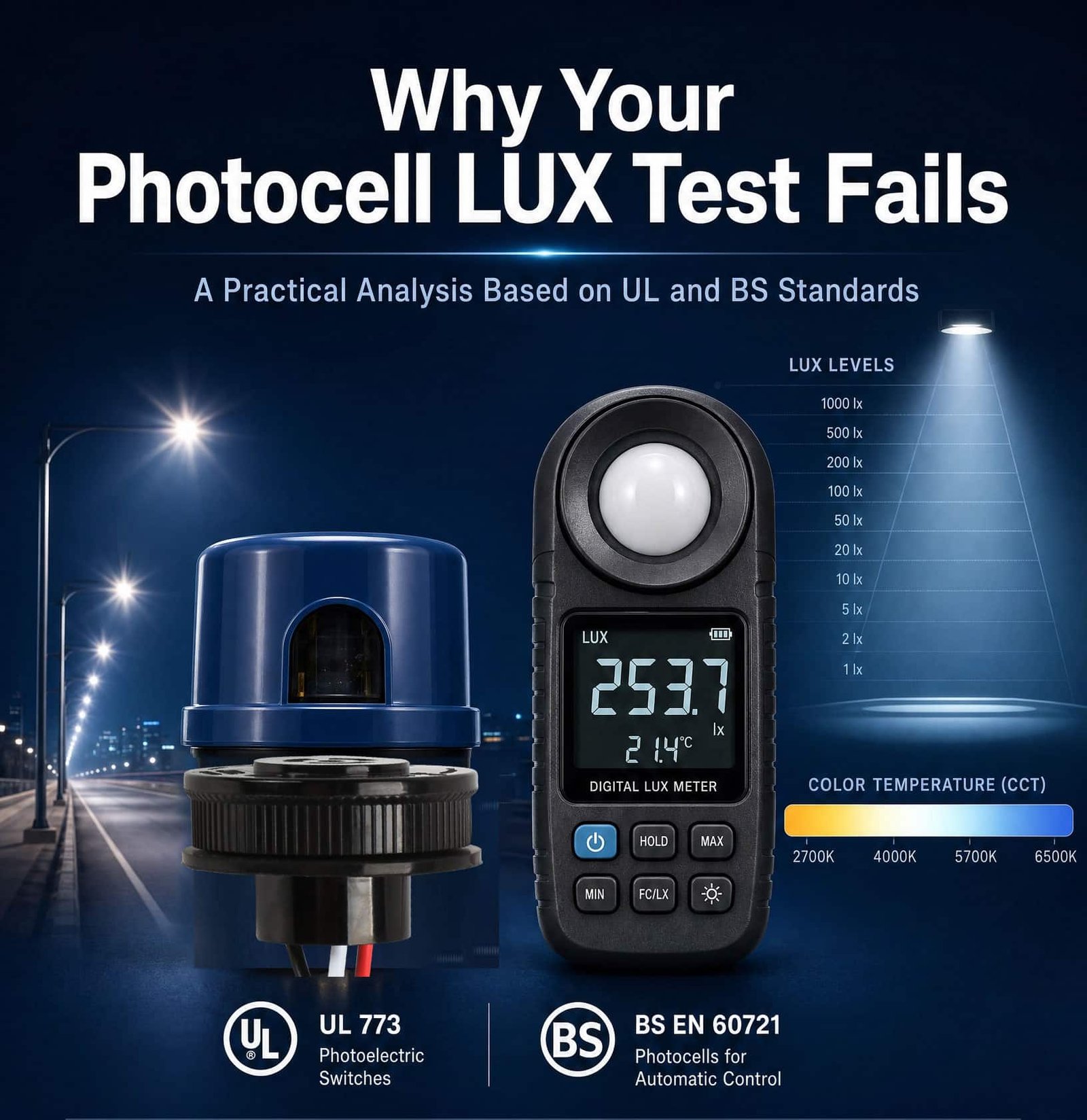
光電セルの照度試験が不合格となる理由:UL規格およびBS規格に基づく実践的な分析

目次

Introduction: Why Are LUX Settings So Important in Photocell Applications?

In contemporary outdoor illumination systems, LUX (illuminance) settings control when a 光電池 turns lights ON or OFF. These thresholds directly impact energy proficiency, security, and system dependability.

However, numerous project problems arise when the measured LUX values during testing do not match anticipations. This every so often leads to misunderstanding, clashes between purchasers and contractors, and needless product rejection.

Actually, most of these problems are not created by faulty products but by confusions related to photocell lux standard requirements and testing circumstances. LUX values are not utter—they differ depending on light source, atmosphere, and measurement method.

Understanding this principle is important to evade lux measurement error and guarantee exact assessment.

What Are the Main Photocell LUX Standards Used Globally?

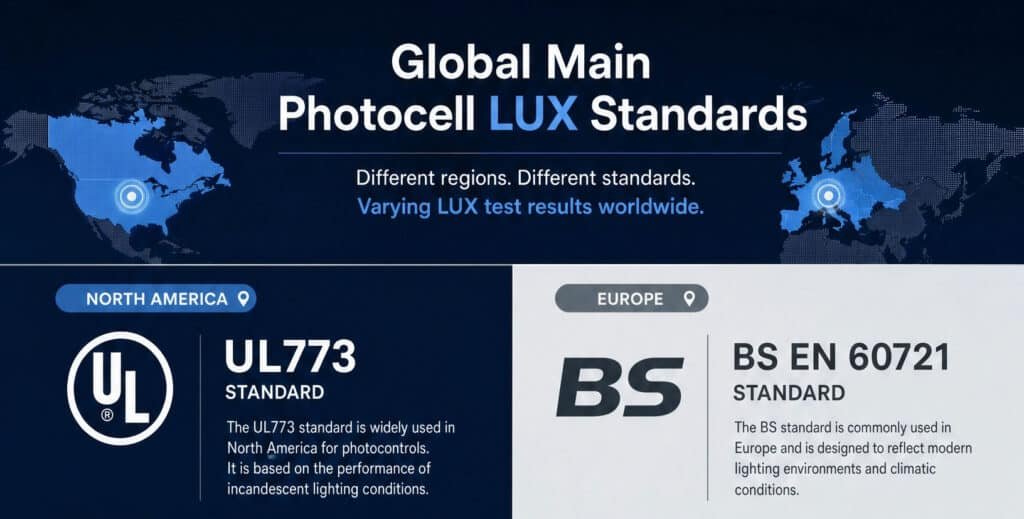
The international illumination industry mainly follows two main standards: UL773 and BS. These standards describe how photocell performance should be tested and assessed.

Why Do Different Standards Exist?

As Different areas use different lighting technologies and have environmental settings. As a result, each standard imitates local necessities and practical usage circumstances.

This leads to a common photocell lux testing difference when matching results across areas.

What Is the UL773 Photocell LUX Standard?

The UL773 photocell lux standard is broadly used in North America, mainly for plug-in photocells.

What Are the Light Source Requirements?

  • Color temperature: 2800K–3000K (warm white)
  • Typically incandescent or equivalent spectrum
  • Simulates old-fashioned street illumination conditions

What Are the Switching LUX Requirements?

  • Turn ON: 16 ± 6 Lux (approximately 10–22 Lux)
  • Turn OFF: Less than 65 Lux

How Does the ON/OFF Relationship Work?

UL773 needs hysteresis to avert recurrent switching.
Typical ON/OFF ratio ranges from 1:2 to 1:4.

What Are the Testing Characteristics?

  • Sensor directly faces the light source
  • Negligible environmental light intrusion
  • Firm control of testing environments

Key Insight

The UL773 photocell lux standard underlines accuracy, narrow forbearance, and repeatability, making it extremely controlled and laboratory-focused.

What Is the BS Photocell Standard?

The BS photocell standard is commonly used in Europe and other global markets.

What Are the Light Source Requirements?

  • Cool white or daylight-type light
  • Color temperature: 4000K–6500K
  • Closer to LED illumination conditions

What Are the Switching LUX Requirements?

  • Turn ON: Less than 80 Lux
  • Turn OFF: Less than 400 Lux

How Does the ON/OFF Relationship Work?

Basic hysteresis is essential, but the design is more malleable matched to UL773.

What Are the Testing Characteristics?

  • Nearer to real-life conditions
  • Less severe laboratory requirements
  • More real-world and application-focused

Key Insight

The BS photocell standard highlights real-life usability instead of strict accuracy.

How Do UL and BS Standards Compare?

Table 1: UL773 vs BS Photocell Standards

特徴UL773 StandardBS Standard
地域北米Europe / Global
Light SourceWarm (2800K–3000K)Cool (4000K–6500K)
Turn ON LUX10–22 Lux< 80 Lux
Turn OFF LUX< 65 Lux< 400 Lux
Testing EnvironmentControlled labReal-world simulation
Focus精度Practical application

Why Do LUX Test Results Often Fail or Differ?

One of the most common problems in photocell testing is irregularity between anticipated and measured values. This is mainly due to photocell lux testing difference caused by changing test circumstances.

What Factors Influence LUX Results?

1. Light Source Type

Incandescent, LED, and fluorescent illuminations produce different spectra, disturbing sensor reaction.

2. Color Temperature

Warm light (UL standard) and cool light (BS standard) produce different LUX readings.

3. Light Spectrum Distribution

Photocells react differently to numerous wavelengths of light.

4. Illumination Angle

Direct exposure against indirect illumination changes the amount of light reaching the sensor.

5. Environmental Interference

Environmental light can misrepresent results, leading to lux measurement error.

Even when using the same photocell, changing any of these factors can produce considerably different results.

How Does Photocell Design Affect LUX Measurement?

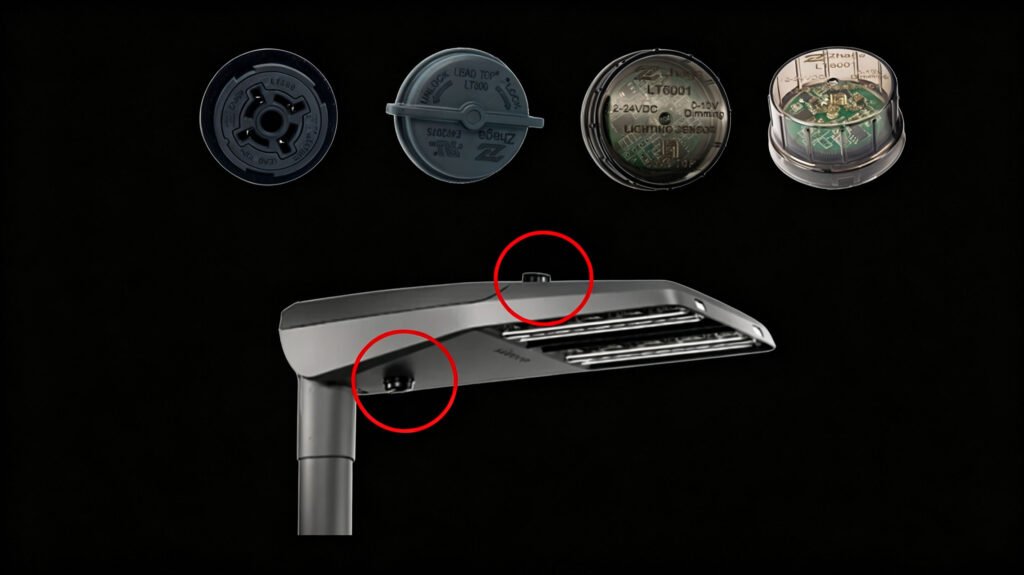
Yonder to outside settings, the physical design of the photocell also plays a role.

What Structural Factors Matter?

  • Housing type (opaque vs transparent)
  • Optical window design
  • Material and color of enclosure

These aspects control how much light reaches the sensor, unswervingly impacting photocell calibration and measurement accurateness.

What Is the Most Common Cause of LUX Test Failure?

A recurrent problem occurs when non-standard light sources are used during testing.

Example Scenario

Instead of using a standard-compliant light source, a buyer tests a photocell using a random LED lamp. When the measured LUX values does not match the specification, it leads to the assumption that the product is defective.

Actually, the test method does not align with the defined photocell lux standard, the photocell is working properly.

What Factors Should Be Defined Before LUX Customization?

To evade testing irregularities, some parameters must be clearly defined.

Table 2: Key Factors for Accurate LUX Testing

要素説明
Applicable StandardUL or BS
Light Source TypeIncandescent or LED
Color TemperatureWarm or cool light
Installation EnvironmentIndoor or outdoor
センサーの向きDirect or indirect exposure
アプリケーションシナリオStreet, industrial, commercial

Devoid of defining these factors, LUX values lack practical meaning and cannot be precisely assessed.

How Can You Ensure Accurate LUX Testing and Validation?

To attain trustworthy results, a structured testing approach is important.

Suggested Practices Include:

  • Use standard-compliant light sources
  • Simulate real installation environs
  • Minimalize external light intrusion
  • Bring into line testing methods between supplier and purchaser
  • Conduct sample authentication before mass production

Constancy in testing is important for proper photocell calibration and performance assessment.

Why Is Consistency More Important Than Absolute LUX Values?

Numerous purchasers focus on achieving exact LUX values, but this approach can be deceptive.

What Really Matters?

  • Constant switching behavior
  • Dependable performance under real circumstances
  • Acquiescence with the true standard

Absolute LUX values are less important than constant performance within a defined photocell lux standard.

よくある質問(FAQ)

Why Do My LUX Test Results Not Match Specifications?

This is commonly due to differences in testing situations, leading to lux measurement error.

Which Standard Should I Use: UL or BS?

It depends on your target market—UL for North America and BS for Europe or global projects.

Can the Same Photocell Meet Both Standards?

Yes, but testing environments must be accustomed accordingly.

How Can I Avoid Testing Errors?

Use standard-compliant light sources and bring into line testing methods with your supplier.

Conclusion: Why Do Photocell LUX Tests Fail and How Can You Fix Them?

LUX is not an utter value—it is a condition-dependent parameter influenced by numerous factors such as light source, environs, and testing method.

Most testing failures are not due to product faults but to irregularities in photocell lux standard application and measurement circumstances.

By understanding the differences between UL773 photocell lux and BS photocell standard, and by executing proper photocell calibration practices, you can eradicate misunderstanding and achieve exact, dependable results.

行動喚起:
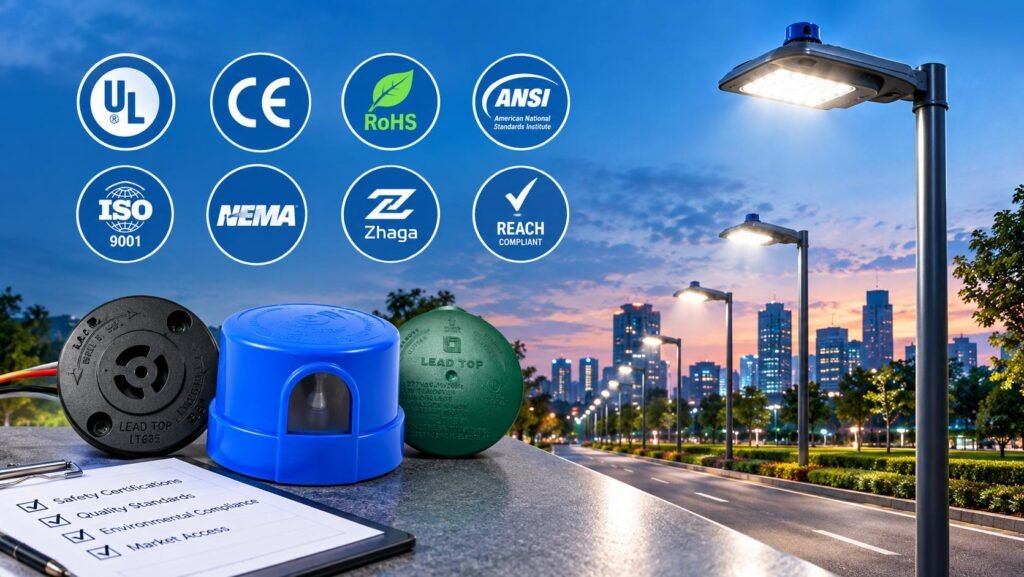
For standard-compliant solutions and expert support in decreasing photocell lux testing difference, contact Lead-Top today and make sure your products meet real-life performance expectations across international markets.

参考文献:

フェイスブック
ツイッター
リンクトイン
ワッツアップ
Sophiaの写真
ソフィア

こんにちは。この記事の著者です。照明業界で10年間働いてきた経験から、イノベーションと繋がりに情熱を注いでいます。業界の洞察を探求し、未来を形作るために、ぜひご参加ください。一緒に光を灯しましょう!

無料見積もり
無料見積もり

コメントを残す

メールアドレスが公開されることはありません。 が付いている欄は必須項目です

jaJapanese

メーリングリストにご参加ください!

独占アップデートで最新情報を入手してください。.

“「照明制御市場のトレンド、業界ニュース、新製品リリースを受け取るため。」”