The most common factors that are noticed in a photocontrol are its switching light levels. Most buyers evaluate products based on this. However, that’s not all that needs to be checked.
As time passes, flickering lamps and lights staying on through overcast mornings became common concerns.
This guide explains various other factors that need to be considered while choosing a light sensor. This includes understanding the following:
- ルクス レベル
- 時間遅延
- 制御システム
- How they interact
- Which specifications are must-haves
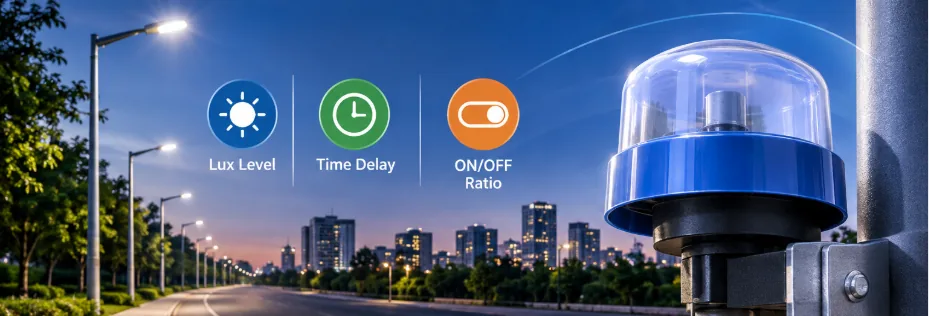
What Is the Lux Level of a Lighting Control?
This is the ambient light threshold at which the sensor decides it is dark enough to switch on.
- A 10–16 lux unit switches on at deep dusk.
- A 35 lux unit switches on earlier, while the sky is still bright enough to read by.
Why is the number a range, not a point?
Production and sensor tolerance mean a "16 lux" unit may legitimately switch on at 10. Datasheets publish a window, and Lead-Top’s standard window is 10–16 lux. Expect that window, not a single value.
Does sensor type matter?
It can. Lead-Top’s LT110 thermal series uses a CDS cell, while the LT124L, LT134, LT154, and LT310A families use IR-filter phototransistor sensing.
CDS cells are known to be prone to drift because of age and seasonality. The manufacturers do not provide comparative information about drift on product specification sheets; hence, request information on that parameter if it is a crucial one when making your decision.
What Is the Difference Between Turn-On Lux and Turn-Off Lux?
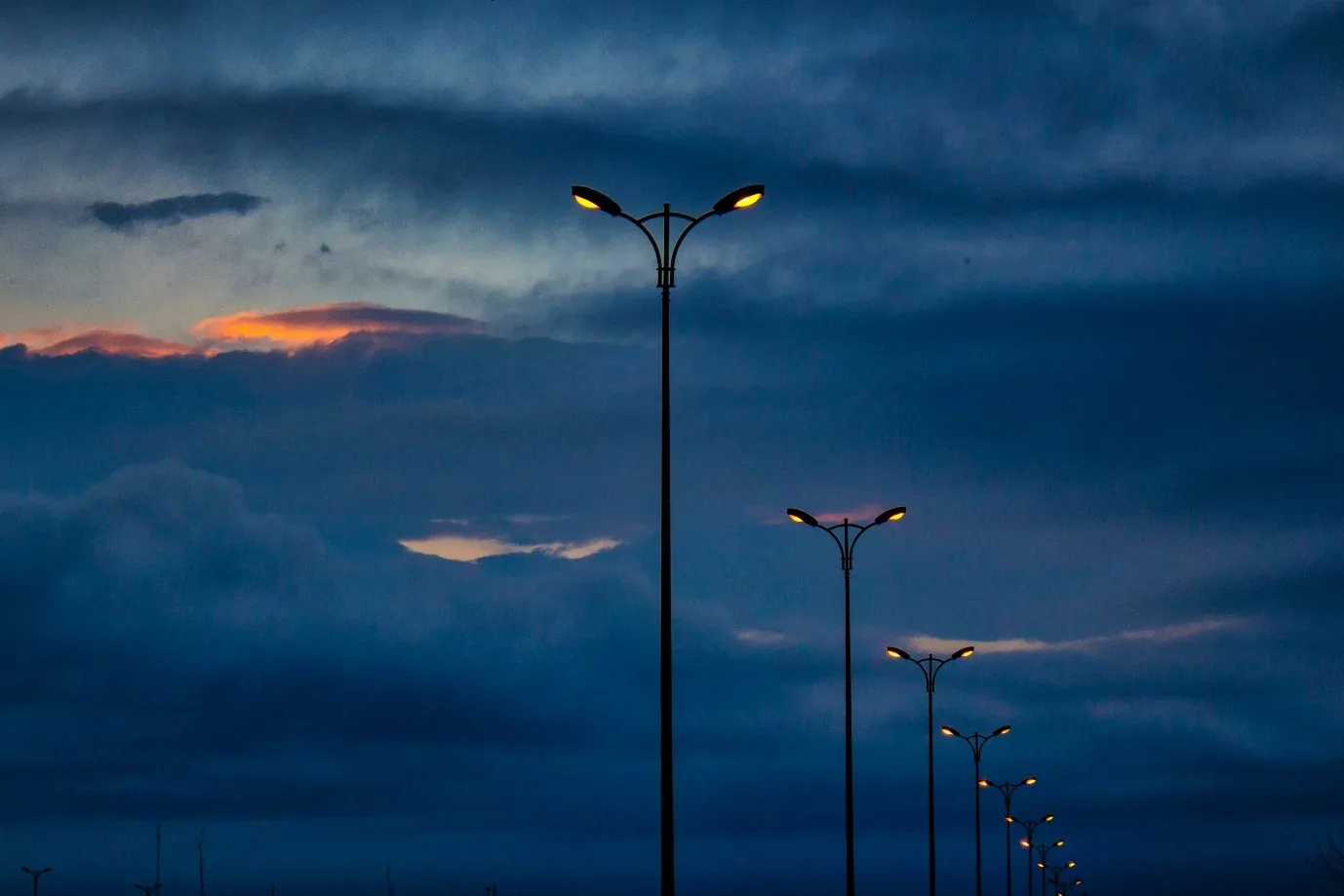
The two thresholds are deliberately different. The lamp turns on at dusk, for example at 10–16 lux, and turns off at a higher level, for example below 65 lux on the LT110. The lamp comes on later than it goes off. That asymmetry is by design.
| If the gap is… | What goes wrong |
| Too small | Morning haze or bright overcast sits between the thresholds and the light cycles on-off-on. This flickering complaint drives most warranty calls. |
| Turn-on set too high. | Lamps burn through twilight hours that didn’t need lighting, and the control reacts more to headlights and reflected light. |
How do you calibrate by application?
- Residential and rural roads: often favour earlier turn-on (a higher lux level).
- Arterial roads and tunnels with safety requirements: specify tighter windows.
- Dark-sky programmes: push the threshold down.
What Is the ON/OFF Ratio, Explained?
This is the relationship between the turn-off and turn-on levels. It is the hysteresis band. In simpler terms, it is the buffer that prevents the system from hunting about one threshold value as light changes from dusk to dawn.
- Some Lead-Top electronic models publish a 1:1.5 ratio, meaning turn-off at 1.5× turn-on. The LT104-DC is one example.
- The LT110 photocell lighting sensor shows a wider gap: 10–16 lux on, below 65 lux off.
- Ratios differ by model, so check each datasheet. Don’t generalise 1:1.5 across all families.
How do you read it on a datasheet?
| Ratio | Effect |
| Wider | More stable switching, slightly later turn-off on bright mornings |
| Tighter | Earlier turn-off and more energy saving, but less margin against haze and reflections |
Why Does Photocell Time Delay Matter?
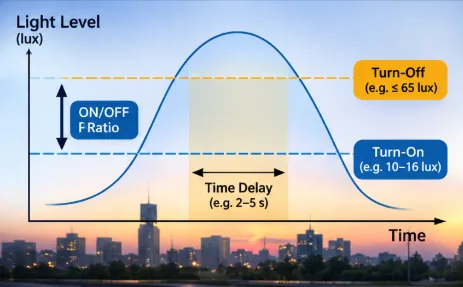
The delay is an ignore window. A 2–5 second delay rides through headlights, lightning flashes, and camera flashes. A 30–90 second delay, like the LT110’s thermal setting, rides through cloud shadow and swinging branches.
"Instant" response sounds ideal for energy savings. However, it produces visible flicker in practice. Every photo switch sensor installation needs a delay matched to what moves through the sensor’s field of view.
What is the difference between a 2–5 second and a 30 second light sensor switch time delay?
| Site | Typical delay |
| Open roadways where headlights are the main disturbance | 2–5 seconds (the LT124L default band) |
| Mixed urban environments | 3~15秒 |
| Leafy residential routes, heavy cloud variation | 30–90 seconds (thermal LT110 class) |
How do lux and delay interact?
They work together. The threshold sets where the photoelectric sensor switches, and the delay sets how long a change must persist. Specifying one without the other is half a specification. A delay also can’t fix a threshold that is wrong for the site.
How Do These Parameters Affect Outdoor Lighting Control?
Here is the failure list, mapped back to the parameters:
- Light flickers at dusk
The gap between on and off levels is too small for the site.
- Light stays on through bright overcast mornings
The turn-off level is too low, or the ratio too narrow for the latitude. Check the model’s published window.
- Light switches on during passing traffic at night
The delay is too short for the disturbance profile.
- Threshold seems to drift year over year
Possible sensor ageing, which may call for a different sensor type rather than recalibration.
- Snow or coastal fog
These edge cases may need a deliberate deviation from the standard window. See our cold-climate and coastal articles.
Why do these belong in the tender?
Each failure above is written in at specification time. If they’re in the tender document, they get checked. If they’re only in the sample, they get inherited.
How Do You Specify Photocell Parameters for a Project?
Here is how to specify a photocontrol receptacle for a tender:
| パラメータ | What to write | Example wording |
| Turn-on lux | A window, not a point | "Turn-ON: 10–16 lux" |
| Turn-off/ratio | The ratio band | "Turn-OFF at ≤1.5× turn-ON" (verify per model) |
| 時間遅延 | The band and its purpose | "Delay: 2–5s (headlight rejection)" or "30–90s (cloud variation)" |
| Sensor type | The technology, not just the number | "IR phototransistor" or "CDS, thermal design" |
| フェイルモード | ON or OFF, by road class | "Fail-ON for safety-critical corridors" |
Configure instead of develop
On the LT124L, turn-on level, delay band, and fail mode are part-number options. That is the same configurable system covered in our OEM/ODM guide.
Run a verification loop
- Order samples of the exact configured part number.
- Run a dusk-to-dawn cycle test at the site’s latitude.
- Release the bulk order only after the result is confirmed.
Which Lead-Top Models Cover the Parameter Range?
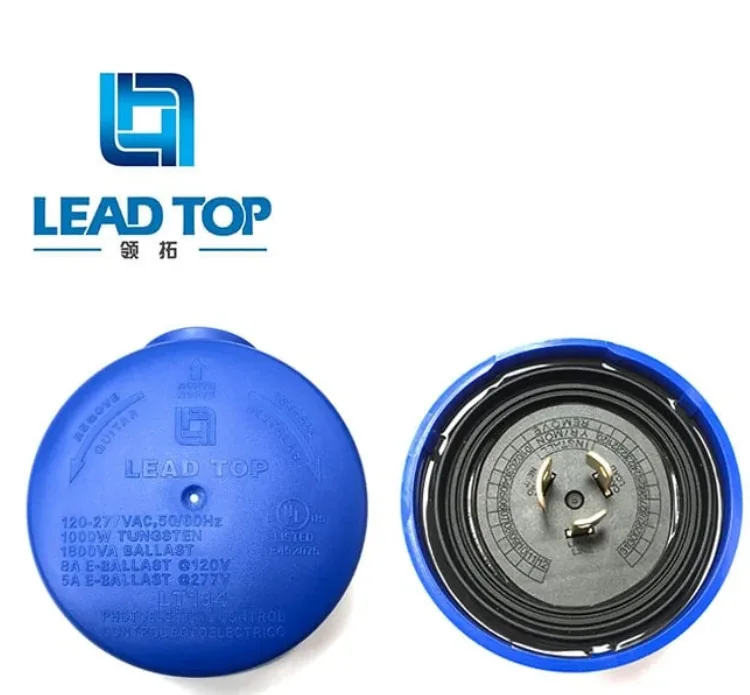
- LT110: 10–16 lux on, below 65 lux off, 30–90 second thermal delay, for traditional programmes.
- LT124L: configurable turn-on level, delay band and fail mode through part-number options.
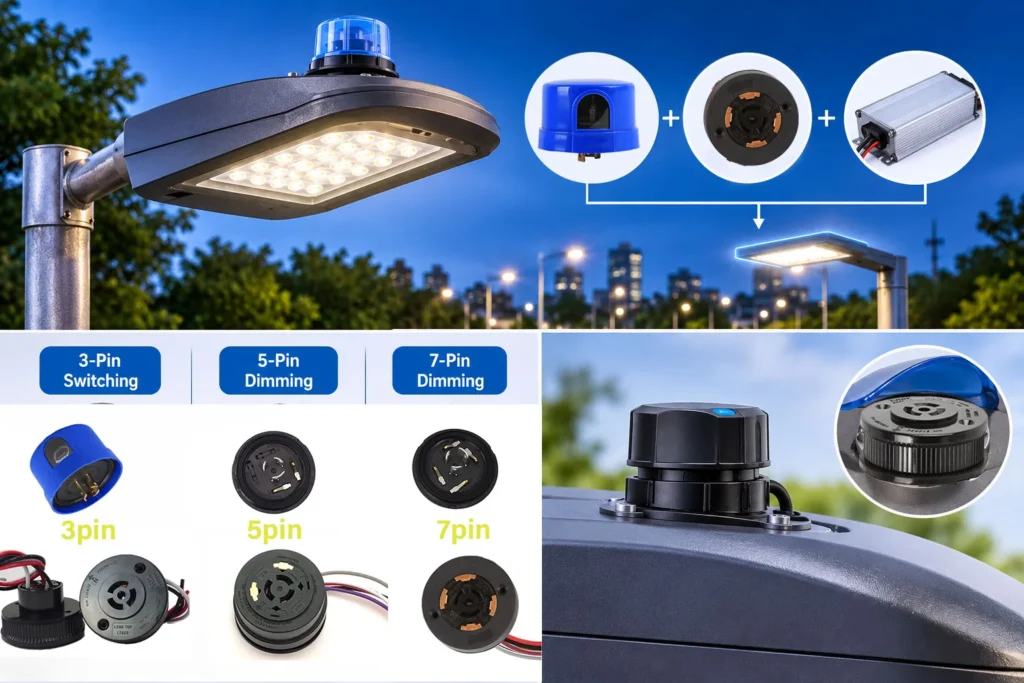
- LT134 屋外用自動昼光センサースイッチ そして LT154 LED街路灯用電子コントローラー: electronic twist-lock options for heavier loads. The LT154 is programmable.
Match the parameters to the site, and confirm the configured part number with Lead-Top before ordering.
よくある質問
What lux level should a photocell turn on at?
For almost all outdoor programmes, a range of 10-16 lux provides good results. This means that it is very dark. To turn lights ON early, a threshold of up to 35 lux is recommended. This is usually applicable for safety reasons.
Why does my photocell flicker on and off at dusk?
The ambient light level is crossing the switching threshold repeatedly. Check the gap between turn-off and turn-on, and the delay. A wider ON/OFF ratio and a delay long enough to ride through the disturbance usually help. Check the wiring and load as well.
What does the ON/OFF ratio mean on a datasheet?
It is the hysteresis band between the switching levels. Some Lead-Top electronic models publish 1:1.5. A wider ratio gives more stable switching. A tighter one gives earlier turn-off with less margin against haze and reflections.
Is a longer time delay better?
Not automatically. A 2–5 second delay handles headlights on open roadways. 30–90 seconds suits leafy or cloudy sites. A delay that’s too long slows genuine dusk response, and one that’s too short lets disturbances through.
Can I order a photocell with my own lux and delay settings?
On models like the LT124L, yes. Turn-on level, delay band, and fail mode are part-number options, not custom development. Send your target parameters, and Lead-Top will confirm the configured part number and a sample for site testing.
結論
Light photocell sensor performance depends on:
- The right lux level
- オン/オフ比
- 時間遅延
So define these requirements before selecting a model. Share your target requirements with リードトップ. The team will confirm the suitable configuration, provide a datasheet, and arrange a test sample.


 English
 Portuguese (Brazil)
 Spanish
 Russian
 Dutch
 Japanese
 Portuguese (Portugal)