Two lighting brands can order the same nominal automatic light sensor and need two different products. One needs a different turn-on threshold for its latitude. Another needs a different voltage window for its grid, a different fail mode for its road class, or a different surge tier for its lightning zone.
Catalogue models cover most of this through options. Where the options end, Lead-Top’s OEM/ODM development begins.
This guide covers what can be customised, what is already a standard option, how development runs, and what to prepare before requesting a quotation.
Why Do Lighting OEMs Need a Customised Light Sensor Switch?
Needs differ along four lines:
| Difference | Examples |
| 電気 | Supply voltage by market 120V North America 220–230V Europe and Asia 347–480V industrial AC or DC circuits Driver load profiles |
| コントロール | Turn-on ルクス for latitude and light-pollution rules Time delay for traffic speed and fog Fail mode by road class Dimming where the driver supports it |
| デザイン | Internal space for wire-in controls Housing colour Branding and packaging |
| 市場 | インターフェースファミリー ANSI C136.10/C136.41 in the Americas ザガ書 18 in European smart programmes Certification and documentation |
The cost framing
Customisation is cheapest when it uses existing configurable options. It only grows when it needs a true development loop. A good supplier tells you which one you are in.
What Photocontrol Specifications Can Be Customised?
電気
- 定格電圧
Multi-voltage windows exist. The LT124 family operates down to 80VAC, the LT124L to 90VAC, and the LT104 to 95VAC.
- Load class
2A, 5A or 8A E-Ballast.
- Frequency and AC/DC versions
The LT104-DC covers 12–24VDC and the LT310A covers 12–48VDC for solar and low-voltage lighting.
光制御
- Turn-on lux level
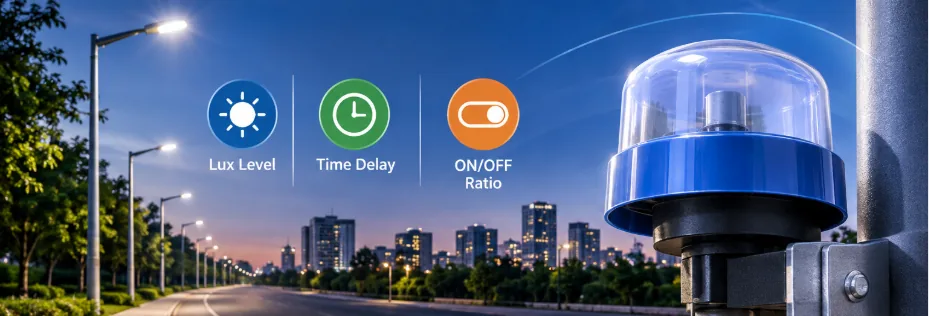
Such as the 15, 26, and 37 lux options on the LT124L, plus the turn-off ratio.
- 時間遅延
From 2–5 seconds up to 30–35 second options.
- フェイルモード
Fail-ON or Fail-OFF.
サージ保護
- On the LT124L, 320J is standard, with 640, 960, and 1,280J options.
- Other families run from 160J up to 950J and beyond, at 6kV, 10kV or 20kV surge levels, depending on model.
- Tier selection is a project evaluation, not a menu item on every model.
Structure, interface and presentation
- Twist-lock, wire-in, or Zhaga controller form
- ネマ (C136.10 / C136.41) or Zhaga Book 18 interface
- Housing size and sealing, IP66 or IP67 options
- Cover colour, base design, logo, packaging and labels
Standard Options vs. Project-Based Customisation: What’s the Difference?
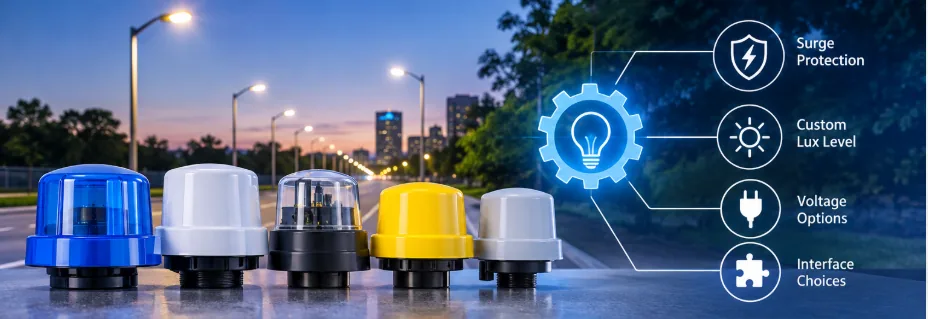
Every OEM buyer needs this line drawn plainly. Some parameters are orderable options on catalogue models. Others enter a development evaluation.
The clearest example is the LT124L part-number system. Take LT124L-BU-F15-D05-NO-M10-66:
| コード | Meaning | コード | Meaning |
| BU | Cover colour | F15 | 電源オンレベル |
| D05 | 時間遅延 | NO | フェイルモード |
| M10 | MOV tier | 66 | IP等級 |
Configuring a variant like this is a purchase order. Inventing a new variant is a project.
The logic is the same for Wire-in controls. The LT310A selection code makes load, switching, and fail mode explicit order options:
- E-Ballast: 1 = 2A, 2 = 5A
- Z: zero-cross switching
- F: Fail-OFF
Can You Get a Photocell With Custom Turn-On Lux, Colour, Logo and Packaging?
Yes, within the limits of each model’s options. The lux level is a configurable option on models such as the LT124L street light controller, which makes a custom lux level photocell a standard order rather than a development project.
For appearance and presentation, private label photocell manufacturer programmes usually cover:
Housing palette
Grey, yellow, transparent blue, black, brown, transparent, blue and green, with UV-stabilised PC covers and PBT bases.
ロゴ
Printed or molded, with options and minimums set per project.
パッケージ
Standard export packing or branded retail and bulk packaging, with label language and content per market.
Confirm marking methods and MOQs with Lead-Top before you commit to a design.
Which Interface Should You Choose: NEMA, Zhaga or Wire-In?
| インタフェース | Products | 最適な用途 |
| NEMA twist-lock (ANSI C136.10) | LT110 / LT124L photocells with LT615-family 3-pin receptacles | Standard on/off switching |
| NEMA dimming receptacle (ANSI C136.41) | Dimming photocontrol line with LT605 / LT605R / LT635 receptacles, 5-pin and 7-pin | Dimming; fixed, rotatable, or tool-free 360° |
| ザガ書 18 | LT600 receptacle with LT6001 (0–10V) and LT6002 (DALI) controllers | European smart-ready programmes |
| Wire-in controllers | LT310A (120–277V, IR sensor, >10,000 cycles) and LT210 thermal series | Luminaire-internal mounting; DC versions for solar |
Category discipline: receptacles, photo switch sensors, and controllers are different product classes. Customisation confirms interface and electrical requirements separately for each.
How Does the OEM Photocontrol Development Process Work?
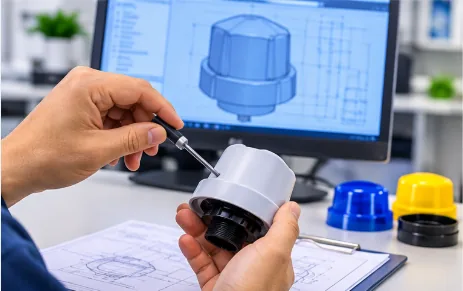
For an ODM photocontrol receptacle supplier, the process runs in six steps:
- ステップ1
Requirement discussion. Application, technical requirements, estimated quantity, and target market.
- ステップ2
Technical evaluation. The factory reviews electrical parameters, structure, interface, and feasibility.
- ステップ3
Sample development. Samples are prepared against confirmed requirements.
- ステップ4
Sample testing and confirmation. You test them. Performance, structure, and appearance are then frozen.
- ステップ5
Mass production against the confirmed specification.
- Step 6
Quality inspection and delivery.
Honest boundary
Development cycles, sample costs, and MOQs are set per project. We don’t quote fixed lead times before the evaluation.
What Should You Prepare Before Requesting a Quote?
A filled specification sheet gets a faster, more accurate answer.
| Information | Details to provide | Information | Details to provide |
| Required voltage | AC or DC, supply window, frequency | 定格荷重 | Load type and rating, LED driver class |
| 製品タイプ | Twist-lock, wire-in or Zhaga | インタフェース | NEMA C136.10 / C136.41 / Zhaga Book 18 / other |
| 光制御 | Turn-on lux, delay, fail mode | サージ保護 | MOV tier or surge level for the site’s exposure |
| 外観 | Cover colour, base design, logo | パッケージ | Standard or branded |
| 量 | Initial and annual estimate | 応用 | Street, area, parking, solar and so on |
Which Applications Does the Custom Range Cover?
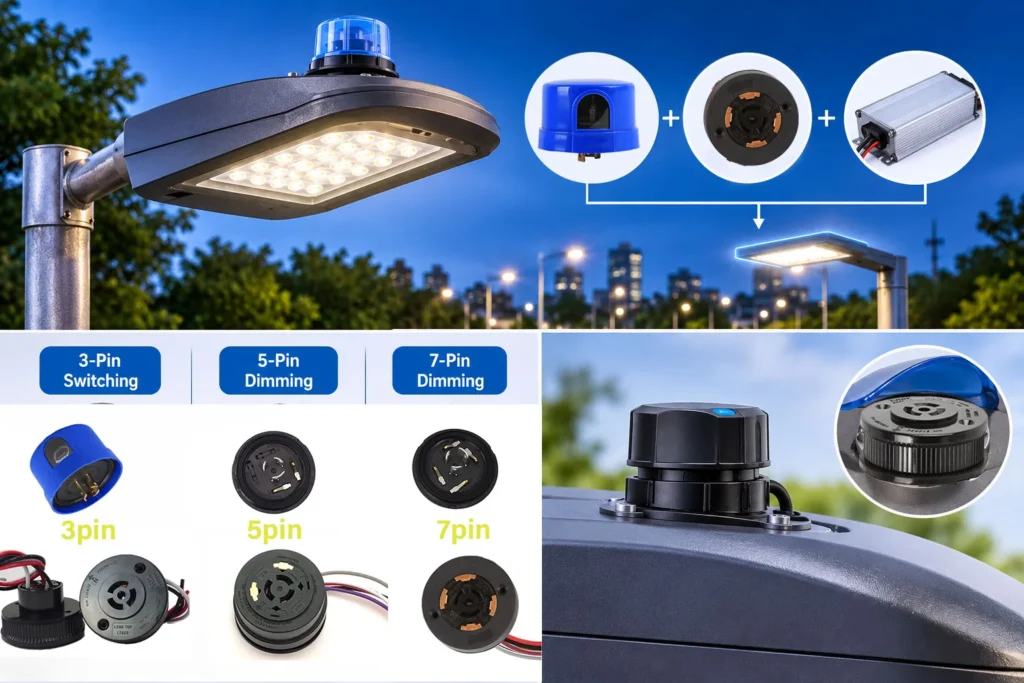
- Street and roadway: 3-pin switching or 5/7-pin dimming packages.
- Area, parking and industrial: higher-load models such as the LT134 (8A) and LT154 (programmable), with higher surge tiers.
- Solar and low-voltage: LT104-DC (12–24VDC) and LT310A (12–48VDC) wire-in.
- Smart-ready programmes: the Zhaga Book 18 package.
Each application ties a requirement (voltage, load, interface) to a product class. No product fits every scene.
Where Does Customisation Start?
For OEM photoelectric sensor programmes, customisation starts with the configurable families:
- LT110
- LT124L (suffix-configured)
- LT134
- LT154 Photoelectric Switch
- LT310A (selection-coded)
It extends through the receptacle and Zhaga lines
- The LT615 family
- LT605/LT605R/LT635
- LT600/LT6001/LT6002
よくある質問
What is the MOQ for a custom twist-lock photocell?
It depends on the layer. Configuring existing options, such as lux level, delay, fail mode, or MOV tier through part-number suffixes, follows the base model’s standard MOQ. Structural or appearance development is quoted per project. Send your specification, and Lead-Top will confirm the tier.
Which parameters can be customised without new development?
On the LT124L, cover colour, turn-on lux level, time delay, fail mode, MOV tier, and IP rating are part-number options. On the LT310A, load class, zero-cross switching and fail mode are selection-code options. Everything else enters project evaluation.
Can you supply 220–230V, 50Hz markets?
Yes. Voltage options exist across the range, including an LT110 220V option, wide-window electronic models operating down to 80–90VAC, and DC versions for solar. Confirm the exact window and load against the configured model’s datasheet.
Can a photocell factory take ODM projects to my own design?
Lead-Top works from your technical specifications, product drawings, and estimated quantity. The six-step process above sets how an ODM project moves from requirements to production.
How long does OEM sample development take?
It depends on how far the request sits from an existing configurable model. Suffix-level configurations follow normal order lead time. New structures or electronics follow the development process, with a timeline set at technical evaluation. We don’t quote fixed periods beforehand.
What documents come with an OEM order?
A datasheet matching the exact configured part number, surge and endurance test reports on request, certification documents for the product family, and units individually marked with date and batch codes.
結びの言葉
Most OEM requirements, from lux levels to MOV ratings and cover colours, are configuration options rather than new development. Share your project details with リードトップ to identify the right solution. The engineering team will provide a configured part number, sample plan, and supporting test data.


 English
 Portuguese (Brazil)
 Spanish
 Russian
 Dutch
 Japanese
 Portuguese (Portugal)