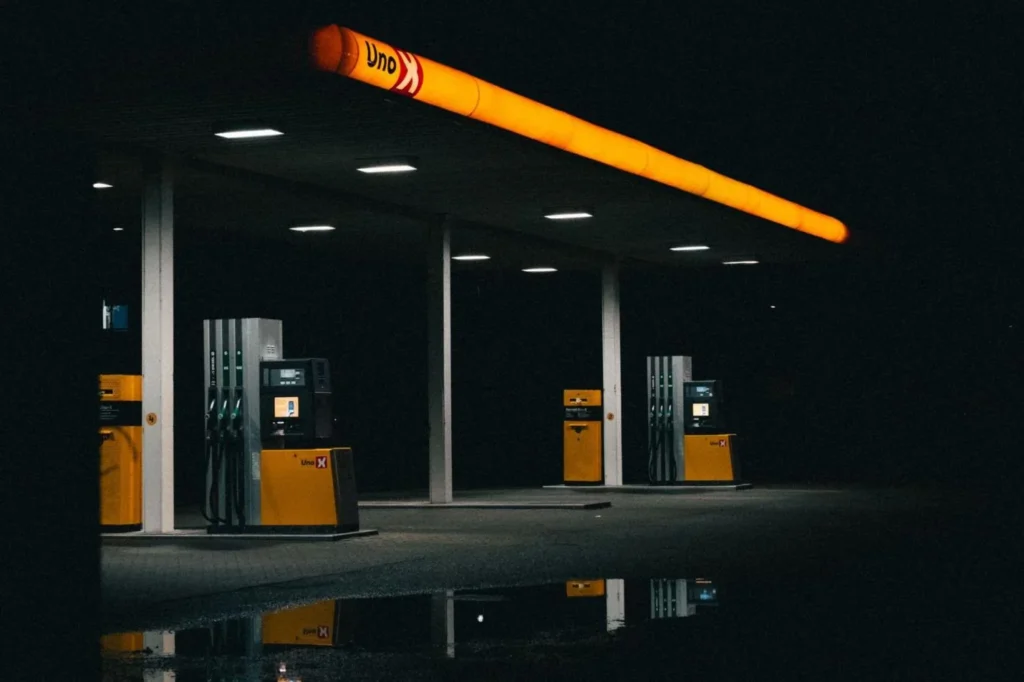
A petrol station canopy houses several LED luminaires that operate automatically. However, when there is a malfunction in the system, visibility and the standards of the lighting are affected.
That is why forecourt projects need more than a voltage and wattage match. Five factors decide whether a photocontrol suits the job:
- Failure mode
- Temperatura de operação
- Proteção de entrada
- Hazardous-area location
- Electrical load and surge requirements
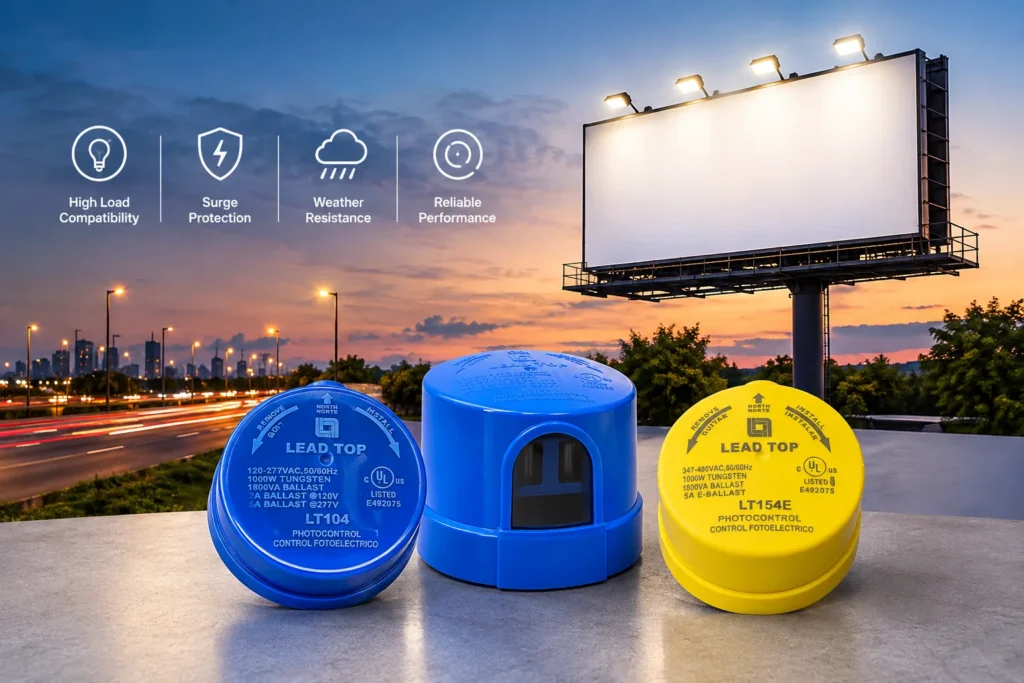
This guide covers each one and introduces the Lead-Top LT134 and LT154 heavy-duty twist-lock photocontrols.
Why Is Canopy Lighting a High-Reliability Application?
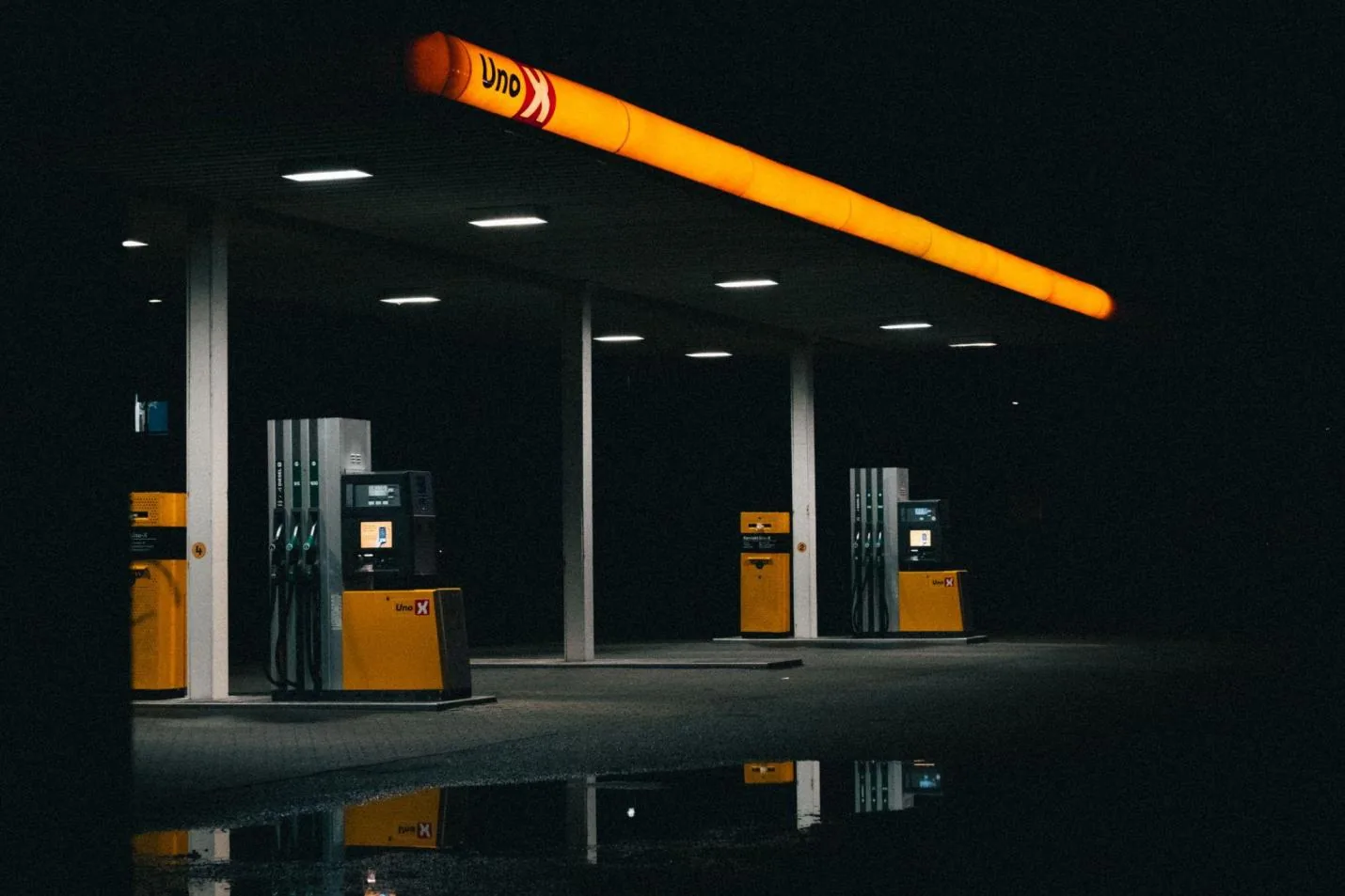
Lighting continuity is part of forecourt operations
Canopy light supports visibility around dispensers and night-time customers. Lighting requirements are often determined by retailers themselves; thus, unexpected lighting failures impact business operations.
Continuity is required during the planning stage of the control system, not just by replacing a malfunctioning photocell. All components determine the reliability of lighting and include:
- Power supply
- Circuit protection
- Contactors
- drivers de LED
Why daylight control still matters
Manual control will make the lights work during the day. But a photocell switch can help save energy by cutting down the number of hours the lights work during the day. However, the effectiveness of savings will be subject to:
- Hours of daylight
- Scheduling
- Control system in place
Why does failure mode matter?
Falha-ligado
After certain control failures, the lighting may stay energised.
Falha-desligada
After the same failures, the lighting may stay off.
Neither guarantees light if the supply, breaker, contactor, or driver fails.
Ask for the documented failure behaviour of the exact configuration, then match it to the project’s continuity requirement.
How Hard Is the Forecourt Environment?
Heat under the canopy
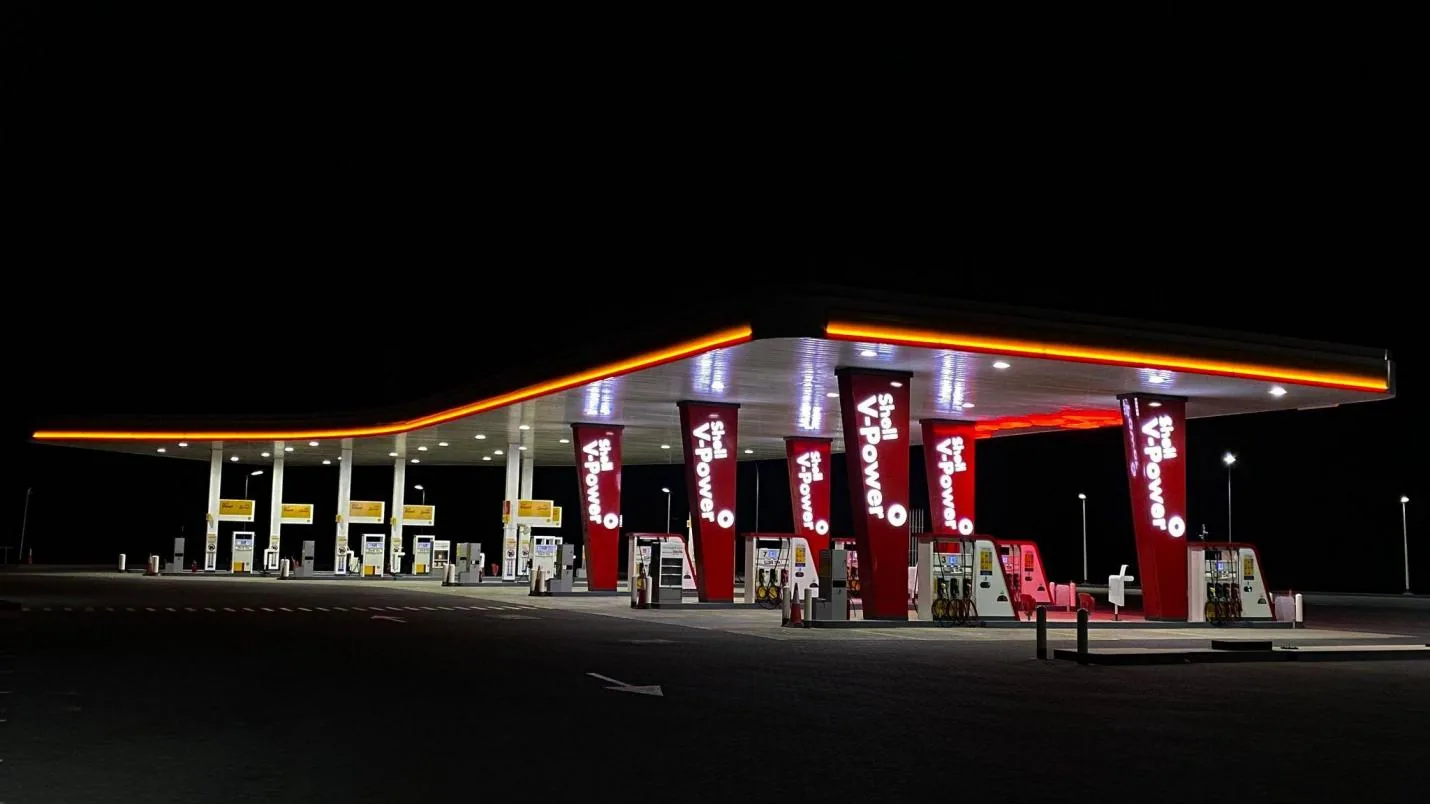
Temperature at the control can differ from outdoors. Sunlight and mounting location both affect it. Check the expected maximum temperature at the actual location against the product rating.
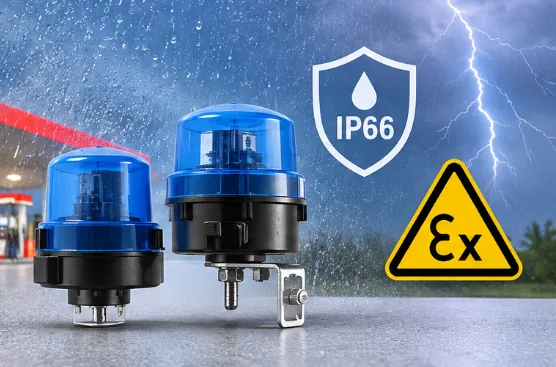
Lead-Top’s LT134 and LT154 are rated −40°C to +70°C.
Rinsing, water jets and chemicals
Forecourts are cleaned with pressure equipment and detergents. Real exposure depends on:
- Method
- Nozzle pressure
- Distance
- Mounting position
| Avaliação | What it covers | Forecourt note |
| IP66 | Powerful water jets | Suits most wash-down exposure |
| IP67 | Temporary immersion | Not automatically better for pressure washing |
- IP ratings do not establish resistance to extended chemical exposure. Confirm that separately.
- LT134 and LT154 are IP66, with optional IP67 configurations. State your cleaning conditions before choosing.
Hazardous-area classification around dispensers
Fuel dispensing areas may be classified as hazardous locations because of flammable vapours. The extent depends on:
- Local regulations
- Site layout
- Project’s hazardous-area assessment
Considerações de segurança
- Don’t assume a standard outdoor photocontrol is suitable inside a classified area.
- Specifications of LT134 & LT154 include ANSI C136.10 & UL773. They do not provide ATEX e IECEx certification.
- Check hazardous location drawings and codes. If needed, locate the photocell lighting sensor outside the area using a rated contactor.
- The electrical designer and HSE department must check the final installation.
Electrical exposure and surge protection
Forecourts that are open are exposed to lightning surges. The EV chargers and other forms of power electronics may introduce additional factors related to power quality.
- MOV energy describes how much energy the varistor can absorb.
- Surge test rating describes the waveform the device was tested against.
- Don’t treat them as interchangeable. Don’t assume EV charging continuously uses up MOV capacity.
What Does Fail-Safe Mean on a Datasheet?
Fail-ON versus Fail-OFF in practice
A project may prefer a configuration that fails toward ON. Don’t confuse the fail-on configuration with emergency lighting. It is important to document the failure mode in the precise configuration.
The role of the MOV
An MOV limits transient overvoltage. It can degrade after electrical stress. Its failure depends on the component and protection design. Some designs add a thermal disconnect to isolate a degraded MOV.
Don’t assume a thermal disconnect keeps the light sensor switch ON. That needs the exact circuit and test evidence.
What should buyers ask the supplier?
- What’s the failure mode for this design?
- Can it be configured as either ON or OFF?
- Which surge protection configuration is provided?
- Is a thermal disconnect used in the MOV circuit?
- What happens to the lighting if the MOV protection reaches end of life?
- Can supporting documents or test reports be provided?
Maintenance and fault visibility
A Fail-ON fault can leave lights burning in daylight, which makes some failures easier to spot. A Fail-OFF fault may need night inspection or remote monitoring. Fail-ON doesn’t remove the need for monitoring, so plan periodic inspection either way.
How Do You Size the Photocontrol for a Canopy?
Switching cycles and service life
Typically there is one OFF and ON cycle per day. However, the control strategy sets the real figure. LT134 and LT154 are rated for more than 15,000 switching operations at rated load. Temperature and load compatibility affect life too.
LED load and inrush current
Often, canopies use many fixtures on grouped circuits. LED drivers may pull high inrush currents during start-up, and wattage alone won’t suffice for compatibility. Check:
- Number of drivers
- Input current per driver
- Inrush peak and pulse duration
- Simultaneous switching conditions
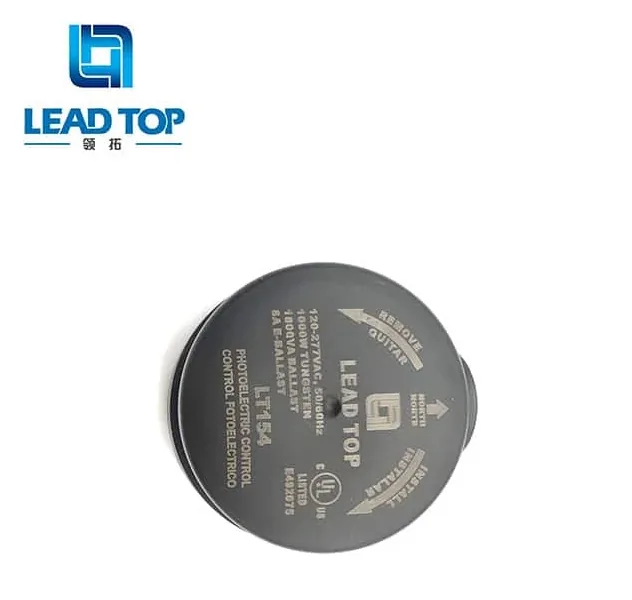
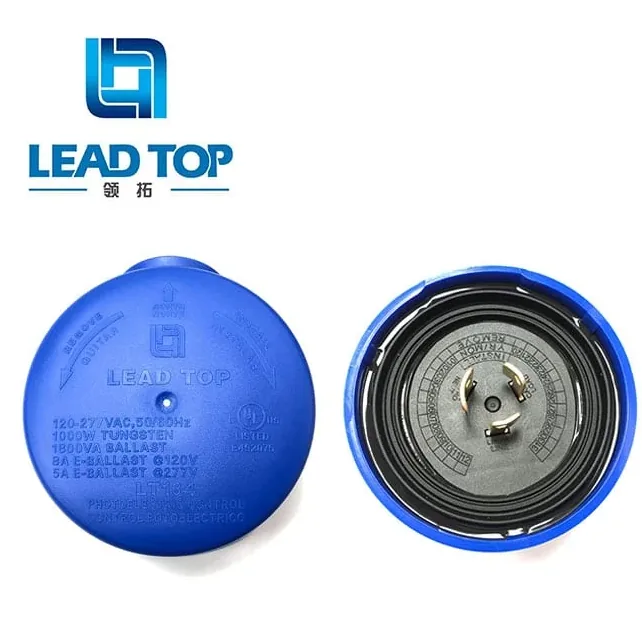
LT134 and LT154 have:
- 8A E-Ballast rating
- Cruzamento zero detection
- High-inrush-current protection
However, that’s not a guarantee that any number of fixtures can be switched directly. Where inrush exceeds the rated capacity, consider a rated contactor with a professionally designed switching arrangement.
Light Sensor position and headlight glare
Headlights can disturb sensing if the sensor faces traffic or direct artificial light. Choose a position with a representative view of daylight.
LT134 and LT154 list a 10–16 luxo turn-on level and a 2–5 second time delay. Don’t treat that delay as enough to reject every passing headlight. Position and site conditions still matter.
Forecourt Specification Checklist
| Item | What to confirm |
| Failure mode | Required ON/OFF behaviour, with documentation for the configuration |
| Temperatura | Maximum at the mounting location; LT134/LT154 are rated −40°C to +70°C |
| Proteção de entrada | IP66 or optional IP67 by actual exposure; detergent compatibility separately |
| Hazardous area | Classification drawing and local code; no non-certified control inside a classified area |
| LED load and inrush | Driver count, total load, inrush, switching arrangement |
| Proteção contra surtos | Site exposure, then the matching MOV and surge-test configuration |
| Sensor location | Away from headlights and artificial light |
| Documentação | Datasheet, IP documentation, surge test information, temperature data, failure-mode information where available |
Which Lead-Top Photoelectric Sensor Models Suit Canopy Lighting?
| Recurso | LT134 | LT154 |
| Tipo | Long-life twist-lock | Trava giratória para serviço pesado |
| Tensão nominal | 120–277 V | 120–277 V |
| Carga nominal | 1000 W / 1800 VA | 1000 W / 1800 VA |
| Classificação LED | Reator eletrônico 8A @ 120 VCA Reator eletrônico 5A @ 208-277 VCA | 8A E-Balasto |
| MOV options | 475J / 950J/1425J | 475J / 525J / 950J |
| Surge options | 6kV/3kA, 10kV/5kA, 20kV/10kA | Same as LT 134 |
| Alternando | Zero-cross, high-inrush protection | Zero-cross, high-inrush protection |
| Programmable | — | Sim |
| Temperatura | −40°C a +70°C | Same as LT 134 |
| Ingress | IP66; IP67 optional | IP66; IP67 optional |
| Endurance | >15,000 ON/OFF at rated load | >20,000 ON/OFF at rated load |
| Garantia | 8 anos | 10 anos |
| Modo de falha | ON / OFF per catalogue; confirm configuration | ON / OFF per catalogue; confirm configuration |
LT134 or LT154?
LT134 Outdoor Automatic Daylight Sensor Switch
For canopy projects that need an 8A E-Ballast-rated, long-life control with suitable surge options.
LT154 LED Streetlight Electronic Controller
For projects that need programmable functions and higher MOV energy options, up to 950J.
Compare the actual surge configuration and control functions before choosing. Neither model should be described as ATEX/IECEx certified. Also, there is no guaranteed Fail-ON without supporting documentation.
Perguntas frequentes
Can a photocell be installed directly on a petrol station canopy?
It depends on:
- Hazardous-area classification
- Mounting position
- Local regulations
Don’t assume a standard outdoor control suits a classified area. The project designer must confirm the permitted location.
What does Fail-ON mean?
It means the documented failure behaviour leaves the lighting ON under the specified failure condition. It doesn’t guarantee light if any of the below-listed components fail.
- The supply
- Breaker
- Contactor
- Motorista
Should I choose IP66 or IP67?
Choose by actual water exposure. Neither rating establishes chemical resistance.
Do EV chargers affect the lighting control?
They can add power-quality considerations. Review the site’s surge environment and protection coordination. Do not assume that EV charging uses up MOV capacity.
Why specify an 8A control if each fixture is only 200W?
Fixture count and driver inrush matter as much as wattage. The 8A rating is a specified limit. It’s not a guarantee for every grouped LED load.
Qual a diferença entre LT134 e LT154?
Both share the 8A rating, zero-cross detection, and high-inrush protection. LT154 adds programmable functions, MOV options up to 950J, and a 10-year warranty, compared to LT134’s 475J/525J and 8 years.
Conclusão
Forecourt canopy photocontrols must meet the site’s electrical and environmental requirements. Evaluate LT134 and LT154 against project specs for high-reliability outdoor lighting. Chumbo-Top offers reliable photocontrollers for demanding outdoor lighting applications. Share your project requirements with Chumbo-Top to compare suitable configurations and obtain the available technical documentation.
Links externos
- https://www.iec.ch/ip-ratings
- https://en.wikipedia.org/?title=LED_driver&redirect=no
- https://www.ansi.org/
- https://www.iec-equipment.com/new/new-31-969.html
- https://www.atexcertified.eu/demystifying-atex-certification-the-key-to-choosing-reliable-and-safe-atex-certified-products/
- https://www.iecex-certs.com/
- https://en.wikipedia.org/wiki/Zero_crossing
- https://en.wikipedia.org/wiki/Lux

 English
 Portuguese (Brazil)
 Spanish
 Russian
 Dutch
 Japanese
 Portuguese (Portugal)