Not sure which certifications to check when choosing a photocell supplier? The answer depends on where the products will be used. Different markets can have different safety and compliance requirements.
UM UL-certified interruptor fotocélula do sensor de luz may be important for a North American project, while European buyers may need to check CE, RoHS, e ALCANÇAR compliance.
But certification is only one part of supplier evaluation. Other important considerations include:
- Especificações do produto
- Controle de qualidade
- Testando
- Production capability
This guide explains which certifications to check and how to verify them before choosing a photocontrol supplier for your lighting project.
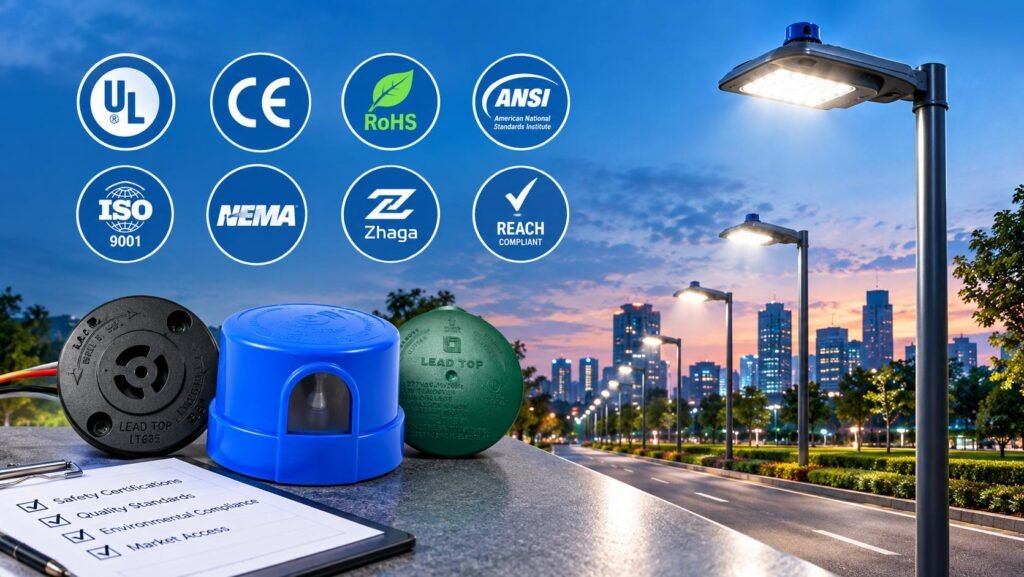
Which Certifications and Standards Matter in Different Markets?
This varies from area to area. A fotocontrole for a U.S. street-lighting project may need different documentation than one sold in the EU. Buyers should first identify the standards that apply to their product and application. Then, they can verify the supplier’s supporting documents.
What Certifications Should You Check for Sensores de luz in North America?
For North American projects, ANSI C136.10 is important for locking-type photocontrols and mating receptacles. The current edition covers physical and electrical interchangeability and testing.
UL certification is another key point for plug-in locking-type interruptores de sensor de luz. UL identifies ANSI/UL 773 as the basic standard used for this product category.
Before ordering, check:
- Applicable ANSI standard
- UL certification or listing
- Exact photocell model
- Electrical ratings and configuration
What Compliance Marks and Standards Matter for European Photocells?
European buyers should check:
- CE
- RoHS
- ALCANÇAR
CE marking indicates conformity with applicable EU product rules. It must not be treated as a general “EU safety certificate.”
RoHS restricts specified hazardous substances in electrical and electronic equipment.
REACH addresses chemical substances and related obligations.
Buyers should request the relevant declarations and technical documentation. The documents should identify the actual product being supplied.
Why Should Buyers Also Check ISO 9001 When Choosing a Photocontrol Supplier?
ISO 9001 is different from a product certification. It sets requirements for an organization’s quality management system. The current edition is ISO 9001:2026.
For a sensor fotoelétrico supplier, it can help buyers assess whether documented quality processes are established and maintained. However, ISO 9001 does not prove that a specific receptáculo de fotocontrole meets other regulatory standards. Buyers should therefore check both:
- Product-level compliance
- Factory-level quality management
Why Should the Target Market Determine Your Certification Checklist?
Certification should start with the destination market, not the supplier’s existing certificate list. Different countries and projects can impose different technical or documentation requirements. EU product rules, for example, require buyers and importers to verify applicable conformity procedures and supporting documents.
Project specifications can also be more specific than general market requirements. A municipal tender may name a particular ANSI standard, safety certification, interface, or test requirement.
Before requesting quotations, identify:
- Destination country and market
- Photocell type and application
- Required electrical ratings
- Applicable standards
- Tender or project specifications
- Required certificates and declarations
This approach prevents buyers from collecting certificates that do not apply to the actual product or project.
Light photocell sensor Certification Checklist by Market
| Market | Certification/Standard | What It Helps Address | What Buyers Should Verify |
| EUA | UL / ANSI-related requirements | Safety and interface compatibility | Exact product and applicable standard |
| Canadá | Applicable Canadian requirements | Product acceptance and safety | Destination-specific requirements |
| EU | CE | Market conformity | Declaration/documentation |
| EU | RoHS | Restricted substances | Compliance documentation |
| EU | ALCANÇAR | Chemical substance requirements | Supplier declaration/supporting documents |
| International | ISO 9001 | Quality management | Factory certification and validity |
What Should Buyers Verify on a Sensor de fotocomutação Certificate?
A certificate is useful only when it matches the product being purchased. Start with the exact model number. Check whether the certificate covers that model and its specific configuration. UL Product iQ, for example, allows buyers to search certification records by model number, file number, and product category.
Before accepting a certificate, verify these details:
- Manufacturer and product model
- Applicable standard
- Organismo de certificação
- Electrical ratings
- Certification or file number
- Current certification status
- Conditions or limitations of use
For CE-marked products, ask for an EU Declaration of Conformity and technical documentation. These documents support the manufacturer’s conformity claim.
Why Is Certification Only One Part of Photocell Supplier Evaluation?
A certificate does not automatically make a supplier reliable. A product certification addresses specific requirements. It does not show the supplier’s complete manufacturing capability or quality process.
Buyers should also examine how the factory controls production. Ask about product testing, inspection procedures, technical documentation, and batch consistency. Mass-production capability also matters when a project requires thousands of photocontrols.
A supplier evaluation can cover:
| Área | What Buyers Should Check |
| Teste de produto | Test methods and equipment |
| Controle de qualidade | Inspection and production controls |
| Documentação | Datasheets, certificates, and test reports |
| Produção | Capacity and consistency |
| OEM/ODM | Custom specifications and configurations |
| Suporte técnico | Pre- and post-sale assistance |
ISO 9001 can provide additional evidence of a structured quality management system. However, ISO 9001 certification applies to the organization’s QMS. It does not replace product-specific certification.
Qual Fotocontrole Products Can Support Different International Lighting Requirements?
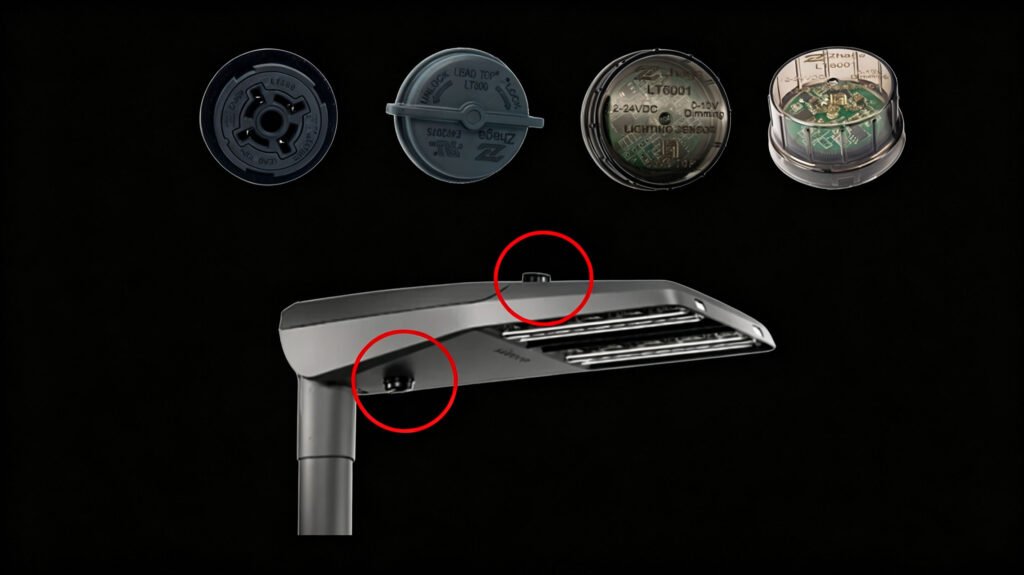
It depends on the fixture, interface, control method, and target market. NEMA photocontrols and receptacles are suited to conventional outdoor and municipal lighting applications. They can be specified around the required ANSI interface and electrical ratings.
For newer connected lighting systems, Conectores Zhaga and sensors provide another option. Lead-Top offers both product categories for different lighting architectures.
Buyers can consider:
- NEMA photocontrols for outdoor ON/OFF control.
- NEMA receptacles for compatible locking-type controls.
- Zhaga connectors for smart-ready luminaires.
- Light sensors for ambient-light-based control.
The key is to match the product with the project’s interface, electrical requirements, control strategy, and destination-market documentation.
Are Certifications the Starting Point or the Whole Picture When Choosing a Photocell Supplier?

Certifications are an important starting point. But are they enough to qualify a photocontrol supplier? No. A certificate confirms specific requirements. It does not show the supplier’s full production capability, testing process, or ability to support a large order.
Buyers should evaluate the supplier across several areas:
● Product compliance
Does the exact model meet the required standard?
● Quality control
How are products inspected during production?
● Testing
What electrical and environmental tests are performed?
● Production capacity
Can the factory maintain consistent bulk supply?
● Documentação
Are certificates, datasheets, and test reports available?
● OEM/ODM support
Can specifications be adapted for the project?
Lead-Top can support international buyers with photocontrol documentation, customization, and factory-direct supply. The right evaluation should consider the product and the supplier together.
Perguntas frequentes
What Certifications Are Important for Photocells in the USA?
UL certification and applicable ANSI standards are commonly relevant for U.S. outdoor lighting projects.
What Certifications Do European Buyers Look for in Photocontrols?
- CE requirements
- Relevant RoHS and REACH compliance documentation
Is ANSI the Same as UL?
No. The former develops standards, and the latter provides safety testing and certification services for products meeting applicable requirements.
What Is the Difference Between CE, RoHS, and REACH?
CE relates to EU market conformity. RoHS restricts certain hazardous substances. REACH addresses chemical use requirements.
Why Should Buyers Check the Exact Model on a Certificate?
A certificate may apply only to specific models and configurations. Thus, the model number should match the photocell being purchased.
Palavras Finais
Certifications are the starting point. However, the right choice also depends on the market and project requirements. Lead-Top supports international buyers with compliant photocontrol solutions, technical documentation, and customization. Contact Chumbo-Top to discuss your certification needs and find a suitable photocontrol solution for your project.


 Portuguese (Brazil)
  English
  Spanish
  Russian
  Dutch
Dutch  Japanese
  Portuguese (Portugal)