In outdoor illumination infrastructure, long-lasted dependability depends not only on design quality but also on proper field handling. This guide explains practical Swivel Stem Control maintenance and real-life adjustable control de fotografía usage considerations based on installation experience instead of theory.
Swivel Stem Control is manufactured to simplify alignment and commissioning. Though, right outdoor photo control handling guarantees that its flexibility supports long-lasted constancy rather than creating needless interference.
This article answers common field questions about adjustment frequency, ecological considerations, wiring protection, and proper swivel stem sensor operation, with reference to products such like Serie LT210CH.

Does Swivel Stem Control Require Regular Maintenance?
Under normal working circumstances, routine Swivel Stem Control maintenance is not compulsory.
The swivel structure is not intended for nonstop motion. Adjustment occurs mainly:
- During installation
- During commissioning
- Occasionally if ecological situations change
Once aligned, the structure remains stationary throughout normal swivel stem sensor operation.
There is:
- No lubrication requirement
- No scheduled tightening interval
- No periodic mechanical servicing
Only standard visual inspections—normally performed during routine illumination upkeep—are enough.
This low-intervention requirement is significant to proper adjustable photo control usage in field applications.
When Should the Sensor Direction NOT Be Adjusted?
Understanding when not to adjust is as significant as knowing when to adjust.
Adjustment is unnecessary if:
- The system switches constantly and certainly
- No new light sources have been introduced nearby
- The sensor is not exposed to glare or reflection
- There are no grievances about timing accurateness
Needless rotation can introduce troubleshooting intricacy. Stable systems should remain undisturbed.
Effective outdoor photo control handling emphasizes restraint. Orientation is a setup step—not a routine maintenance task.
When Is Adjustment Recommended in Field Applications?
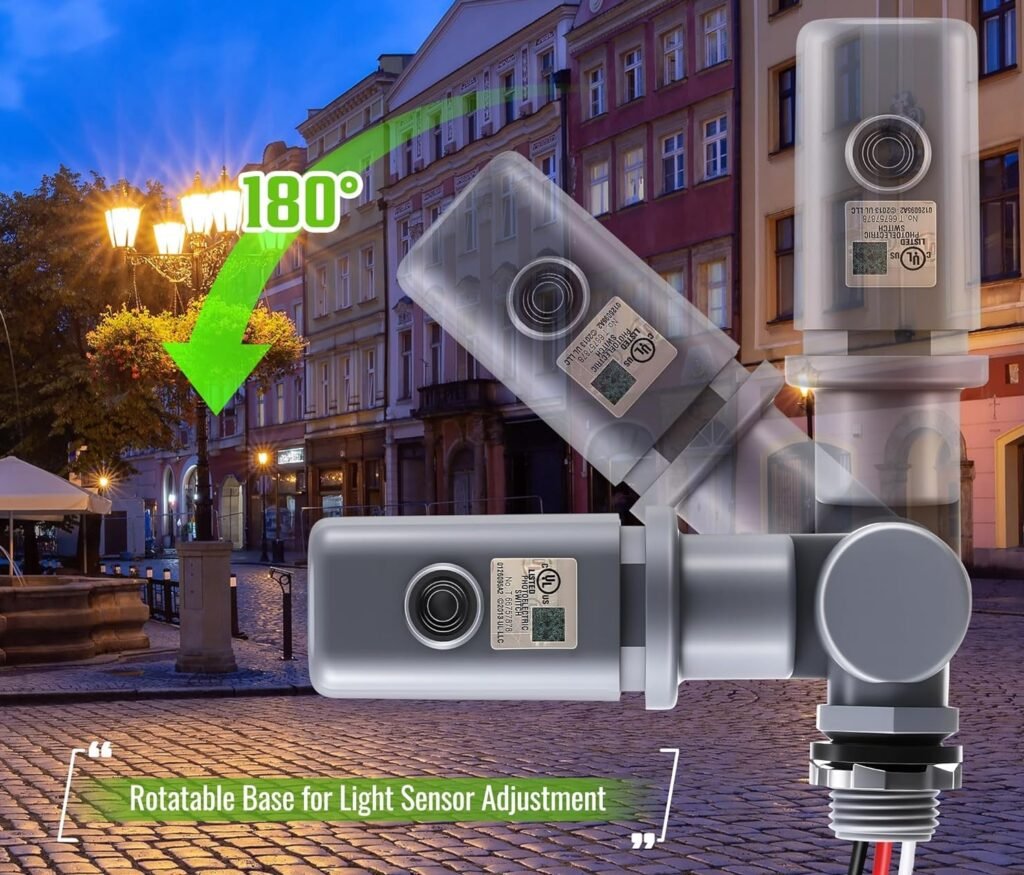
Adjustment should be considered when ecological settings change.
Common triggers comprise:
- Installation of new luminaires in neighboring
- Addition of illuminated signage
- Construction of reflective glass or metal surfaces
- Alteration of pole height or fixture orientation
- Seasonal foliage changes upsetting sky exposure
- Erratic switching behavior crosswise similar fixtures
In these circumstances, adjustment serves as a corrective measure. It is not a trial-and-error experiment but a targeted response.
Proper swivel stem sensor operation depend on optimizing what the sensor “sees,” instead of changing internal electronics.
How Much Adjustment Is Typically Needed?
In most cases, only minor rotation is needed.
Control de vástago giratorio is made for fine directional tuning, not large-angle repositioning. Even small orientation changes can considerably affect switching behavior.
Best practice for adjustable photo control usage includes:
- Make small incremental adjustments
- Observe at least one full evening or dawning cycle
- Evade numerous quick adjustments
- Record changes if managing large installations
This technique averts overcorrection and safeguards steady swivel stem sensor operation.
Can Repeated Adjustment Damage the Mechanism?
Normal adjustment inside the intended mechanical range does not harm the structure.
Though, inappropriate handling can compromise performance.
Avoid:
- Unnecessary force
- Rotating beyond design limits
- Using pliers or tools rather than manual adjustment
- Twisting wiring during rotation
Swivel Stem Control is manufactured for precise setup, not constant mechanical cycling. Responsible Swivel Stem Control maintenance includes respecting the designed adjustment range.
Does Adjustment Affect Wiring or Internal Connections?
When used properly, adjustment does not disturb wiring.
The swivel mechanism is structurally detached from internal electrical connections. During normal swivel stem sensor operation, internal wiring remains safe.
Though, proper outdoor photo control handling needs that:
- Wiring is not under tension before rotation
- The mounting base is firmly fastened
- Adjustment occurs smoothly without sudden force
These safety measures avert stress on internal components and make sure long-lasted dependability.
What Environmental Conditions Should Be Avoided During Adjustment?
Although designed for outdoor use, adjustment should be performed under appropriate conditions.
Avoid:
- Forcing rotation in extreme cold when materials are less flexible
- Adjusting while the device is partially mounted
- Allowing dirt or debris to enter the swivel interface
- Rotating the device while supporting weight improperly
Basic environmental awareness improves Swivel Stem Control maintenance outcomes and conserves enclosure integrity.
How Does Swivel Stem Sensor Operation Differ from Fixed Controls?
The main difference lies in alignment flexibility.
A fixed photo control depends completely on right initial installation. If misaligned, rectification needs exclusion or replacement.
In contrast, proper adjustable photo control usage allows:
- Post-installation fine tuning
- Ecological adaptation
- Corrective rearrangement
- Abridged replacement frequency
This difference considerably improves field proficiency and lifespan value.
How Does This Apply to the LT210CH Series?
The LT210CH series incorporates Swivel Stem Control directly into the housing structural design. The adjustment interface is part of the structural enclosure instead of an external attachment.
This design certifies:
- Sealed enclosure reliability during rotation
- Steady positioning after adjustment
- No give and take to electrical safety
- Simplified field alignment
In most applications, LT210CH series units need no extra Swivel Stem Control maintenance beyond initial setup and occasional rectification if nearby situations change.
What Are the Key Usage Principles for Long-Term Stability?
| Guideline | Field Application Impact |
| Perform adjustment only during installation or environmental change | Reduces unnecessary intervention |
| Use manual rotation only | Prevents mechanical stress |
| Make small, incremental changes | Avoids overcorrection |
| Observe full switching cycle before further adjustment | Ensures accurate evaluation |
| Keep wiring free of tension during rotation | Protects internal connections |
| Avoid adjustment in extreme environmental conditions | Preserves material integrity |
These principles define responsible outdoor photo control handling.
What Are the Most Common Field Mistakes to Avoid?
| Error | Consequence | Prevention |
| Over-adjusting repeatedly | Cambio inconsistente | Allow full cycle observation |
| Using tools for rotation | Mechanism damage | Adjust manually only |
| Ignoring new reflective surfaces | Premature activation | Reassess sensor exposure |
| Adjusting while device is loose | Wiring stress | Secure mounting first |
| Forcing rotation in extreme cold | Material strain | Adjust under moderate conditions |
| Treating adjustment as routine maintenance | Unnecessary system disturbance | Adjust only when needed |
Evading these mistakes guarantees dependable swivel stem sensor operation all through the service life.
How Does Proper Usage Reduce Long-Term Maintenance?
Accurate initial alignment reduces future intervention.
When orientation is improved:
- Switching remains steady
- Energy proficiency increases
- Objection rates decline
- Maintenance visits decline
The thinking behind Swivel Stem Control maintenance is minimalism. Adjustment is a precision setup tool—not a continuing maintenance requirement.
By focusing on proper adjustable photo control usage, field players can preserve dependability while decreasing operating complication.
At Lead-Top, the purpose of Swivel Stem Control is to decrease field interference—not increase it.
The LT210CH series demonstrates how structural adjustability can co-occur with resilience and sealed protection. By entrenching flexibility into the housing design, the product supports practical field use devoid of adding complication.
Lead-Top recommends:
- Highlighting accurate initial alignment
- Evading needless rotation
- Treating orientation as a controlled puesta en servicio step
- Performing adjustment only when ecological circumstances justify it
Through proper outdoor photo control handling, dependable performance can be maintained over prolonged service lifespans with negligible effort.
In contemporary infrastructure, flexibility must be balanced with discipline. Swivel Stem Control offers the flexibility—but long-lasted steadiness depends on responsible field usage.



 Spanish
  English
  Portuguese (Brazil)
  Russian
  Dutch
Dutch  Japanese
  Portuguese (Portugal)