Choosing the right photocell—every so often called a dusk-to-dawn sensor—is no more a insignificant technical decision. In 2025, photocells have become important control components that unswervingly affect energy savings, system dependability, acquiescence, and smart-city readiness. Whether you are an EPC contractor, OEM luminaire producer, utility purchaser, or supplier, choosing the best photocell 2025 needs more than relating prices.
This dusk-to-dawn sensor guide explains how to assess photocells appropriately, compares the top 10 models used globally, and shows how to match each model to real-world applications for instance LED street light controller systems and outdoor lighting automation projects.

How to Choose the Right Photocell? 2025 Top 10 Models Compared
Photocells are the “decision-makers” in outdoor illumination systems. They regulate when lights turn on and off, how dependably they work over time, and whether the system meets monitoring and bid necessities. A below par chosen photocell can cause:
| Failure Outcome | Technical Cause | System-Level Impact | Project / Procurement Consequence |
| Daytime burning (energy waste) | Improper lux threshold, sensor drift, optical contamination, meagre shielding from luminaire light | Lights remain ON during daytime hours | Increased energy usage; greater operative cost; negative energy-saving KPIs |
| Night-time outages (safety risk) | Water admission, thermal instability, relay sticking, false initiating | Lights switch OFF or cycle during dark | Public security objections; liability exposure; emergency maintenance |
| Premature LED driver failure | Non-LED-rated switching, high inrush current, insufficient surge defense | Driver stress, component damage, early letdown | Increased warranty claims; higher replacement and labor cost |
| Tender rejection / non-acceptance | Omitted or inacceptable UL/ANSI/CE/Zhaga certifications | Product fails technical bid requirements | Tender ineligibility; project postponements; fiscal loss |
In contrast, a properly selected NEMA photocontrol or Zhaga photocell increases system constancy, prolongs luminaire lifetime, and supports future smart renovations.
What Are the Key Factors When Selecting a Photocell?
Voltage Compatibility
Photocells must match the electrical characteristics of the luminaire and the local power grid. Common voltage ranges comprise:
- 120–277V (North America)
- 347V (Canada)
- 480V (industrial and highway lighting)
- Full-range 105–305V (export and multi-region projects)
Selecting the incorrect voltage range can lead to high temperature, relay letdown, or unreliable switching. For international OEMs, wide-range photocells decrease SKU complexity and simplify exports—an imperative consideration in any photocell comparison.
Load Type Compatibility
LED luminaires perform very differently from old-style HID or HPS lamps. LEDs introduce:
- High inrush current
- Sensitive electronic drivers
- Quicker switching requirements
Contemporary photocells planned as LED street light controller components use zero-crossing or solid-state technology to decrease electrical stress. Using legacy photocells not enhanced for LED loads is one of the most common reasons of early system letdown.
Weather & Surge Protection
Outdoor illumination atmospheres are severe. Temperature, moisture, dirt, UV radiation, and lightning all damage electronics over time. For dependable outdoor lighting automation, photocells should offer:
- IP66 or IP67 sealing (dust-tight and water-resistant)
- 10–20kV surge protection, specifically in lightning-prone areas
This is predominantly important for projects in the Middle East, Latin America, coastal Asia, and Africa, where surge events are recurrent.
Certification Requirements
Most public and utility bids mandate specific certifications. Common necessities comprise:
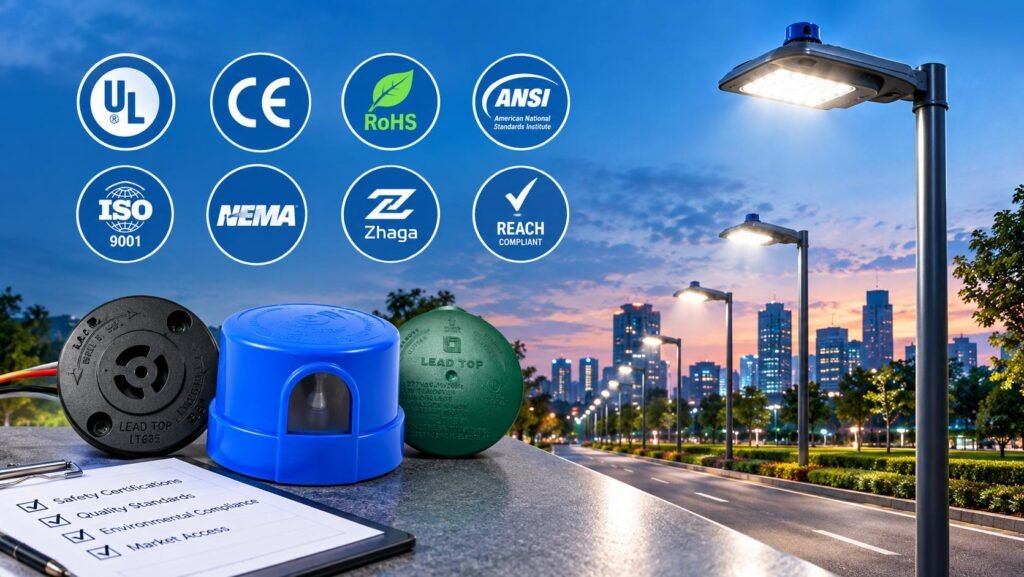
- UL773 (photocontrol safety)
- ANSI C136.10 (twist-lock photocontrols)
- ANSI C136.41 (dimming & smart interfaces)
- CE, CB (global acquiescence)
- Zhaga-D4i (smart city readiness)
Devoid of these consents, even the best photocell 2025 performance-wise may be ineligible at the bidding stage.
Which Are the 2025 Top 10 Photocell Models Compared?
The following photocell comparison is established on performance, resilience, certification coverage, and international acceptance. Rankings mirror real-world market usage—not marketing claims.
Acuity Controls DLL Elite (USA)
Best for: U.S. and Canadian utility networks
Acuity’s DLL Elite chain is extensively positioned by utilities due to its tremendously constant relay performance and stern ANSI acquiescence. It is a benchmark NEMA photocontrol in North America, although pricing is best and customization is restricted.
Lead-Top LT154 Heavy-Duty (China)
Best for: Severe environments & municipal bids
The Lead-Top LT154 stands out as one of the most stable options in the best photocell 2025 category:
- 20kV surge defense
- IP67 sealing with anti-UV PC housing
- 10-year design life
- Verified use in the U.S., Middle East, LATAM
It carries utility-grade resilience at a competitive cost, making it popular amongst EPCs and OEMs.

Fisher Pierce 7571 (USA)
Best for: Legacy utility infrastructure
Fisher Pierce has a extended repute in the photocontrol industry. Model 7571 remains reliable for orthodox grid applications, although it is less stretchy for contemporary smart lighting elevations.
Lead-Top LT134 (China)
Best for: Civic highway projects
The LT134 uses zero-crossing switching to decrease inrush stress on LED drivers. Important features comprise:
- UL773 listing
- 8–10 year service life
- Customizable lux levels and cover colors
It is extensively accepted as a dependable LED street light controller for standard highway fittings.
Shenzhen OEM Model A
Best for: Non-critical commercial use
These models usually bid basic dusk-to-dawn functionality but lack certifications, surge defense, and long-lasted dependability. They are not appropriate for civic or utility bids.
Philips SS2 Series
Best for: High-end EU applications
Philips SS2 photocells highlight accuracy and constancy and are every so often used in smart metropolitan pilots crossways Europe. Though, they are expensive and less customizable for OEM branding.
Zhaga-D4i Photocell Node Model Z18
Best for: Adaptive and connected lighting
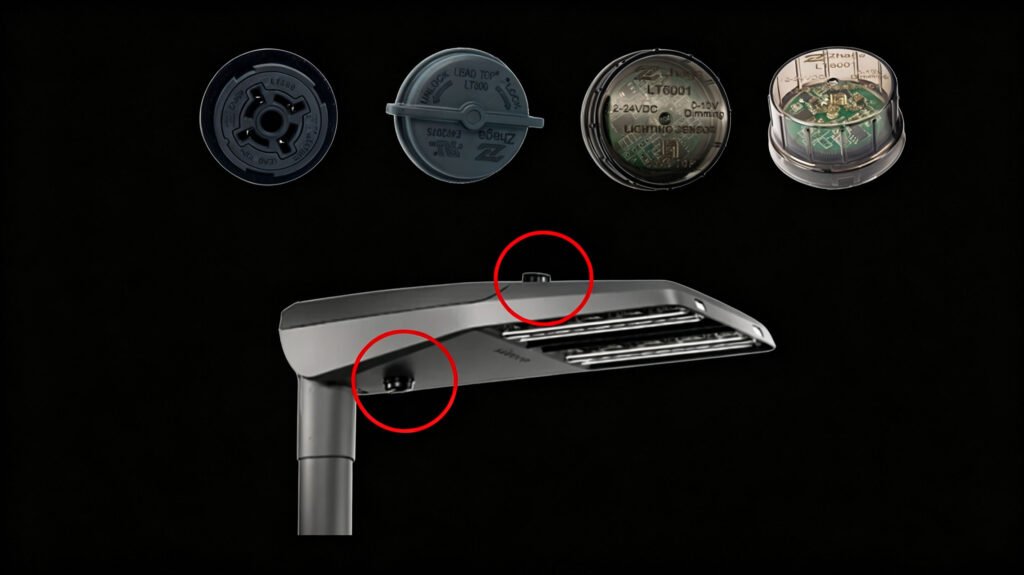
A Zhaga photocell node supports digital communication, sensor incorporation, and data exchange. These are perfect for smart city dispositions but need compatible drivers and control platforms.
Lead-Top LT210 Thermal Type
Best for: Compact luminaires
The LT210 is a thermal-type, wire-in photocell made for inner mounting. It is cost-effecient, compacted, and long-lasting—perfect where external NEMA sockets are not used.
Delixi Photoelectric Switch
Best for: Basic industrial illumination
Delixi photocells offer simple day/night switching devoid of progressive defense or certifications. They are acceptable for controlled environs but not infrastructure projects.
10) Generic Low-Voltage Model (No Brand)
Best for: Transitory use only
These unbranded models lack certification, surge defense, and constancy. They pose substantial dependability and liability risks and are not suggested for professional use.
What Are the Most Frequently Asked Questions About Photocell Selection?
Q1: Can you provide samples for testing?
Yes. Lead-Top offers free samples for assessment and pre-production testing.
Q2: What certifications do your photocells have?
UL, CE, CB, RoHS, ANSI C136.10, ANSI C136.41, IP66/IP67, among others.
Q3: Do you support customization?
Yes. Lux level, color, logo, housing, surge grade, and packing can be customized with no MOQ.
Q4: Which models have won government/EPC tenders?
Lead-Top models LT124, LT124L, LT134, and LT154 have been used successfully in the U.S., Saudi Arabia, Brazil, Mexico, and Southeast Asia.
Q5: What is your delivery time?
3–5 days for samples; 7–20 days for bulk orders depending on quantity.
Conclusion: Which Photocell Should You Choose in 2025?
| Project Requirement | Recommended Solution | Key Technical Reason | Typical Application |
| Maximum resilience & surge confrontation | LT154 Heavy-Duty Photocell | 20 kV surge defense, IP67 sealing, LED-rated switching | Severe environments, freeways, utilities, community bids |
| Cost-efficient, municipal-grade control | LT134 Standard Photocell | UL773 listed, zero-crossing relay, steady long-lated performance | Roadway lighting, metropolitan streets, public infrastructure |
| Smart city / adaptive lighting readiness | Zhaga-D4i Node (not a photocell) | Digital interface, sensor & data communication ability | Smart metropolises, IoT lighting, adaptive control systems |
The correct photocell changes lighting systems from simple lighting into dependable, automatic infrastructure. In 2025, the best photocell 2025 is one that balances resilience, certification, LED compatibility, and smart readiness.
Lead-Top Electrical remains a reliable supplier for OEMs, EPCs, and international distributors by bringing licensed, customizable, and tender-ready resolutions for contemporary outdoor lighting automation.



 English
 Portuguese (Brazil)
 Spanish
 Russian
 Dutch
Dutch Japanese
 Portuguese (Portugal)