Introduction
As municipalities around the world continue upgrading to smart outdoor illumination systems, the demand for standardized, flexible, and easy-to-install illumination control interfaces has increased considerably. Contemporary smart street lighting interface technologies are no more restricted to basic photocontrol sockets. In its place, cities, illumination manufacturers, and smart city developers are approving modular systems that support wireless communication, remote monitoring, dimming, and future smart city growth.
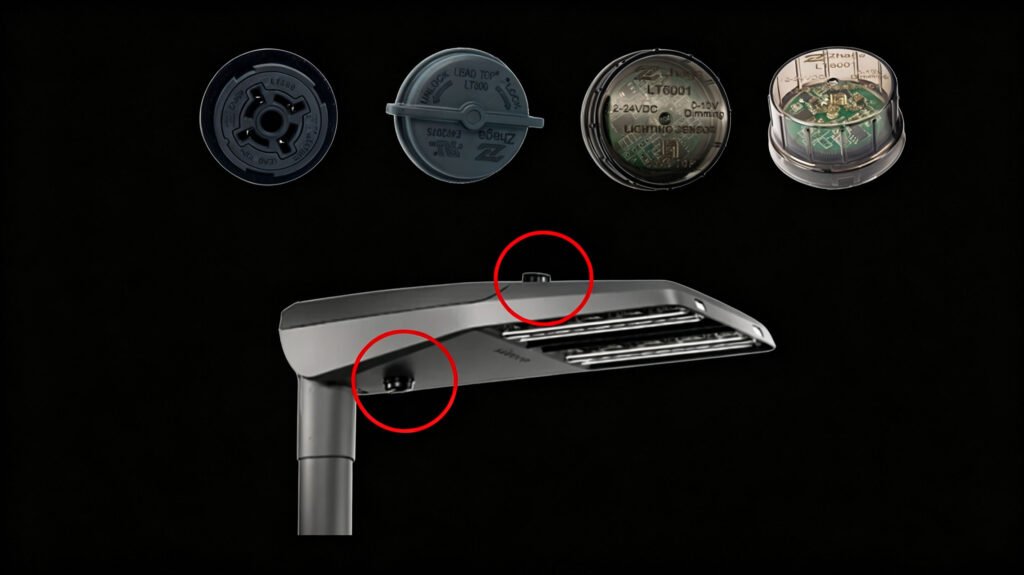
One of the most broadly accepted standards allowing this makeover is the ANSI C136.41 receptacle. Intended to offer a standardized electrical and mechanical connection between luminaires and smart illumination controllers, this interface streamlines installation while guaranteeing compatibility across different producers.
Amongst the modern innovations in this field is the LT635 receptacle, a 360° tool-less rotatable receptacle that provides enhanced installation flexibility, better signal orientation, and stress-free maintenance. By merging a 7-pin NEMA socket with a fully rotatable design, the LT635 helps contractors and cities to cut installation time while preparing illumination infrastructure for future smart city applications.
In this article, we elucidate how the ANSI C136.41 receptacle works, why rotation and tool-free adjustment matter, and why products like the LT635 receptacle are becoming progressively popular in contemporary outdoor illumination projects.

What Is an ANSI C136.41 Receptacle?
The ANSI C136.41 receptacle is an industry-standard electrical interface planned specially for smart outdoor illumination systems.
Dissimilar to orthodox photocontrol sockets that only offer power switching, this interface supports both power delivery and communication signals, permitting smart controllers to manage illumination more proficiently.
Depending on project needs, the receptacle is usually available in:
- 3-pin configuration
- 5-pin configuration
- 7-pin NEMA socket configuration
The 7-pin NEMA socket is mainly popular because it supports additional control wiring required for innovative illumination applications such as:
- 0–10V dimming
- DALI control
- Smart nodes
- Wireless communication modules
- Illumination management systems
Because the interface follows ANSI standards, producers can develop compatible smart devices devoid of requiring custom socket designs for each illumination project.
This standardization streamlines procurement, maintenance, and future advancements while prolonging the service life of municipal illumination infrastructure.
Table 1. ANSI C136.41 Receptacle Configurations
| Configuration | Typical Function | Common Applications |
| 3-Pin | Basic power switching | Standard photocontrols |
| 5-Pin | Power + control signals | Dimming applications |
| 7-Pin NEMA Socket | Power + advanced communication | Smart nodes, IoT lighting, DALI, 0–10V control |
What Does a 360° Rotatable Design Mean?
One of the most valued inventions in contemporary illumination interfaces is the rotatable receptacle.
Old-style receptacles are fixed after installation, meaning the orientation of the connected smart node or controller cannot easily be attuned. Unluckily, this may cut wireless communication performance if antennas face an unfavorable direction.
A 360° rotatable receptacle solves this problem.
After installation, installers can rotate the connected device through a full 360 degrees devoid of removing the receptacle from the luminaire.
This offers some important advantages:
Improved Wireless Signal Performance
Communication modules often do best when antennas face a particular direction. Rotation permits installers to optimize antenna positioning for stronger and more dependable communication.
Greater Installation Flexibility
Streetlamp poles, highway layouts, and mounting positions vary significantly. A rotatable design permits installers to adjust quickly to different site situations.
Easier Smart Node Alignment
Numerous smart city devices need precise positioning for GPS reception, wireless communication, or sensor orientation. Rotation makes these tunings much simpler.
Reduced Installation Errors
Rather than uninstalling and reinstalling components, specialists simply rotate the controller until the preferred orientation is achieved.
What is a tool-free socket?
A tool-less receptacle is intended to simplify field tunings after the initial installation.
Although a screwdriver or similar tool is required to mount the receptacle during the first installation, subsequent modifications can be completed without additional tools.
This provides some operational benefits.
Faster Field Installation
Engineers can relocate controllers quickly devoid of carrying specialized tools.
Lower Labor Costs
Reducing adjustment time cuts overall installation expenditures, particularly during large municipal illumination projects.
Easier Maintenance
When smart nodes need replacement or relocation, maintenance teams can complete the task more proficiently.
Improved Contractor Productivity
Less time spent making adjustments means teams can complete more installations each day.
These advantages become especially valuable in extensive smart street lighting interface deployments involving thousands of luminaires.
What Makes the LT635 Receptacle Different?
The LT635 receptacle is specially engineered to meet the developing needs of modern smart illumination infrastructure.
It combines numerous advanced features into a single compact solution.
Main Features
- 360° rotatable receptacle
- Tool-less adjustment
- ANSI C136.41 receptacle acquiescence
- 7-pin NEMA socket
- Smart node compatibility
- DALI and 0–10V support
- Resilient outdoor construction
- Outstanding weather resistance
- Dependable electrical performance
Typical Applications

The LT635 receptacle is appropriate for:
- Smart street illumination
- Municipal road illumination
- Freeway lighting
- Smart pole systems
- Parking lot illumination
- Smart city infrastructure
- Outdoor commercial illumination
- Wireless illumination control projects
Because it conforms with ANSI standards, it incorporates easily with many commercially available smart controllers and communication nodes.
Table 2. LT635 Receptacle Benefits
| Feature | Benefit |
| 360° Rotatable Design | Optimizes smart node orientation |
| Tool-less Adjustment | Faster installation and maintenance |
| ANSI C136.41 Compliance | Broad industry compatibility |
| 7-Pin NEMA Socket | Supports advanced dimming and communication |
| Smart Node Compatibility | Ready for connected lighting systems |
| Weather-Resistant Construction | Reliable outdoor performance |
| Modular Design | Simplifies future upgrades |
Why Is the Lighting Industry Moving Toward Modular Smart Interfaces?
Outdoor illumination is quickly progressing from standalone lighting into smart infrastructure.
Modern luminaires progressively support:
- Wireless communication
- Remote diagnostics
- Adaptive illumination
- Energy monitoring
- Predictive maintenance
- Sensor integration
A modular smart street lighting interface makes this possible.
Municipalities can simply upgrade the connected controller, communication module, or sensor rather than swapping the luminaire.
By providing protection to long-term infrastructure investments, this methodology also decreases lifespan costs, reduces maintenance interruptions.
By permitting cities to evade vendor lock-in and choose compatible devices from multiple producers, open standards such as ANSI C136.41 receptacle technology also encourage interoperability.
Frequently Asked Questions (FAQ)
What Is ANSI C136.41 Used For?
The ANSI C136.41 receptacle offers a standardized interface for connecting smart illumination controllers, dimming systems, and communication modules to outdoor luminaires. It permits interoperability and streamlines future advancements.
What Is a Rotatable Receptacle?
A rotatable receptacle permits connected smart devices to rotate through 360 degrees after installation. This improves antenna orientation, installation flexibility, and communication performance.
Why Is Tool-less Design Important?
A tool-less receptacle lessens installation and maintenance time by permitting engineers to adjust connected devices devoid of using additional tools after the initial installation.
Is the LT635 Compatible with Smart Nodes?
Yes. The LT635 receptacle is intended to support smart illumination controllers, wireless communication nodes, and advanced illumination management systems through its 7-pin NEMA socket configuration.
Conclusion
As outdoor illumination continues its changeover toward smart, connected infrastructure, standardized interfaces have become just as significant as the illumination fixtures themselves. The ANSI C136.41 receptacle offers a dependable basis for integrating smart controllers, dimming systems, and communication modules into modern street illumination networks.
Novelties such as the 360° rotatable receptacle and tool-less receptacle design considerably improve installation proficiency, streamline maintenance, and offer greater flexibility for aligning smart nodes in the field.
The LT635 receptacle combines ANSI acquiescence, a 7-pin NEMA socket, full 360-degree rotation, and tool-free adjustment into a single solution intended for today’s smart street lighting interface requirements. Whether used in road illumination, smart pole applications, or connected city infrastructure, it provides trustworthy perfor
mance and long-lasted scalability.
Call to Action (CTA)
Lead-Top specializes in OEM and ODM illumination control solutions, including the LT635 receptacle, ANSI C136.41 receptacles, photocontrols, and smart illumination connectivity components. Our engineering squad can provide technical supervision, product customization, and reliable manufacturing support to meet your project requirements.
Contact Lead-Top today to request technical specifications, discuss your application, or receive expert recommendations for your next smart lighting project.



 English
 Portuguese (Brazil)
 Spanish
 Russian
 Dutch
Dutch Japanese
 Portuguese (Portugal)