Highway and industrial lighting are where 347V and 480V light photocell sensors actually live, and the two applications ask for different things.
- A highway pole sits in open terrain, far from the next one, exposed to lightning and to oncoming headlights.
- An industrial yard sits behind a plant full of VFDs and welding equipment, switching banks of large LED floods.
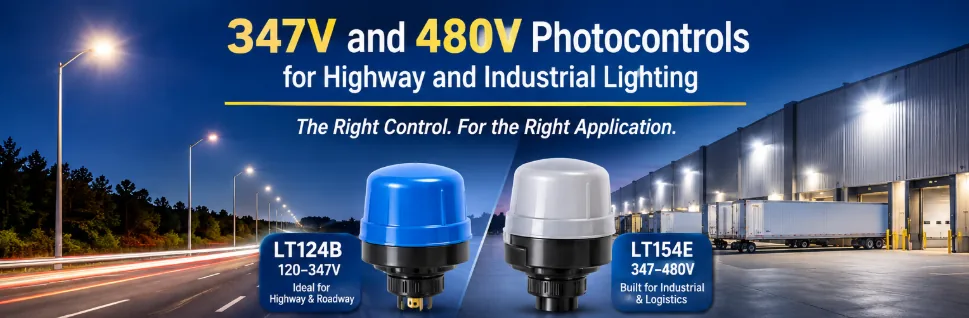
Both need a photocell sensor rated for the system voltage. Neither needs the same control. This guide covers two Lead-Top high-voltage twist-lock photocontrols:
- LT124B (120–347V)
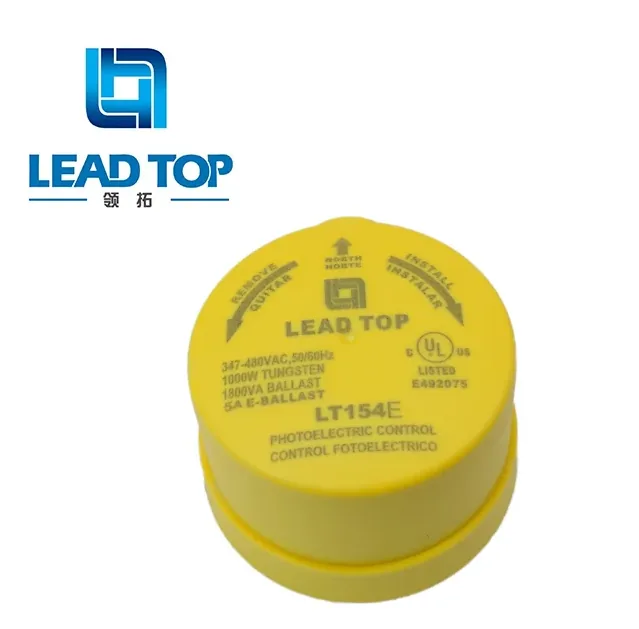
- LT154E (347–480V)
It explains which application conditions drive which specifications, so the choice can be defended in a submittal.
Where Do 347V and 480V Come From?
It’s important to know the source of the voltage. This will change how you read a datasheet.
- 347V is a Canadian roadway voltage. It is the phase-to-neutral value of a 600Y/347V system, common in highway, arterial, and commercial lighting.
- 480V lighting circuits are common in US industrial systems. Note that a 277/480V system gives 277V phase-to-neutral. A 480V luminaire circuit is connected across two phases.
Either way, the photocontrol must hold off 347V or 480V continuously, not 120–277V. That changes three things:
Arc interruption
Each dawn switch-off breaks a more energetic arc at higher voltage. This drives contact material, gap, and creepage. A 120–277V unit cannot simply be relabelled for 347V.
MOV selection
The varistor needs a higher maximum continuous operating voltage as well as enough energy capacity. One sized for 277V sits too close to its own threshold on a 480V circuit.
Project scope
For 120–277V projects, the LT124 and LT124L cover the range.
What Does the Highway Lighting Application Demand, And Which Spec Does It Drive?
Surge exposure is high
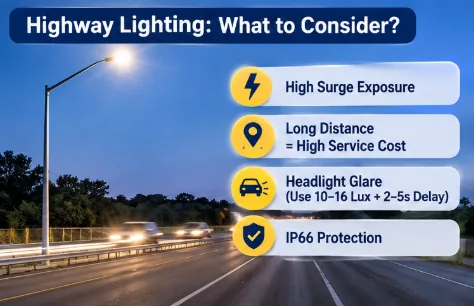
Poles placed in open corridors tend to be the tallest items in the vicinity and may induce surges from lightning strikes nearby through overhead lines.
In this case, the surge protection ratings (6kV/3kA vs. 10kV/5kA) and the joule rating of MOVs (342J on LT124B, 475J on LT154E) affect maintenance costs.
Distance makes every failure expensive
A photocell switch kilometres from the depot can mean a truck roll, lane closure, and traffic management for one failed unit. Switching-cycle rating and a sealed enclosure matter. That is why IP66 is standard, and IP67 is available on request.
Headlight glare is a highway-specific failure mode
Median-mounted or low-mounted controls can see oncoming headlights and switch the lights off mid-evening. The defence is a 10–16 lux light-level threshold plus a 2–5 second time delay to reject a passing vehicle.
Per-pole or cabinet-level control?
Both designs exist. If circuits are grouped at the service cabinet, the same voltage and surge logic applies. This guide covers per-luminaire twist-lock control in a NEMA socket. Confirm which design the project uses before ordering.
Canadian roadway projects usually mean 347V. This points to the LT124B. Confirm from the drawings, not the project name.
What does the Industrial and Logistics Lighting application demand?
Load comes first
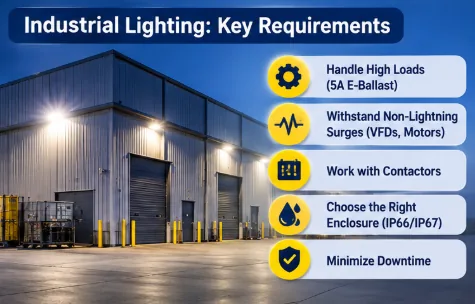
Plants, yards, ports, and distribution centres use large LED floods and high-bay fixtures with high inrush current. The 5A E-Ballast rating is the floor. The LT154E’s high-inrush current protection is aimed at this kind of switching duty.
Surges are not only lightning
Transients from VFDs, welders, capacitor bank switching, and large motors are repetitive transients on the same distribution. Using up the joule budget will be faster; hence the need for high MOV ratings.
Contactors are common
In multi-fixture circuits, the photocontrol will be responsible for energizing the coil of the contactor rather than the fixtures themselves. You will need to check whether the inrush and VA requirements of the coil match those of the control. If not, you may experience contact welding.
Air quality decides the enclosure
Chemical plants, wash-down areas, and coastal yards may need IP67.
Downtime is a safety issue
In 24/7 operations, a failed-OFF control on a loading yard is an incident.
US industrial projects at 480V point to the LT154E.
How does LT124B Compare With LT154E?
| Specification | LT124B | LT154E |
| Typical application | Canadian 347V highway, arterial, commercial | US 480V industrial, logistics, highway |
| Rated voltage | 120–347V | 347–480V (277–528V multi-voltage build on request) |
| Low-voltage operation | Down to 80V AC | Within rated range only |
| Load | 1000W / 1800VA | 1000W / 1800VA |
| LED rating | 5A E-Ballast | 5A E-Ballast |
| Switching | Zero-cross | Zero-cross |
| Inrush protection | — | High-inrush current protection |
| MOV energy | 342J | 475J |
| Surge level | 6kV/3kA typical, 10kV/5kA enhanced | 6kV/3kA typical, 10kV/5kA enhanced |
| Turn-on level | 10–16 lux | 10–16 lux |
| Time delay | 2–5 seconds | 2–5 seconds |
| Ingress protection | IP66; IP67 on request | IP66; IP67 on request |
| Switching cycles | >10,000 at rated load | >10,000 at rated load |
| Operating temperature | −40°C to +70°C | −40°C to +70°C |
| Standards | ANSI C136.10, UL 773 | ANSI C136.10, UL 773 |
The 347V Decision Rule: Why Range Position Of Lighting Control Matters
Both models list 347V, but in opposite positions. It is the top of the LT124B range and the bottom of the LT154E range.
- A 347V nominal system can sag. A control whose range starts at 347V has little room below nominal.
- The LT124B is specified down to 80V AC. So 347V sits inside its range with margin on both sides.
- Rule of thumb
- 347V nominal points to LT124B. 480V nominal points to LT154E.
- For wide supply variation at 480V, the LT154E is available in a 277–528V multi-voltage build. Ask before designing around a standard unit.
What Are Five Checks Before You Submit the Specification for an Automatic Light Sensor?
Circuit voltage
Read it from the panel schedule and drawings, not the fixture label.
Load and inrush
Check connected load and driver inrush against the 5A E-Ballast rating. On industrial circuits, check the contactor coil too.
Receptacle rating
The ANSI C136.10 interface is standard, but confirm the base itself. The LT615 family is rated 480V/15A.
Surge tier and joules together
Choose 6kV/3kA or 10kV/5kA by exposure. Read the MOV figure for service life.
Documentation
Request the datasheet and surge test report. Highway and industrial work is normally inspected.
Which Lead-Top Products Should You Consider?
LT124B Photo Electric Light Control Switch: Highway and roadway, 347V
120–347V, 342J MOV, 5A E-Ballast, zero-cross switching, IP66 standard with IP67 on request. Its wide operating range runs down to 80V AC. See the LT124B product page.
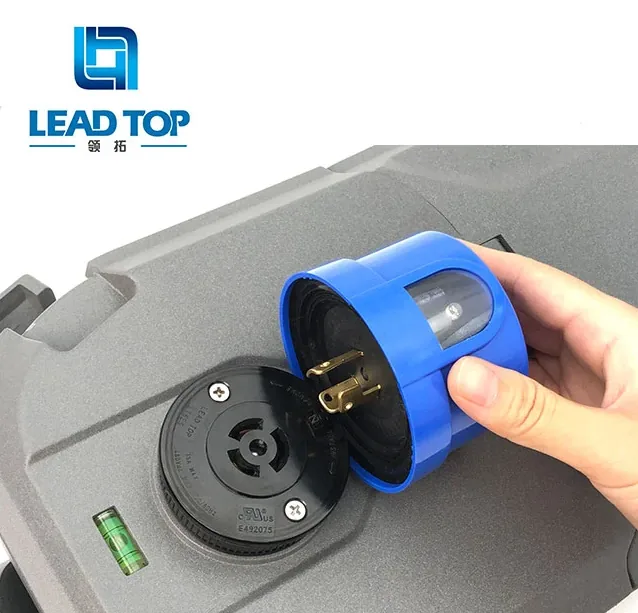
TWIST-LOCK PHOTOELECTRIC SWITCH LT154E : Industrial, logistics, and highway, 480V
347–480V (277–528V on request), 475J MOV, high-inrush current protection, 5A E-Ballast, IP66 standard with IP67 on request. See the LT154E product page.
Standard 120–277V projects
The LT124 and LT124L cover this range. See their product pages.
FAQ
What is the difference between a 347V and a 480V photocell?
They serve different systems. 347V units are built for 600Y/347V circuits, common in Canadian roadway and commercial lighting. 480V units are built for 480V lighting circuits. This is common in US industrial systems. The difference is the continuous voltage the control must hold off, which sets contact design and MOV selection.
Can I use a 120–277V street light controller on a 347V circuit?
No. It would run above its rated voltage, overstressing the MOV and contact insulation. A 347V-rated model is required.
Which model for a 347V highway project?
The LT124B. Its range runs 120–347V and operates down to 80V AC, so a sagging 347V supply stays within its range.
Which model for a 480V industrial yard?
The LT154E, rated 347–480V, with high-inrush current protection for large LED floods and high-bay fixtures. A 277–528V build is available for wide supply variation.
Why does my highway photocell switch the lights off at night?
Often, it is headlight glare reaching the sensor. A 10–16 lux threshold plus a 2–5 second delay helps reject a passing vehicle. Persistent switching may need a shielded mounting position.
Do these models need a special receptacle?
No. Both have the ANSI C136.10 three-pin twist-lock type of connection. Confirm the installed base is rated for the system voltage. The LT615 family is rated 480V/15A.
What documentation should I request before approval?
- The datasheet
- The surge test report (waveform, applied voltage and current, pulse count)
- The MOV energy rating
Final Words
Highway and industrial lighting need controls rated for the system voltage. But they stress the controls in different ways. Send Lead-Top the system voltage. The team can confirm the model and return a quotation with the datasheet and surge test report.


 English
 Portuguese (Brazil)
 Spanish
 Russian
 Dutch
 Japanese
 Portuguese (Portugal)