The European Union is not simply reinforcing regulations—it is restructuring how every electronic product is documented, licensed, and assessed crosswise its complete lifespan. For producers of outdoor illumination controls, this swing goes far outside customary acquiescence with electrical safety or EMC standards. It now touches carbon reporting, digital traceability, repairability, circularity, and supply chain clearness.
Lead-Top, with its long-standing engineering and manufacturing impression in metropolitan illumination components, is by now exclusively prepared for this renovation. This article illuminates the monitoring environment and explains exactly how Lead-Top photocells line up with the EU’s approaching sustainability demands—not reactively, but proactively.

What Is the Real Difference Between EN 18031 and LCA Requirements?
A noteworthy amount of misperception just surfaced in the illumination manufacturing, specially around the claim that:
“CEN/TS 18031:2025 will mandate LCA documentation for all streetlighting controllers starting September 1st.”
Afterwards cautiously revising EU controlling publications, harmonised standards lists, and committee drafts, the reality is clear:
Is EN 18031 actually about carbon footprint?
No. The EN 18031 (2024 series) is part of the Radio Equipment Directive (RED) and emphases on cybersecurity, secrecy, and data fortification for radio-capable or linked devices. These criteria are designed to safeguard:
- safe firmware,
- resistant communication protocols,
- defense against unapproved access,
- and safe data handling.
These requirements do not address ecological metrics such as material composition, recyclability, or lifespan carbon emanations.
If EN 18031 is not the source, where is the environmental pressure coming from?
The real drivers are three main controlling frameworks:
- ESPR – Ecodesign for Sustainable Products Regulation
Expands ecodesign philosophies to all physical products, compelling producers to circularity, recyclability, and carbon transparency. - DPP – Digital Product Passport
A digital record knotted to every product that stores lifespan data, reparation options, material composition, and carbon values. - CSRD – Corporate Sustainability Reporting Directive
Needs thousands of EU firms to report auditable Scope 3 emissions, which compels OEMs to demand proved data from every component supplier.
What does this mean?
Though no EU law needs photocell constructers to generate LCA/EPD today, the market does:
- Municipal tenders progressively award points for carbon transparency.
- OEM customers subject to CSRD demand supplier data to complete their own reports.
- Future DPP rules will standardize lifespan carbon and circularity disclosures.
So, providers who cannot offer dependable LCA/EPD data will face a new kind of blockade—not legal, but commercial.
What This Means for Street Light Control Products?
1. Tender Advantage
Crossways Europe, specially in Scandinavia, Germany, and the Benelux region, bids now award points for:
- EPD (Environmental Product Declaration)
- LCA reports
- material transparency
- repairability
- waste minimization
Even when these documents are “optional,” the scoring makes them conclusive. Auction-goers short of them can lose 5–18 points, sufficient to lose the whole tender.
2. Supply Chain Integration
Main OEMs—platform corporations, illumination producers, IoT integrators—are now lawfully need to report Scope 3 emissions. They cannot do this devoid of:
- material composition,
- product carbon footprint (PCF),
- recyclability data,
- packaging footprint,
- energy usage profile.
This efficiently turns photocell manufacturers into mandatory carbon data suppliers. Firms lacking proper certification risk losing main OEM partnerships.
3. Future-Proofing with DPP
When DPP becomes applicable to lighting components (likely 2027–2028):
- Each photocell or controller will need a distinctive ID or serial code.
- Every serial number must be connected to:
- lifespan carbon data
- reparation directives
- material composition
- end-of-life guidance
Lead-Top’s manufacture and serialization systems by this time make this changeover simple.
What Is Lead-Top’s Competitive Advantage in This Sustainability-Driven Market?
Lead-Top’s manufacturing philosophy—positioned on resilience, modularity, and traceability—directly line up with developing sustainability rules.
1. Built-In Reliability
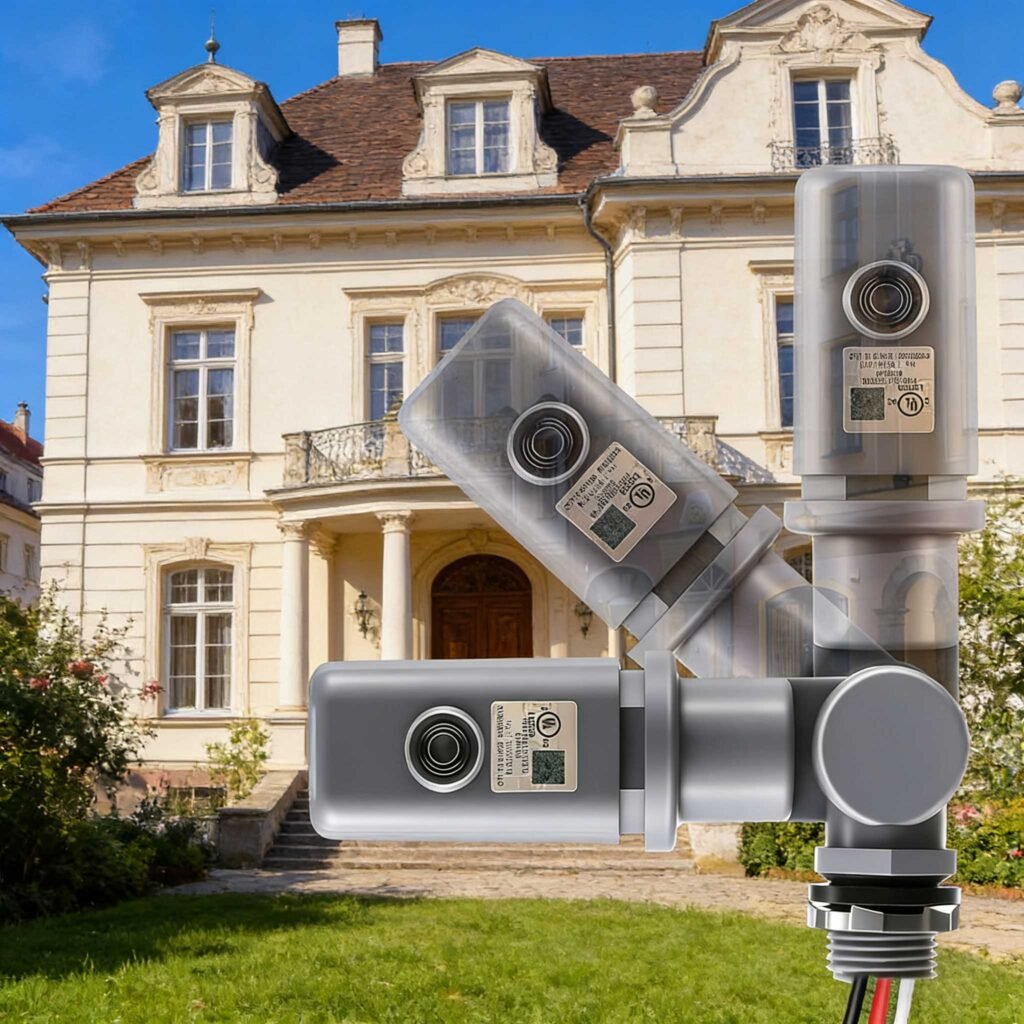
The LT134 and LT154 series are made for elongated service life:
- Zero-crossing technology decreases switching tension.
- High inrush endurance guards internal components from LED driver surges.
- IP66/67 guarantees long lasted confrontation to ecological exposure.
- Surge protection (up to 20kV/10kA) reduces fiasco risk even in severe electrical networks.
Extensive lifecycle =
less replacements → less upkeep truck rolls → lesser Scope 3 emissions.
This is precisely why many bids now score “anticipated service life” as a sustainability criterion.
2. Customization & Modularity = Repairability
Under ESPR and future DPP rules, products with greater repairability gain market significance.
Lead-Top photocells outshine here through:
- Replaceable housings
- Swappable sensors/LDR modules
- Modular gasket design
- Low-MOQ customization for parts
This modularity offers:
- improved circularity,
- prolonged lifecycle,
- and greater repairability scores.
3. Certified & Ready
Lead-Top grips a complete certification assortment:
- UL773
- ANSI C136.10 / C136.41
- Zhaga Book 18
- CE, CB
- ISO9001 factory certification

Joint with an yearly manufacture capacity above 5 million units, these authorizations assure metropolises and OEMs that Lead-Top is not only technically skillful but operationally stable.
4. Fast Delivery, Flexible Manufacturing
In sustainability-driven markets, nimbleness is a competitive benefit.
Lead-Top offers:
- 2–3 days: sample production
- 7 days: 500–1000 pcs
- 15 days: 1001–5000 pcs
This allows:
- fast prototyping for trial projects,
- rapid alterations to developing standards,
- and quick alteration to new categories like:
- low-CCT wildlife-friendly “turtle lighting”
- solar streetlight photocontrols
- EPD-enhanced tender specifications
12-Month Action Roadmap for EU Compliance
| Phase | Action | Outcome |
| Q4/2025 – Preparation | Map BOM → LCA data for LT134, LT154, LT600 | Define system boundaries |
| Q1/2026 – Validation | Conduct pilot LCAs + draft EPDs | Verified carbon baseline |
| Q2–Q3/2026 – Publication | Release bilingual EPD summary cards | Higher tender scoring |
| Q3/2026 onward – Scaling | Link LCA data to QR/DPP cloud | Ready for ESPR rollouts |
This timeline places Lead-Top ahead of regulatory deadlines.
Low-Cost, High-Impact Moves
Lead-Top is by this time applying numerous cost-effective promotions:
1. What Material Changes Can Improve Carbon and Circularity Scores?
- Recycled polycarbonate housings
- Halogen-free flame retardants
- Stainless steel with higher recycled content
- Lower-weight packaging
2. How Can Transportation Footprint Be Reduced?
- Enhance packing thickness
- Swing consignments to ocean or rail
- Include carbon-intensity metrics on invoices
3. How Can Customers Meet Their CSRD Obligations?
Lead-Top can deliver Supplier Sustainability Data Packs counting:
- Product Carbon Footprint (PCF)
- Recyclability percentages
- Replaceable component list
- Packaging material breakdown
This data benefits OEM companions directly fill CSRD modules.
Conclusion: Why Are Lead-Top Photocells a Future-Proof Choice for EU Markets?
Lead-Top combines:
- DLC-ready electronics
- Extensive dependability
- EPD/LCA-compatible data
- DPP-prepared serialization
- Modular, repairable designs
The result?
- Lower Scope 3 emissions
- Higher tender scores
- Less maintenance cost for municipalities
- Better compliance for OEMs under CSRD
| Lead-Top Advantage | Why It Matters for EU Sustainability Requirements |
| DLC-ready electronics | Meets advanced performance and efficiency criteria required in many EU tenders. |
| Extensive dependability | Longer lifespan reduces replacements, lowering carbon impact and minimizing maintenance operations. |
| EPD/LCA-compatible data | Supports environmental reporting, carbon footprint calculation, and ESG documentation demanded by municipalities and OEMs. |
| DPP-prepared serialization | Ready for Digital Product Passport integration, enabling traceability, repairability, and lifecycle transparency. |
| Modular, repairable designs | Aligns with ESPR and circular economy standards by extending product life and improving repairability scores. |
Lead-Top photocells aren’t just built for today—they’re engineered for the sustainability standards of tomorrow.



 English
  Portuguese (Brazil)
  Spanish
  Russian
  Dutch
Dutch  Japanese
  Portuguese (Portugal)