In outdoor illumination projects, photo controls are often observed as simple accessories instead of a performance-critical components. As a result, selection decisions are recurrently made late in the design process, under time pressure, and with restricted site-specific insight. When performance problems later appear, the photo control is blamed—even though the root cause is almost always an early selection decision.
Actually, most photo control selection mistakes do not stem from product flaws. They initiate from improper assumptions about installation circumstances, ecological constancy, or the capability of electrical settings to compensate for structural restrictions. Understanding these faults permits engineers to avert costly downstream rectifications and guarantee dependable long-lasted operation.

Why Do Most Photo Control Problems Originate from Selection Rather Than Failure?
Contemporary photo controls are generally vigorous and electrically dependable. When fiascoes occur in the field, they are more often performance failures than hardware failures. Lights may switch too early, too late, or contradictorily—but the device itself is usually working as intended.
These problems fall under outdoor lighting control errors, where the sensor is reacting perfectly to the light it “sees,” but the light it sees is not representative of environmental conditions. This incompatibility is almost always determined by structure and orientation, not electronics.
Why Is Assuming Sensitivity Adjustment Can Fix Orientation a Mistake?
One of the most common photo control selection mistakes is assuming that sensitivity or delay settings can compensate for poor sensor orientation.
When switching behavior seems improper, the first instinct is often to adjust sensitivity. While these settings fine-tune response thresholds, they cannot change the direction from which light enters the sensor.
If a sensor is exposed to mirrored light, neighboring luminaires, or automobile headlights, regulating sensitivity only masks the problem for the time being. The fundamental issue—improper exposure—remains.
Avoidance strategy:
During selection, assess whether right orientation can be assured at installation. If not, highlight adjustable photo sensor selection so orientation can be rectified during commissioning. Structural alignment must be addressed before electrical tuning.
How Is Underestimating Installation Variability a Critical Error?
Design documentation often assumes ideal situations: vertical poles, unhindered sky exposure, and constant fixture layouts. As a matter of fact, outdoor installations hardly meet these expectations.
Poles lean to some extent, conduit routing dictates mounting angles, and site restraints force compromises. Fixed-direction photo controls assume these deviances do not exist. When they do, performance problems appear after installation—when rectification is most expensive.
This disconnect is one of the most costly outdoor lighting control errors in large projects.
Avoidance strategy:
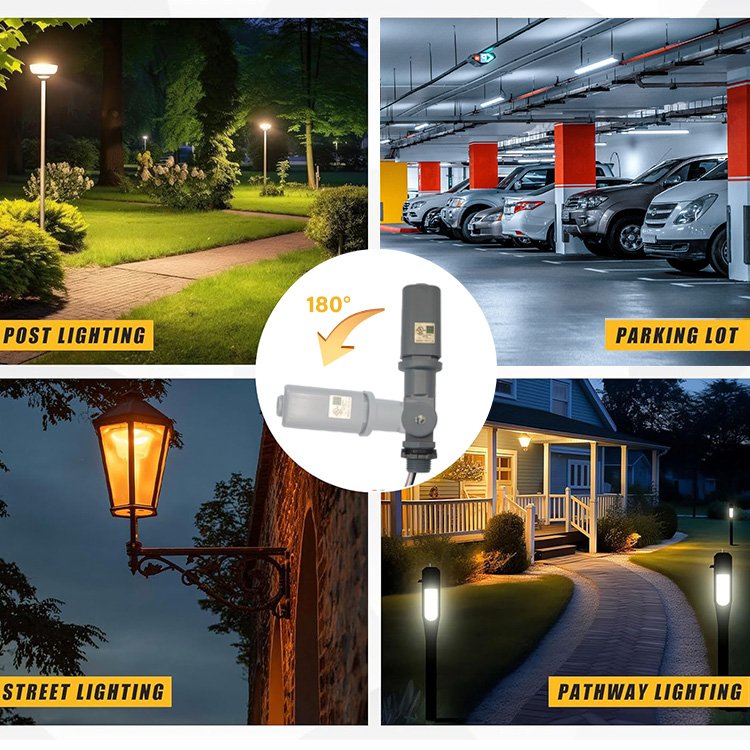
Select photo controls based on worst-case installation situations, not best-case drawings. Swivel stem control benefits are most seeming in environs where real-life inconsistency cannot be eradicated through planning only.
Why Is Treating All Outdoor Applications as Structurally Equivalent a Mistake?
One more recurrent selection mistake is assuming that one sensor structure fits all outdoor applications.
Street illumination, parking spaces, wall-mounted fixtures, and industrial sites all present very different ambient light environs. Picking a single fixed-direction design for all of them often results in unreliable behavior across the project.
What works well on an open highway may nosedive on a wall-mounted luminaire or in a reflective parking range. This oversimplification leads unswervingly to photo control selection mistakes at the system level.
Avoidance strategy:
Differentiate applications during selection. Not all sites need adjustability, but high-variability atmospheres demand it. Adjustable photo sensor selection should be driven by application complexity, not by habit.
How Focusing Only on Unit Price Leads to Poor Outcomes?
Procurement-driven selection often highlights the lowermost unit price. While understandable, this tactic recurrently shifts cost to later project stages.
Lower-cost fixed photo controls may need extended installation time, repeated commissioning adjustments, or eventual replacement. These unseen costs are not observable during procurement but rapidly accumulate during execution.
This is one of the most ignored photo control selection mistakes, particularly in extensive projects.
Avoidance strategy:
Assess total cost of ownership rather than unit price only. Structural choices effect installation labor, commissioning proficiency, rework frequency, and upkeep cost. Unit price is only one component of overall value.
Why Is Assuming Long-Term Environmental Stability Risky?
Several selection decisions implicitly assume that once commissioned, a photo control’s atmosphere will remain unchanged. Actually, outdoor environs evolve endlessly.
New buildings introduce shades, extra luminaires change light patterns, and seasonal sun angles alter exposure. Fixed-direction photo controls cannot acclimatize to these variations without replacement or reestablishment.
This leads to early replacement of electrically functional devices—a silent cost driver in outdoor illumination systems.
Avoidance strategy:
For projects with elongated anticipated lifespans, highlight designs that can be readjusted. Swivel stem control benefits include the capacity to restore performance through adjustment instead of replacement.
Why Is Separating Mechanical Design from System Performance a Mistake?
Mechanical structure is often observed as a housing detail instead of a functional component. This separation leads engineers to emphasis on electrical specifications while overlooking how the sensor actually interacts with its surroundings.
In actuality, structure determines:
- What light the sensor sees
- How easily it can be installed
- Whether it can be adjusted or maintained
Overlooking this connection is a foundational photo control selection mistake.
Avoidance strategy:
Treat mechanical structure as part of the control system. Orientation, adjustability, and mounting flexibility effect performance just as much as electronics.
How Do Adjustable Designs Reduce Selection Risk?
Adjustable photo controls accept improbability. Rather than assuming perfect installation and stagnant environs, they offer a mechanism to correct orientation after installation and over time.
This flexibility lessens reliance on perfect circumstances and shifts control back to commissioning squads. In multifaceted surroundings, adjustable photo sensor selection acts as a form of risk vindication.
Products such as the LT210CH series embody this method by combining dependable electrical performance with structural flexibility.
How Can Engineers Systematically Avoid These Selection Mistakes?
Evading photo control selection mistakes needs a structured assessment process:
- Evaluate installation unpredictability truthfully
- Organize applications by ecological complexity
- Assess long-lasted ecological change
- Compare lifespan cost, not unit price
- Incorporate mechanical and electrical considerations
By following this process, engineers can considerably decrease outdoor lighting control errors before they reach the field.
Common Selection Mistakes and Root Causes Table
| Selection Mistake | Root Cause | Resulting Issue |
| Relying on sensitivity adjustment | Ignoring orientation | Inconsistent switching |
| Assuming ideal installation | Underestimating variability | Post-installation rework |
| One design for all applications | Oversimplification | Uneven system behavior |
| Choosing by unit price | Ignoring lifecycle cost | Higher total expense |
| Ignoring environmental change | Short-term thinking | Premature replacement |
Mistake Avoidance Strategy Table
| Problem Area | Recommended Approach | Structural Implication |
| Orientation uncertainty | Select adjustable designs | Post-install alignment |
| Variable environments | Match structure to application | Reduced interference |
| Large project scale | Standardize commissioning | Consistent behavior |
| Long service life | Enable realignment | Extended lifespan |
| Cost control | Evaluate total ownership | Lower hidden cost |
Well-designed products decrease the consequences of imperfect assumptions. By proposing structural flexibility, they permit engineers to adjust to real-life conditions instead of forcing circumstances to match the design.
The LT210CH series, as swivel wire-in thermal type photo controls, reflects this philosophy. Their design incorporates swivel stem control benefits with reliable electrical performance, helping engineers to evade many of the most common photo control selection mistakes.
What Is the Lead-Top Engineering Perspective on Selection Mistakes?
At Lead-Top, we view selection mistakes as system failures, not user errors. Most problems arise because products assume perfect environments that hardly exist in the field.
By incorporating adjustable structures such as Swivel Stem Control into solutions like the LT210CH series, we help engineers decrease risk at the selection stage—where it is least expensive to tackle. This tactic supports dependable performance from installation through long-lasted operation, minimalizing outdoor lighting control errors and maximizing system value.

 English
  Portuguese (Brazil)
  Spanish
  Russian
  Dutch
Dutch  Japanese
  Portuguese (Portugal)