When debating sustainability in electronic products, various discussions stop at regulatory acquiescence. Accreditations such as RoHS Compliance are often treated as the crucial benchmark for being “eco-friendly.” While such principles are irrefutably significant, they represent only the least legal requirement—not the full meaning of environmental responsibility.
A product that merely evades restricted substances may still fail ahead of time, requiring early substitution and eventually contributing to electronic waste. Therefore, it becomes what we might call a acquiescent disposable: legally acceptable, but ecologically short-sighted. True Sustainable Durability, though, demands a deeper and more holistic approach.
Supervisory outlines like RoHS Compliance emphasis on chemical safety, not product lifetime. A device may be non-toxic yet structurally fragile, likely to ecological degradation, or ill suited for long-lasted outdoor use.
When such products nose-dive after only a few years, the ecological cost swells. Substitution needs new raw materials, extra engineering energy, logistics emanations, and dumping of the old unit. From a sustainability viewpoint, recurrent replacement is one of the most destructive outcomes.
This is why sustainability must be assessed over the whole lifespan of an Outdoor Lighting Solution, not just at the point of sale.
At Lead Top, sustainability originates before a product is ever manufactured. It starts with farsightedness in material selection, continues through manufacturing design, and is eventually measured by how much long-term value a product brings all through its life.
Instead of focusing only on supervisory checkboxes, Lead Top highlights Long Service Life as a fundamental ecological principle. A product that functions dependably for a decade or more evades multiple substitution cycles and melodramatically lessens ecological burden.
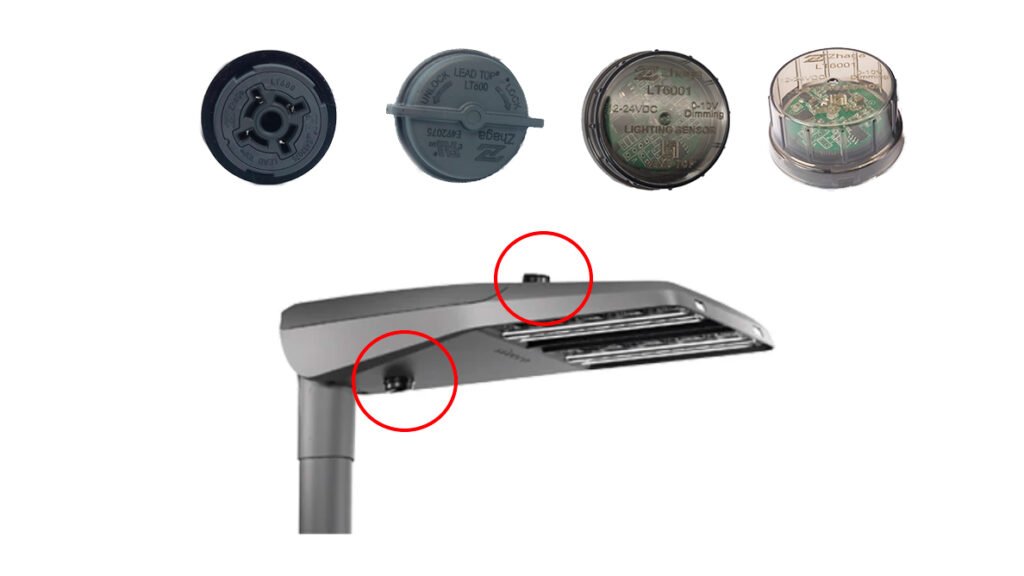
To demonstrate this philosophy, we inspect the LT6001 Zhaga-standardized controller as a practical example.
Why Is Long Service Life the Foundation of Sustainable Durability?
The most effective way to lessen electronic waste is not simply to make products recyclable—it is to make them last longer. Sustainable Durability means manufacturing products that fight ecological stress and continue working dependably in real-world circumstances.
A controller with a Long Service Life decreases resource extraction, engineering frequency, transport emanations, and disposal volume. This lifespan tactic carries ecological benefits that no short-term acquiescence label can match.
In outdoor settings, resilience is not elective—it is the main determinant of sustainability.
How Does Material Science Shape Eco-friendly Photocell Performance?
Material choice plays a significant role in whether a product becomes a long-lasting asset or a nonrefundable component. In outdoor illumination control, disclosure to sunshine, temperature, dampness, and temperature cycling persistently damages weak materials.
An Eco-friendly Photocell must therefore be built with materials capable of battling these forces over several years, not just enduring initial installation.
This is where progressive material manufacturing becomes a sustainability strategy instead of a cost burden.
Ultraviolet radiation is one of the most damaging forces acting on outdoor electronics. Constant UV exposure causes normal plastics to yellow, powder, crack, and lose mechanical strength.
For LED Lighting Control devices fixed outdoors, casing degradation often leads to seal failure, humidity ingress, and ultimate electronic breakdown. Avoiding this chain of disappointment is important to attaining Maintenance-Free Design.
The LT6001 tackle this contest by using UV-Resistant Material in its enclosure, considerably slow down the aging process and conserving structural reliability over long-lasted exposure.
Temperature is one more main opponent of resilience. Outdoor fixtures experience heat from sunshine, internal LED drivers, and restricted ventilation. Over time, thermal stress causes deformation, slackened connections, and mechanical fatigue.
To counter this, the LT6001 base is made from High-Temp PBT (polybutylene terephthalate), a material famous for thermal constancy and mechanical strength.
By upholding dimensional stability crosswise severe temperature ranges, High-Temp PBT guarantees secure electrical connections and reliable performance, even under severe ecological cycling.
Resilience is hardly attained through a single material choice. It is the result of a system-level approach. The mixture of UV-Resistant Material for the enclosure and High-Temp PBT for the base tackles the two most damaging outdoor forces: radiation and heat.
This material coupling is not about excess—it is about balance. Collected, they guard internal electronics, preserve sealing reliability, and uphold mechanical stability all through the product’s lifecycle.
The outcome is an Eco-friendly Photocell that evades early letdown and delivers constant performance over many years.
A product capable of constant working for 10 years or more evades numerous substitution cycles. Every evaded substitution represents saved raw materials, abridged engineering energy, less logistics emanations, and less waste sent to landfills.
In actual, Sustainable Durability openly decreases the ecological footprint of all Outdoor Lighting Solution positioned at scale. This advantage compounds crosswise metropolises, freeways, and infrastructure projects.
What is this phenomena: From “Purchase Cost” to “Total Cost of Ownership”?
Sustainability is closely related to economics, particularly in professional illumination projects. Initial buying price is only one part of the equation. True value is shown through Total Cost of Ownership (TCO).
A low-cost but short-lived controller may look eye-catching upfront, yet incur high downstream costs through upkeep, substitution, and failure-related disturbances.
Understanding Total Cost of Ownership (TCO) swings the decision-making attention from short-term savings to long-lasted proficiency.
How Does Sustainable Durability Lower Total Cost of Ownership?
A product made for Maintenance-Free Design reduces working ambiguity. Its low failure rate decreases service calls, employment costs, and unexpected downtime.
In infrastructure projects, predictableness is irreplaceable. A long-lasting controller steadies budgets and transforms uncertain upkeep expenditures into controlled long-lasted investments.
This is why Sustainable Durability is not just an ecological concept—it is a monetary strategy.
Sustainable Durability: A Responsible Choice
The LT6001 follows the Zhaga Standard, guaranteeing mechanical and electrical interoperability within contemporary luminaire environments. Though, standardization only does not warranty sustainability.
True Smart Lighting resolutions need hardware adept of supporting long-lasted digital control devoid of recurrent substitution. Resilience forms the basis upon which intelligent systems can dependably work.
A smart function is only as valued as the hardware that supports it.
In large-scale placements, upkeep is one of the most costly and disrupting features of illumination management. A Maintenance-Free Design decreases the need for site visits, traffic control, and service disruptions.

| Maintenance Factor | With Maintenance-Free Design |
| Site Visits | Greatly abridged |
| Traffic Control | Seldom required |
| Service Interruptions | Minimalized or removed |
| Operational Disruption | Very little |
| Maintenance Cost | Considerably lesser |
By merging resilient materials, vigorous sealing, and conservative manufacturing margins, long-lasting controllers permit long-lasted LED Lighting Control with negligible humanoid interference.
| Design Element | Contribution to Long-Term LED Lighting Control |
| Durable Materials | Repel wear and ecological stress |
| Robust Sealing | Defends against dampness and pollutants |
| Conservative Engineering Margins | Guarantees steady working over time |
| Overall Result | Negligible humanoid interference required |
When choosing illumination control components, the real question is not whether a product is acquiescent—but whether it is designed to last.
Are you satisfied with positioning acquiescent disposables, or are you investing in robust assets built around Sustainable Durability, Long Service Life, and responsible manufacturing?
Selecting Lead Top means picking products manufactured not only to function—but to endure.

 English
  Portuguese (Brazil)
  Spanish
  Russian
  Dutch
Dutch  Japanese
  Portuguese (Portugal)