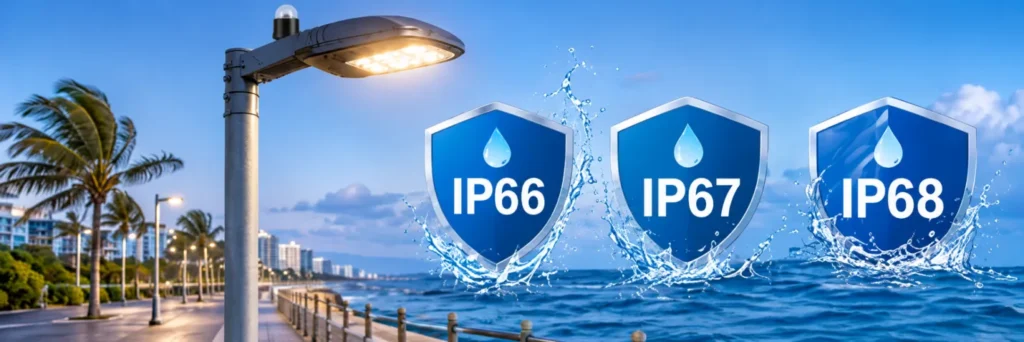
A photocell device on a seafront promenade faces more than rain. Salt carried by sea air can gradually affect its components. Therefore, the product selection is somewhat more complex than merely buying one with a high Clasificación IP.
So, what should customers actually look for?
This guide explains everything about IP ratings and what else to ask for when a site sits near the coast.
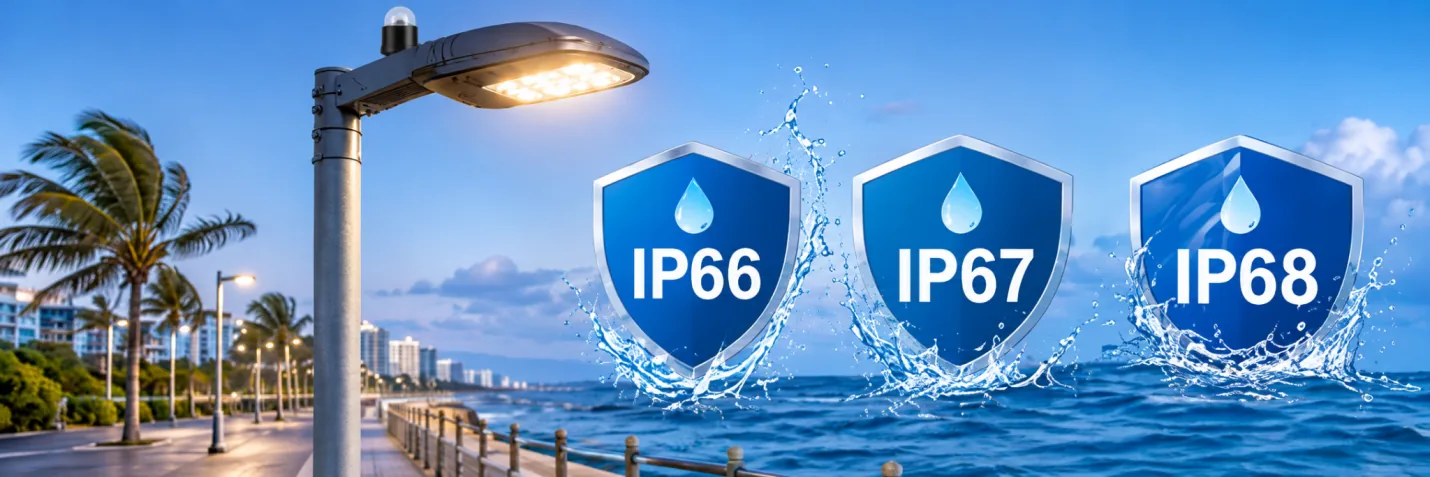
What Do IP66, IP67, and IP68 Actually Mean?
The coding system involves two digits. The first covers solids. The second covers water. In the three codes listed above, the first digit is the same, and it’s the second digit that takes effect.
| Clasificación | Water test | In practice |
| IP66 | 12.5mm nozzle, about 100 L/min, at least 3 minutes | Powerful jets, heavy rain, wash-down |
| IP67 | Temporary immersion, up to 1m for 30 minutes | Flooding or standing water that drains away |
| IP68 | Continuous immersion under conditions agreed between manufacturer and user | Submerged use; the depth and duration are not fixed by the standard |
Two points are easy to miss:
- IP66 and IP67 test different things. Jets are not immersion. A product can pass one and not the other, so IP67 is not automatically "better" than IP66 for a pole-top light sensor photocell switch.
- IP68 has no single meaning. The test conditions are set by agreement, so one manufacturer’s IP68 may not match another’s.
Why Isn’t an IP Rating Enough for a Coastal Site?
An IP rating describes water and dust ingress at the time of testing. It does not describe how the product ages.
IP testing does not cover:
Salt spray and chloride exposure
Various elements react differently in different environments. This calls for a different corrosion test.
Galvanic corrosion
This is when two dissimilar metals corrode more quickly because of salt moisture between them – for example, brass pins with a steel pole bracket.
UV aging
Plastics become brittle in the presence of salt and high temperatures.
Seal fatigue
Gaskets compress, stiffen, and crack after repeated exposure to temperature changes.
To be more explicit, a light sensor switch that meets IP66 in a new state may be found wanting in its third year if the material used in it was not suited for the coastal environment.
Which Photoelectric Sensor IP Rating Fits Which Coastal Location?
Exposure varies a lot, even within one project.
| Ubicación | Typical exposure | Rating to consider |
| Inland road, 5+ km from coast | Rain, occasional wind-blown salt | IP65 or IP66 |
| Seafront promenade, coastal highway | Salt mist, driven rain, high humidity | IP66 with coastal-grade materials |
| Port, harbour, quay, wash-down area | Direct spray, jet cleaning, salt crust | IP66 minimum; IP67 where flooding is possible |
| Low-lying flood-prone site | Occasional temporary submersion | IP67 |
| Permanent submersion | Continuous immersion | Not a normal photocontrol application |
Practical note
With regard to most pole-top and wall-mounting light photocell sensors, the luminaire and control are installed above flood level. IP66 with good materials is generally better than pursuing IP68.
What Else Should You Check In Light Sensors Beyond the IP Rating?
Ask the supplier about the following. Each one is a point where coastal installations commonly fail.
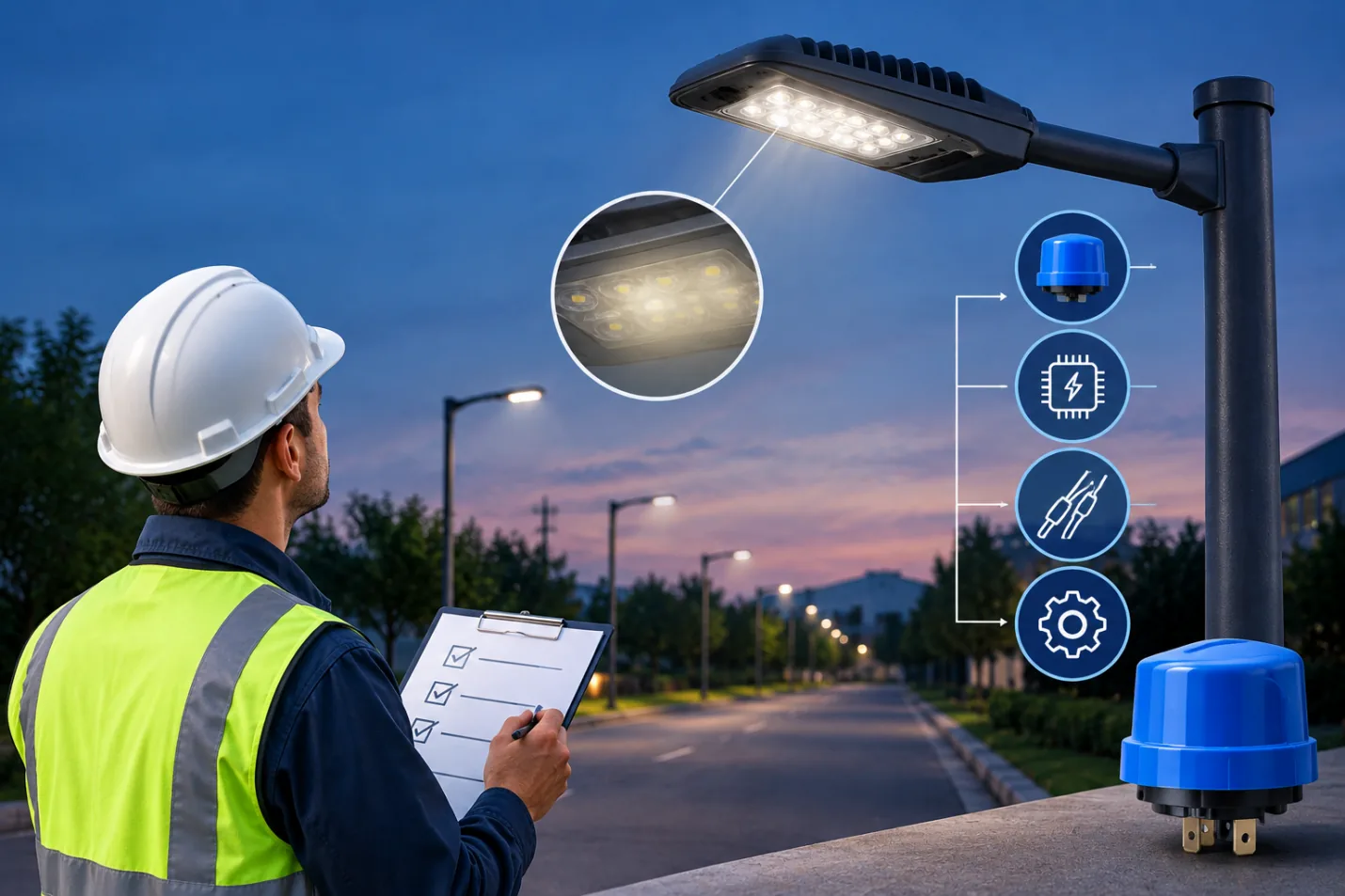
Salt-spray test report
Request a report on the ASTM B117 o CEI 60068-2 salt mist test. This should include duration and results. A claim without a report is only a claim.
Material declaration
Controlar:
- The housing plastic
- The pin plating
- The metal contacts
- What the UV and corrosion data cover
Contact plating
It’s recommended to use plated pins. They are more resistant to corrosion than bare brass in salt air.
Gasket material and fit
The seal between the photocontrol and the receptacle matters as much as the housing.
Rango de temperatura de funcionamiento
Coastal sites can combine a variety of climates. The product must be compatible.
Receptacle quality
The light sensor switch only seals as well as its base receptacle.
If the documentation is not up to the mark, treat the claim as unproven.
What Documents Should Buyers Request?
Before approving a product, ask for the following documents:
- Salt-spray test report.
- IP test certificate with specified conditions.
- Material declaration.
- Pin plating and finish specifications.
- Available installation and assembly instructions.
How Do LT600 and LT100B Compare for Outdoor Connectors?
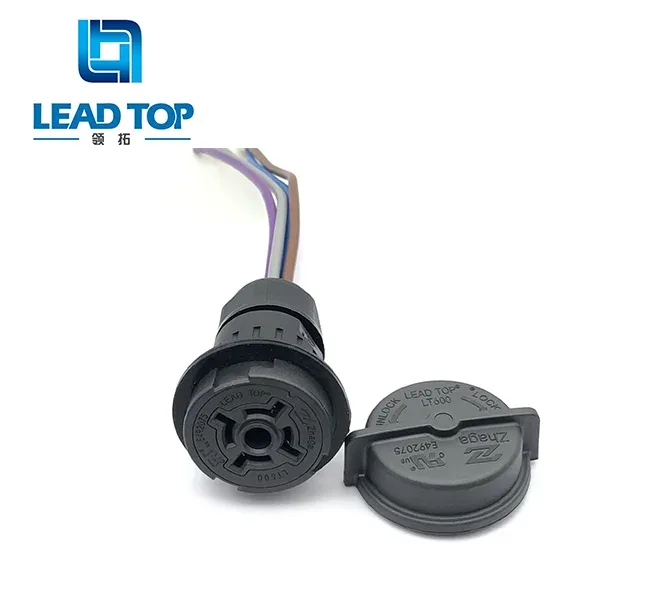
These two are the best options that coastal buyers sometimes compare. They serve different standards, so the comparison is about fit, not "which is better."
| Característica | LT600 | LT100B |
| Estándar | Libro Zhaga 18 | Normas ANSI C136.41 |
| Interfaz | Zhaga Book 18 receptacle | C136.41 receptacle (5-pin/7-pin dimming) |
| Published IP rating | IP66//IP67/IP68 Optional | IP66/IP67/IP68 Optional |
| Impacto mecánico | IK09 | – |
| Related part | Zhaga-compatible controls | PBT base, brass tin-plated power pins, UV-resistant 3mm PC cover in 90 / 100 / 130mm heights |
A Practical Coastal Specification Checklist
- Confirm the site’s exposure class:
- Inland
- seafront
- Port
- Flood-prone
- State the IP rating needed, and explain why.
- Request the salt-spray report and the material declaration.
- Confirm contact plating and gasket details.
- Specify a gasketed receptacle and a mounting method that avoids dissimilar metals.
- Match:
- Voltaje
- Carga
- Surge tier to the circuit
- Plan inspection intervals for corrosion and seal condition.
Preguntas frecuentes
Is IP68 better than IP66 for a coastal streetlight?
Not always. IP66 evaluates sprays and jets. IP68 evaluates immersion according to mutually agreed conditions. Where a pole-mounted controller is never immersed, then IP66, together with coastal-grade materials, will be more appropriate.
Does an IP rating mean the product is salt-spray resistant?
No. IP ratings do not test:
- Salt spray
- Chloride exposure
- Corrosión
Ask for a separate salt-spray test report.
Which salt-spray standard should I ask for?
A report to ASTM B117 or an IEC 60068-2 salt-mist test is a common request. Ask for the test duration and the result, not only a pass statement.
Is IP67 worth specifying?
It can be critical where temporary flooding and standing water are possible. Where it is not, IP66 usually suffices.
Do Lead-Top photocontrols come in IP68?
No. The listed options range between IP65 and IP67. Confirm the exact configuration with Lead-Top.
Why do coastal photocontrols fail early?
Common causes are:
- Corrosion at the pins
- Degraded gaskets
- An unsealed receptacle
- Materials not chosen for salt and UV
Water ingress alone is only one of those.
En resumen
Coastal lighting connectors need more than a high IP rating. Material quality and proper sealing also matter. Punta de plomo offers reliable photocontrollers and lighting connectors for different outdoor applications. Contact Lead-Top to find a suitable solution for your coastal lighting project
Enlaces externos
- https://www.iec.ch/ip-ratings
- https://www.astm.org/Standards/B117.htm
- https://en.wikipedia.org/wiki/International_Electrotechnical_Commission
- https://www.zhagastandard.org/?view=article&id=64%3Abook-18&catid=10
- https://www.ansi.org/
- https://en.wikipedia.org/wiki/EN_62262#:~:text=The%20European%20Standard%20EN%2062262,to%20IK%20(impact%20protection)%20ratings
- https://www.nema.org/

 English
 Portuguese (Brazil)
 Spanish
 Russian
 Dutch
 Japanese
 Portuguese (Portugal)