Introduction: Why Are Sockets Becoming the Core of Smart City Lighting?
Cities around the entire world are quickly adopting smart city lighting. Looking at this quick shift, we can say that by 2030, municipalities will move overwhelmingly from simple dusk-to-dawn lights to smart and intelligent connected, IoT-powered lighting. This lighting infrastructure is very efficient when it comes to power use. They bring down carbon emanations, improve safety, and support data-driven town administration.
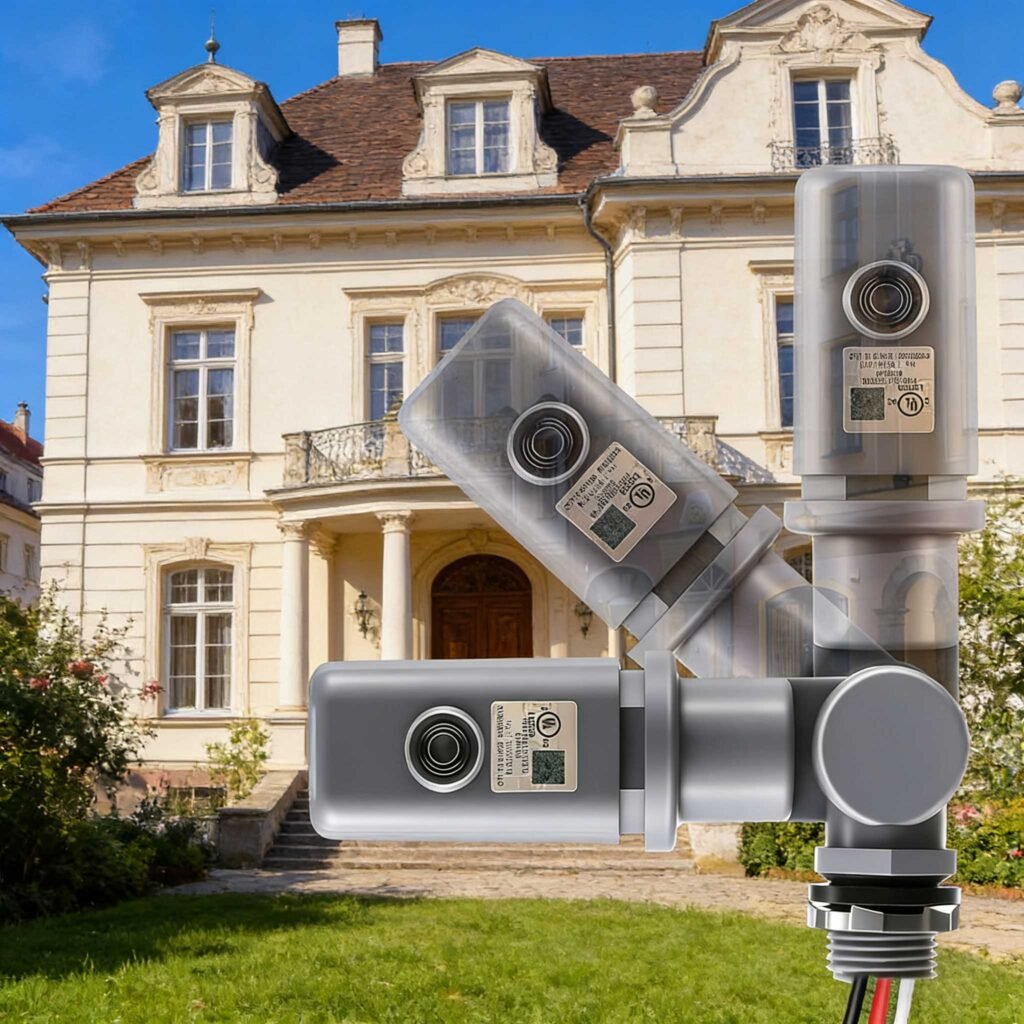
At the core of this revolution lies a frequently unnoticed but critical component—the photocell socket. Whether it’s a old-style NEMA socket used for a photocell or contemporary Zhaga Book 18 connectors made for IoT lighting, this physical interface decides how a streetlight communicates, detects, and progresses over time.
The upswing of the two-node architecture, which uses a NEMA socket on top and a Zhaga Book 18 connector on the side, is becoming the blueprint for the next generation of city lighting infrastructure.

What Are NEMA and Zhaga Sockets?
Understanding NEMA sockets and Zhaga Book 18 connectors is the key to understanding the prospect of outdoor lighting controls.
What Is a NEMA Socket?
A NEMA socket is a rounded, twist-lock interface extensively used in North America. These sockets are well-defined by ANSI C136.10 and ANSI C136.41 and come in 3-pin, 5-pin, and 7-pin variants. They are made to host a photocontrol, a photocell, or a networked street light controller.
Why NEMA is essential:
- Supports legacy and contemporary photocontrol devices.
- Interoperable crosswise thousands of lighting brands.
- Well-suited with UL773 safety standards.
- Perfect for cities transitioning from old-style photocontrols to progressive IoT nodes.
What Is a Zhaga Book 18 Connector?
Zhaga Book 18 is a compacted, homogenous connector that supports D4i and DALI-2 digital communication. Dissimilar to NEMA, Zhaga is generally side-mounted on the luminaire, making it perfect for insubstantial IoT lighting sensors.
Why Zhaga matters:
- Small, low-cost, and easy to fix.
- Allows plug-and-play sensors: air quality, motion, temperature, traffic.
- Made for smart city illumination environments.
- Strong worldwide acceptance crossways Europe and APAC.
Together, NEMA and Zhaga are not rival standards—they are balancing technologies forming the basis of contemporary outdoor lighting controls.
Why Is the Two-Node Architecture Becoming the Global Standard?
What Is the Two-Node Architecture?
The two-node architecture positioned a NEMA socket at the topmost of the luminaire and a Zhaga Book 18 interface on the side. This forms a dual-socket system where every connector has a distinctive role.
How Does Each Socket Contribute?
| Position | Component | Purpose |
| Top | NEMA socket | Powers the photocell, photocontrol, or street light controller in control for swapping and dimming. |
| Side | Zhaga Book 18 | Hosts insubstantial IoT sensors transferring ecological and behavioral data. |
Why Is This Architecture Ruling?
- Decreases upgrading cost melodramatically
Metropolises can add sensors later devoid of exchanging luminaires. - Supports modularity and open ecosystems
Attuned with D4i, DALI, and multi-brand devices. - Permits data collection + lighting control in one pole
A streetlamp becomes a digital asset. - Future-proofs investment
As needs develop, only the plug-in nodes change.
This hybrid model allows metropolises implement smart city lighting incrementally instead of committing to a full network refurbishment.
Market Data: Why It Matters?
Latest industry studies show explosive progress in the smart lighting sector:
- The worldwide smart city illumination market will jump from $2.0B in 2023 to $4.5B by 2028.
- By 2030, 60%+ of new poles will ship with sensor-ready sockets.
- Metropolises using two-node architecture report 25–35% cost savings compared to single-node alternatives.
Why This Growth Is Happening:
- Administrations push for sustainability and carbon declines.
- Utilities depend on adaptive illumination to lesser peak energy demand.
- Street lighting represents up to 40% of a city’s energy bill.
- Smart sensors decrease maintenance by providing accurate diagnostics.
The market is making one fact clear: Selecting the correct sockets now forms the next decade of lighting strategy.
How NEMA + Zhaga Benefit Customers?
1. How Does It Increase Flexibility?
Metropolises can instigate with a simple photocell fitted on a NEMA socket. Later, as finances grow, they can add IoT sensors via the Zhaga Book 18 side port.
This decreases monetary barricades and spreads investment across numerous years.
2. How Does It Promote Interoperability?
Both sockets support open standards:
- NEMA → extensively used in North America and backed by every single main photocontrol brand.
- Zhaga-D4i → guarantees multi-brand sensor compatibility.
3. How Does It Allow Smart City Features?
When join up with a street light controller, Zhaga sensors support:
- Adaptive dimming
- Predictive maintenance
- Actual event alerts
- IoT-based data integration
- Central cloud controls
4. How Does It Decrease Total Lifespan Cost?
- No need to substitute luminaires for renovations.
- Sensors can be changed in minutes.
- Abridged truck rolls—the most costly part of streetlight upkeep.
The blend of NEMA + Zhaga offers performance today with upgrade paths for the next decade.


What Real-World Applications Are Enabled by Dual-Socket Smart City Lighting?
1. Adaptive Lighting
Using motion sensors attached via Zhaga Book 18, metropolises vague illuminations when roads are unoccupied and brighten them when people or automobiles approach.
2. Environmental Monitoring
Zhaga sensors allow:
- Air quality measurement
- Temperature and moisture tracing
- Noise level sensing
This supports climate action plans and urban health initiatives.
3. Traffic Optimization
IoT sensors help monitor:
- Automobile flow
- Pedestrian density
- Overcrowding regions
Metropolises can regulate signal timing or redirect traffic in real time.
4. Energy and Maintenance Efficiency
NEMA-based photocontrols with features such as:
- 20kV surge defense
- Zero-cross swapping
- LED-optimized response curves
guarantee dependability even in severe climate.
Smart streetlamps become multi-purpose urban assets.
How Do Sustainability & Regulations Influence Socket Choices?
Municipalities experiences mounting compression to obey with ecological standards. The move toward NEMA + Zhaga helps cover these developing requirements.
Important Regulatory Drivers:
- DLC 6.0 & LUNA: Sterner demands for glare, uplight, backlight, and wildlife safety.
- EU ESPR: Compulsory eco-design, sturdiness, reparability.
- Digital Product Passport (DPP): Requires traceability and lifespan data.
- LCA/EPD: Ecological influence reporting required for public tenders.
Why Lead-Top Devices Are Ahead of These Trends
Products like the LT134 combine:
- UL773 certification
- ANSI C136.10 compliance
- IP67 sealing
- D4i and smart-ready compatibility
- High surge immunity
- Long warranties
| Feature | Description / Benefit |
| UL773 Certification | Guarantees the photocontrol covers stern North American protection criteria for street lighting applications. |
| ANSI C136.10 Compliance | Promises compatibility with standard NEMA sockets, permitting plug-and-play incorporation crosswise community lightings. |
| IP67 Sealing | Offers full dirt defense and water immersion resistance, making the device dependable in severe open-air surroundings. |
| D4i & Smart-Ready Compatibility | Supports evolving smart city lighting environments, allowing communication with IoT sensors and controllers. |
| High Surge Immunity | Guards the device against flashing and grid spikes, decreasing fiascoes and upkeep costs. |
| Long Warranties | Reflects prolonged service life and producer self-confidence, improving lifespan value for cities and OEMs. |
| Overall Advantage | All features combined make Lead-Top devices perfect for next-generation, maintainable illumination networks internationally. |
Conclusion: How Will NEMA and Zhaga Drive the Next Decade of Smart City Lighting?
The prospect of smart city lighting is perfect:
- NEMA sockets bring dependability, control, and compatibility.
- Zhaga Book 18 connectors allow IoT extension, sensors, and intelligence.
- Together, they form the two-node architecture—the most flexible, accessible, and future-proof resolution for outdoor lighting controls.
Cities, OEMs, and EPC workers that invest in NEMA + Zhaga readiness now build infrastructure that will remain technologically appropriate, ecologically acquiescent, and competitively durable through the next era of revolution.
Lead-Top is bridging old-style photocontrol dependability with the prospect of IoT lighting through innovative NEMA and Zhaga-compatible systems.


 English
  Portuguese (Brazil)
  Spanish
  Russian
  Dutch
Dutch  Japanese
  Portuguese (Portugal)