Introduction: Why Should Municipalities Look Beyond the Sticker Price?
In municipal street lighting projects, buying decisions are time and again abridged to a single figure: unit price. Procurement squads are under stress to bring cost savings, and project engineers are required to meet budget caps. Photocells therefore risk being treated as basic accessories instead of critical control components.
Though, this tactic often evidences short-sighted. A photocell is not just an on-off switch—it is an ecological sensor, a safety mechanism, and a controller that finally defines when electricity is used and when it is saved. When a cheap photocell flops, it acquaint with costs that far exceed the original buying price.
The true fiscal lens is not price evaluation, but Total Cost of Ownership (TCO). TCO measures the real cost of equipment over its entire life cycle—factoring in:
- Installation employment
- Substitution expenditures
- Energy wastage
- Warranty claims
- Functioning downtime
- Disposal and reprocurement
When procurement assesses photocells from a TCO viewpoint rather than unit pricing only, the results are often amazing. What seemed like a “cheap product” at first becomes the most costly decision a city could make.

What Drives Total Cost of Ownership in Photocells?
Understanding TCO means segregating the operating expenditures that secretly accumulate over time.
Maintenance Costs
A street lighting photocell may cost only a few dollars to purchase—but hundreds of dollars to substitute.
Consider a public deployment of 20,000 photocells:
- A 1% botch rate means 200 field substitutes.
- A typical upkeep visit includes:
- Bucket truck placement
- Traffic control
- Technician labor
- Safety management
- Administrative reporting
The actual substitution cost often ranges from USD 200–300 per unit.
That means a simple 1% fault rate converts into USD 40,000–60,000 in unintentional operating spending—deprived of refining infrastructure in any way.
Now visualize that botch rate rises to 3% or 5%. The fiscal load intensifies rapidly, consuming operating budgets and distracting upkeep schedules.
In contrast, a best photocell with a botch rate lower than 0.5% significantly decreases these secreted costs. Over a decade, upkeep expenditures time and again surpass initial buying costs by a multiple of 5 to 10 times.
Energy Efficiency
Photocells manage electricity consumption computerization. When they flop to function accurately, they inaudibly waste money every day.
Two common performance flaws in cheap sensors contain:
- Turning ON too early in the evening
- Turning OFF too late in the dawn
Even a 15-minute shift per cycle multiplies considerably crosswise thousands of luminaires.
For instance:
- A metropolitan functioning 50,000 lights
- Each wasting 0.2 kWh per day due to timing faults
- At $0.15/kWh
- The yearly waste surpasses USD 547,500
This is not a “theoretical loss”—it is a quantifiable and recurrent cost.
Top photocells use IR filtering, accuracy lux calibration, and hysteresis control to uphold accurateness all through the year, averting light pollution and decreasing energy outflow.
System Reliability
When a photocell nosedives, consequences spread outside maintenance logs.
Street illumination fiascoes can cause:
- Traffic accidents
- Pedestrian injuries
- Security breaches
- Reputational damage
- Legal liability
Public authorities experience mounting stress from people and media when illumination systems flop commonly. Reliability unswervingly affects belief in public institutions.
One defective photocell may not be newsworthy—but dozens of dark streets generate public outrage.
High-quality photocells highlight:
- Surge confrontation
- UV-resistant housings
- Moisture-proof sealing
- Mechanical stability
The result is reliable nightly brightness and abridged service objections from publics.
Warranty and Lifecycle
Warranty is not just a marketing term—it mirrors engineering confidence.
A producer proposing a 2-year warranty thinks the product may not perform dependably outside that period.
In contrast, models proposing 8 to 10 years of warranty are made deliberately for prolonged outside exposure.
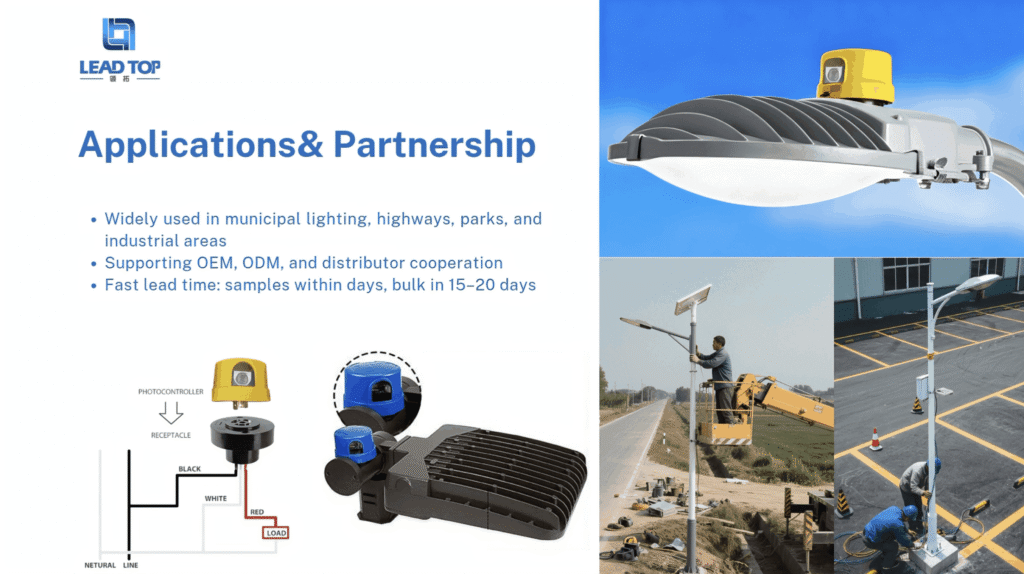
Consider a best photocell like the LT134:
- Surge defense up to 20kV/10kA
- Zero-crossing sensing (reduced contact wear)
- IP67 shield
- Eight-year warranty
This blend reduces:
- Electrical tension
- Dampness damage
- Thermal botch
- Component fatigue
The substitution cycle becomes lengthier, budgets stabilize, and field involvement cuts abruptly.
Cost Comparison: What Is the True Cost Difference Between Cheap and Quality Products?
Let us relate average financial performance crosswise 10 years.
Low-Cost Photocell (USD 2/unit)
Attributes:
- Small lifecycle (2–3 years)
- No surge defense
- No third-party accreditation
- Greater fiasco rate (3–5%)
Long-Term Reality:
- Recurrent substitutions
- Downtime risk
- Extraordinary energy loss
- No warranty protection
Quality Photocell (USD 5/unit)
Attributes:
- Lifecycle 8–10 years
- Certified
- Surge-protected
- High-grade materials
Long-Term Reality:
- Limited substitutions
- Steady energy consumption
- Negligible service calls
- Elongated warranty
Result:
Over 10 years, quality devices constantly exhibit 30–40% lesser TCO.
What appeared costly at buying becomes cheaper by year three.
What are The Standards That Protect ROI?
Certifications are not administrative hurdles—they are monetary protections.
Compulsory certifications comprise:
- UL773 / ANSI – Electrical safety (North America)
- Zhaga Book 18 / D4i – Smart compatibility
- CE / CB / RoHS – Environmental and trade acquiescence
- IP / IK – Ecological sturdiness

Certified products:
| Objective | What Certification Provides | Exact Operational Result | Business Impact |
| Enter bids effortlessly | Evidence of acquiescence with compulsory standards (UL, IEC, CE, ANSI, ISO) | Pass technical admissibility checklist in bids | Quicker qualification, broader tender entrée |
| Evade regulatory refusal | Proved third-party testing and conformism documents | Approval by inspectors and establishments | No consignments blocked, no restructure or retesting |
| Uphold warranty integrity | Products meet declared specifications | Warranty remains legal | Lesser replacement expenses |
| Decrease liability risk | Documented obedience to safety codes | Abridged exposure to accidents and claims | Less legal fines, lower insurance |
Without certification:
| Business Area | Without Certification – Exact Condition | Immediate Outcome | Commercial Impact |
| Project Approval | No proof of acquiescence with required standards in bid documents | Technical submittal is prohibited | Project ineligibility |
| Insurance Coverage | Product does not meet policy acquiescence sections | Insurance becomes partly or fully negated | Unrecoverable losses |
| Warranty Claims | Producer refutes warranty due to non conformism | Claims invalid | Full replacement cost |
| Asset Reliability | No third-party quality confirmation | Failure rate rises | Replacement cycle shortens |
How Did Quality Influence a Real Municipal Tender Outcome?
In Latin America, a large EPC contractor lost a USD 5 million street illumination agreement due to the use of non-UL-approved photocells.
The product was low-cost.
The system was functional.
But acquiescence failed.
Another bidder offered surge-protected, certified models and won the project by signifying:
- Lesser energy loss
- Lengthier replacement cycle
- Greater system dependability
The municipality gave the contract not based on price—but on project life cost.
Conclusion: How Much Will This Photocell Really Cost You?
Not these days.
Not this year.
But over 10 years.
In lighting infrastructure, the lowermost invoice does not mean lowermost investment.
Quality decides ROI.
Trustworthiness decides safety.
Accreditation decides eligibility.
Photocells decide results.


 English
  Portuguese (Brazil)
  Spanish
  Russian
  Dutch
Dutch  Japanese
  Portuguese (Portugal)