
In outdoor and commercial lighting projects, success is hardly determined merely by whether a control device technically works. More frequently, performance depends on how easily the device can be fixed, associated, attuned, and upheld under practical circumstances. Swivel Stem Control was developed as a direct retort to these practical contests encountered on-site.
Dissimilar to laboratory settings, installation sites are volatile. Poles may not be perfectly vertical, luminaires may differ in shape, and nearby light sources often interfere with sensor precision. Swivel Stem Control introduces a simple but commanding mechanical solution that adds adaptableness devoid of increasing system intricacy.
At its core, this design acknowledges a basic truth: installers should not be compelled to make permanent directional decisions before they fully apprehend the working atmosphere. By permitting post-installation orientation, Swivel Stem Control bridges the gap among manufacturing design and field actuality.
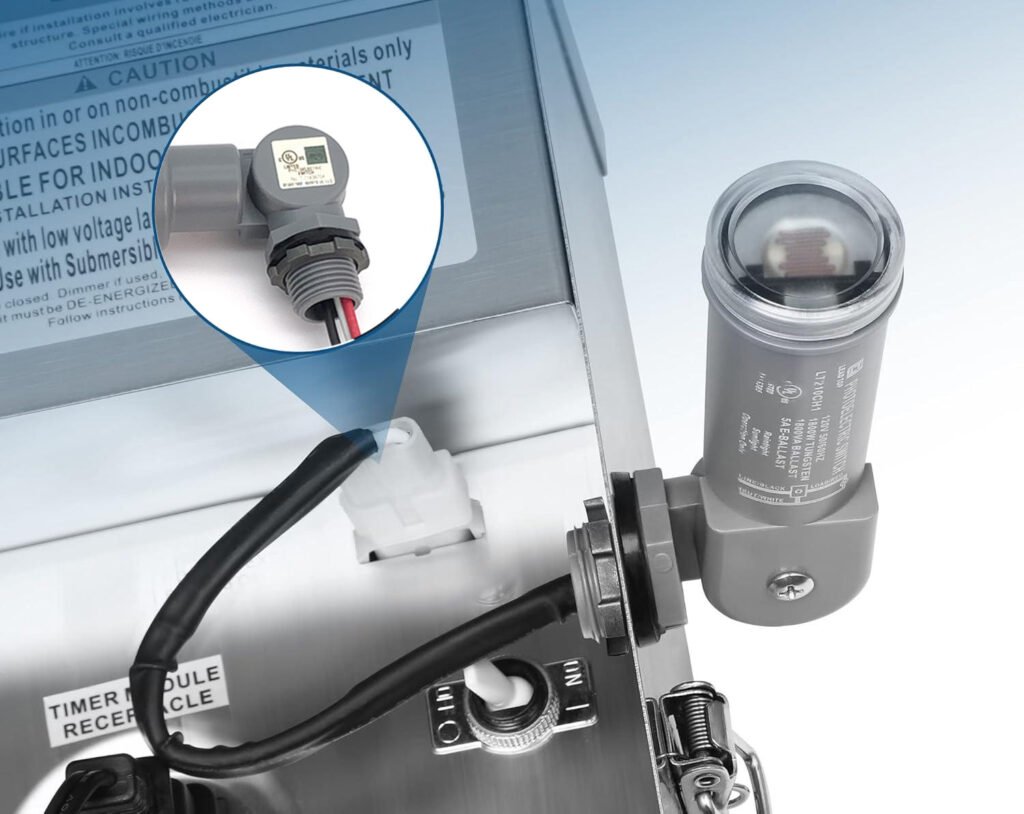
What Does Swivel Stem Control Look Like Structurally?
Structurally, Swivel Stem Control comprises of three important elements: a mounting base, a swivel joint (stem), and a sensor body. The mounting base is fixed to the luminaire or enclosure, while the sensor body is attached through a rotatable stem that permits directional adjustment.
This swivel stem design generates a mechanical separation among physical fitting and sensing direction. Once the base is protected, the sensor head can be rotated or angled to attain best arrangement devoid of loosening or reinstalling the device.
Instead of being an accessory or add-on, the swivel mechanism is a combined part of the product’s mechanical structural design. This guarantees long-lasted stability and averts drift produced by vibration, wind load, or thermal cycling.
How Does Swivel Stem Control Function During Installation?
During installation, Swivel Stem Control streamlines the workflow by decreasing precision requirements at the mounting stage. Installers can focus on safeguarding the device properly without worrying about seamless sensor placement.
Once the fixture is powered and ecological situations can be observed, the adjustable sensor can be fine-tuned. This is predominantly valuable when installers discover unanticipated light interfering from neighboring buildings, reflective surfaces, or head-to-head luminaires.

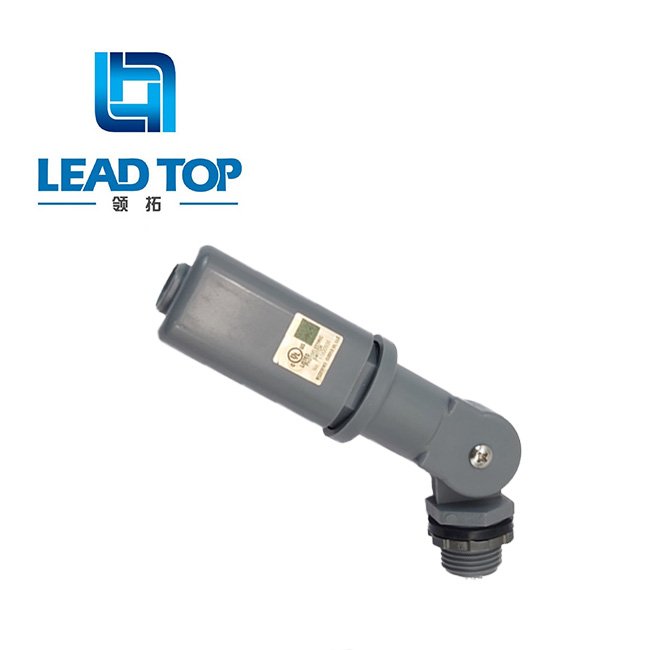
Why Is Directional Adjustment So Important for Outdoor Lighting Sensors?
Outdoor illumination environs are vibrant and hardly perfect. Streetlamps, parking lots, and industrial courtyards regularly comprise numerous light sources working at different heights and angles. Devoid of suitable orientation, an outdoor lighting sensor may sense reflected or stray light rather than factual ambient situations.
Swivel Stem Control permits the sensing window to be targeted away from undesirable interfering while upholding exposure to natural light. This expands dusk-to-dawn accurateness and decreases false switching, cycling, or hindered operation.
Directional suppleness is particularly critical in retrofit projects where existing pole layouts and fixture designs were not initially optimized for contemporary control devices.
How Does Swivel Stem Control Improve Sensor Installation Flexibility?
Sensor installation flexibility is one of the key advantages of swivel stem designs. A single sensor model can accommodate dissimilarities in mounting height, pole orientation, and luminaire geometry.
This adaptableness lessens the requisite for custom brackets, spacers, or special-order parts. Installers can adjust the sensor orientation in the field rather than adjusting the hardware itself.
For EPC suppliers and cities handling large deployments, this suppleness translates into less installation mistakes, quicker commissioning, and more anticipated performance results.
How Does Swivel Stem Control Support Long-Lasted Usability?
Lighting environs evolve. New buildings are built, trees grow, and illumination designs change. A sensor that performed flawlessly on day one may struggle years later.
With Swivel Stem Control, the sensor does not become outdated simply because its surroundings change. Preservation squads can reorient the sensor instead of substituting it, prolonging product life and decreasing total cost of ownership.
This long-lasted adaptableness line up with contemporary infrastructure goals that highlight sustainability, serviceability, and lifespan proficiency.
Why Is Swivel Stem Control Considered a User-Oriented Design?
From a design philosophy viewpoint, Swivel Stem Control echoes an understanding of how products are actually used—not just how they are specified.
Instead of compelling users to adjust to inflexible hardware constraints, the design acclimates to user needs. It identifies time pressure during fitting, unpredictability across sites, and the significance of field-level decision-making.
By entrenching suppleness into the structure, producers support better results devoid of needing advanced training or specialized tools.
Where Is Swivel Stem Control Most Commonly Used?
Swivel Stem Control is extensively applied in outdoor and semi-outdoor environs where illumination situations vary:
- Street and highway illumination
- Parking lots and garages
- Industrial courtyards and logistics centers
- Commercial lands and university grounds
In all of these surroundings, the ability to regulate sensor orientation increases dependability and decreases commissioning time.
Table 1: Structural Comparison Between Fixed and Swivel Stem Sensors
| Feature | Fixed Sensor Design | Swivel Stem Control |
| Sensor orientation | Fixed at installation | Adjustable after installation |
| Installation tolerance | Low | High |
| Adaptability to site conditions | Limited | Excellent |
| Post-installation correction | Requires reinstallation | Simple manual adjustment |
Table 2: Key Benefits of Swivel Stem Control in Real Projects
| Benefit | Practical Impact |
| Adjustable sensor direction | Improved detection accuracy |
| Reduced rework | Faster commissioning |
| Adaptable to changing environments | Longer product lifespan |
| One model, multiple uses | Simplified inventory |
Conclusion: How Does Swivel Stem Control Reflect Lead-Top’s Design Philosophy?
At Lead-Top, product development initiates with practical observation instead of theoretical assumptions. Swivel Stem Control arose from understanding how installers work, how surroundings vary, and how systems grow with the time.
Rather than improving only for specifications, the design highlights usability, flexibility, and long-lasted performance. By integrating adjustment ability into the structure itself, Lead-Top guarantees that products stay effective beyond initial installation.
This methodology decreases upkeep effort, increases dependability, and helps clients to attain reliable results crosswise varied applications.
Swivel Stem Control is not simply a rotary sensor—it is a real-world design response to real installation encounters. By splitting mechanical mounting from directional alliance, it introduces suppleness where it matters most.
For outdoor illumination sensors, this means improved accurateness, stress-free installation, lengthier service life, and better project results. As illumination systems continue to progress, designs that hold flexibility will stay significant and dependable.
In this sense, Swivel Stem Control signifies a small structural change with a noteworthy effect—one that line up manufacturing accuracy with real-life situations.




 English
  Portuguese (Brazil)
  Spanish
  Russian
  Dutch
Dutch  Japanese
  Portuguese (Portugal)

One Response