Introduction: Why Are European Municipal Lighting Systems Moving Beyond Simple LED Retrofits?
Across Europe, cities are quickly converting public illumination infrastructure. Previously modernization projects largely focused on substituting old-style HID lamps with energy-efficient LEDs. Whereas this first wave of promotions successfully abridged electricity usage, metropolises are now entering a second stage of development focused on smart infrastructure and connected urban systems.
This trend is driving key interest in Smart Pole Infrastructure, Municipal Smart Lighting, and Connected Lighting Systems that chain illumination with sensors, communication modules, surveillance apparatus, and ecological monitoring technologies.
Contemporary municipalities no more view street illumination as only a source of lighting. In its place, illumination poles are becoming multifunctional urban assets skillful of supporting extensive smart city applications.
Projects in towns such as Genoa and Siedlce clearly exhibit how public illumination is growing into a critical part of Urban IoT Infrastructure and the wider Future of Street Lighting.

What Are the Two Main Phases of Urban Lighting Modernization?
European illumination modernization can generally be separated into two main phases.
| Phase | Main Objective | Key Technologies | Primary Benefit |
| Phase 1 | Replace old lighting with LEDs | LED luminaires, basic photocells | Energy savings |
| Phase 2 | Build smart urban infrastructure | Smart sensors, IoT control, Zhaga/NEMA systems | Automation + data integration |
What Components Make Up Modern Smart Pole Systems?
Smart poles need several incorporated technologies working together seamlessly.
Photocells
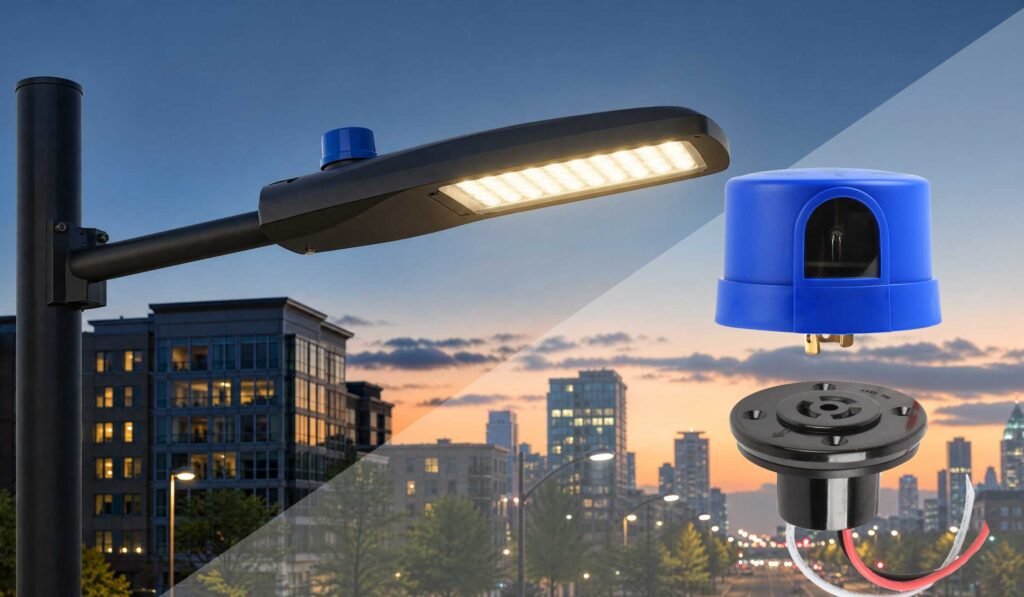
Though illumination systems are becoming increasingly smart, the photocell remains one of the most important components.
Contemporary Street Light Sensors do far more than simply switch lights ON and OFF.
Today’s innovative photocells can support:
- Automatic dusk-to-dawn control
- Remote diagnostics
- Dimming functions
- Energy monitoring
- IoT communication
- Smart node incorporation
This development is converting the old-style photocell into a central control point within Municipal Smart Lighting systems.
Environmental Sensors
Environmental sensors are modular IoT nodes integrated into smart pole infrastructure to convert traditional streetlights into an intelligent, hyper-local urban monitoring grid. By leveraging the poles’ continuous electrical power, vertical elevation, and high-speed network connectivity, cities can seamlessly collect and transmit real-time data across wide urban areas without deploying bulky standalone equipment.
Functions:
- Air Quality Monitoring: Tracks localized particulate matter (\(PM_{2.5}\)), carbon monoxide, and ozone levels to map pollution hot spots and protect public health.
- Micro-Climate Tracking: Measures ambient temperature, humidity, and barometric pressure to detect urban heat islands and optimize seasonal road maintenance.
- Adaptive Lighting Automation: Uses photodiode light sensors to measure ambient brightness, automatically dimming or brightening LEDs to save city energy.
- Acoustic Noise Mapping: Monitors decibel levels via embedded microphones to track urban noise pollution and flag sudden audio emergencies like collisions.
- Data Transmission Hub: Aggregates environmental telemetry locally at the edge and routes it to municipal cloud platforms via the pole’s 5G or Wi-Fi network.
Wireless controllers
Wireless controllers allow centralized communication between streetlamps and metropolitan management systems.
Common communication technologies comprise:
- LoRaWAN
- NB-IoT
- Zigbee
- LTE-M
These technologies permit illumination systems to:
- Adjust glare remotely
- Sense failures robotically
- Optimize energy consumption
- Monitor actual performance
This level of control is important for scalable Connected Lighting Systems.
Standardized sockets (NEMA/Zhaga)
One of the prevalent challenges in smart city deployment is compatibility between components from different producers.
This is why homogeneous interfaces such as NEMA Socket and Zhaga Photocell systems are becoming increasingly important.
Standardization permits metropolises to:
- Swap components easily
- Upgrading of systems over time
- Decrease maintenance intricacy
- Evade supplier lock-in
Devoid of standardized interfaces, future advancements become costly and technically tough.
Why Are Photocells Becoming Central Nodes in Smart Cities?
Old-fashioned photocells operated only as automatic switches. Current smart photocells serve a much comprehensive role.
They now function as smart interface platforms within smart illumination networks.
Gateway to automation
A contemporary photocell endlessly monitors environmental illumination situations and robotically adjusts operation accordingly.
This permits:
- Accurate dusk-to-dawn control
- Adaptive dimming
- Abridged energy waste
- Enhanced operational constancy
Therefore, Smart Lighting Controllers help cities to maximize proficiency while minimalizing needless power usage.
Data collection interface
Numerous innovative smart photocells now support incorporation with IoT platforms and sensor networks.
These systems can collect:
- Energy consumption data
- Lamp status information
- Ecological conditions
- Operational diagnostics
This information helps cities to make data-driven infrastructure decisions.
Remote diagnostics capability
Contemporary smart photocells support predictive maintenance.
Municipalities can pinpoint problems early through remote diagnostics, rather than waiting for failures to occur.
Benefits include:
- Abridged upkeep costs
- Quicker troubleshooting
- Lower downtime
- Enhanced service dependability
For large cities operating thousands of fixtures, predictive maintenance is a key operating advantage.
What Can We Learn from Genoa and Siedlce?
European municipalities are already signifying the benefits of smart illumination infrastructure.
Why Is Genoa Considered a Smart Lighting Success Story?
Genoa’s modernization project is one of Europe’s most noticeable smart illumination initiatives.
Main achievements comprise:
- Over 55,000 improved illumination points
- Above 70% energy savings
- Enhanced citizen satisfaction
- Incorporation with wide-ranging smart city planning
How Is Siedlce Supporting Smart Infrastructure Goals?
Siedlce has also spent greatly in LED modernization and smart illumination management.
The metropolitan exhibits how medium-sized cities can successfully adopt Urban IoT Infrastructure devoid of requiring huge megacity budgets.
Projects like these are quickening demand for:
- Smart-ready photocells
- Standardized sockets
- Smart dimming systems
- Modular control platforms
What Opportunities Exist for Manufacturers and Integrators?
Producers and system integrators face major growth prospects, as smart illumination grows.
OEM customization
Urban projects often need application-specific solutions.
Metropolises may request:
- Tailored voltage ranges
- Different dimming protocols
- Special surge defense levels
- Exclusive communication interfaces
This generates strong demand for OEM-capable producers.
Global certifications
European urban tenders typically need acquiescence with:
- CE certification
- RoHS acquiescence
- EN standards
- Smart interface compatibility
Devoid of proper certifications, contractors may be disqualified from public projects.
Which Lead-Top Products Support Smart Pole Infrastructure?
Several Lead-Top products are specifically designed for modern European smart pole applications.
LT605R-7PIN Rotatable ANSI C136.41 Dimming Receptacle

This receptacle supports innovative smart illumination communication and dimming interfaces.
Main advantages comprise:
- Rotatable installation design
- ANSI C136.41 compatibility
- Support for wireless control modules
- Simplified field maintenance
It is perfect for large-scale smart illumination deployments.
LT100B-7PIN ANSI C136.41 Base

This product offers a homogeneous smart-ready platform for smart illumination systems.
Benefits comprise:
- Steady electrical connection
- Smart node compatibility
- Scalable infrastructure incorporation
It supports future advancements within Connected Lighting Systems.
LT600 Series Zhaga Connector

The LT600 series supports compact smart illumination applications based on Zhaga Photocell standards.
Advantages comprise:
- Zhaga Book 18 compatibility
- Compact modular structure
- DALI integration support
- Future-proof smart architecture
LT154E High-Voltage Electronic Photocontrol

Made for demanding highway and infrastructure projects, this model supports:
- 347–480V operation
- Heavyweight outdoor applications
- Elongated operational lifecycle
- Improved surge defense
It is particularly appropriate for large infrastructure projects.
What Are the Main Benefits of Smart Pole Infrastructure?
| Benefit | Description | Impact on Cities |
| Energy Efficiency | Intelligent lighting optimization | Lower electricity costs |
| Predictive Maintenance | Remote diagnostics and monitoring | Reduced maintenance expenses |
| Smart Integration | Supports IoT and sensor systems | Better urban management |
| Scalability | Modular upgrade capability | Long-term infrastructure flexibility |
| Standardization | Easier component replacement | Simplified maintenance |
| Sustainability | Reduced carbon emissions | Supports green policies |
Which Smart Lighting Interfaces Are Most Common?
| Interface Standard | Main Market | Key Advantage | Typical Application |
| NEMA ANSI C136.41 | North America & global municipal projects | Robust smart-node compatibility | Smart street lighting |
| Zhaga Book 18 | Europe | Compact modular smart integration | Smart urban lighting |
| DALI | Global | Digital dimming communication | Intelligent lighting control |
| 0-10V | Commercial lighting | Simple dimming control | Energy-saving systems |
FAQ
Q1: What is a smart pole?
A smart pole is a multifunctional metropolitan infrastructure that chains illumination, sensors, communication, and data systems.
Q2: How do photocells fit into smart poles?
They act as control points for illumination and can incorporate with sensors and communication modules.
Q3: What standards are used in smart pole systems?
NEMA and Zhaga are the most common standards for modular and scalable designs.
Why Is Smart Lighting Becoming Essential for European Cities?
European cities face mounting pressure to:
- Decrease energy usage
- Meet sustainability targets
- Enhance public safety
- Modernize infrastructure
- Permit digital urban services
Photocells now play a far more significant role than ever before. They are no more simple switching devices—they are becoming smart control nodes that support the development of fully connected smart metropolises.
As Europe continues spending in Smart Pole Infrastructure, Municipal Smart Lighting, and Urban IoT Infrastructure, smart-ready photocells and standardized control systems will become increasingly important for future town development.
CTA:
Distributors, OEM partners, and lighting contractors are encouraged to connect with Lead-Top for customized outdoor lighting control solutions tailored to different project requirements and market standards.
With flexible OEM/ODM support, reliable photocell products, and experience in global lighting projects, Lead-Top helps customers achieve stable performance, efficient installation, and long-term project reliability.
References:
- https://en.wikipedia.org/wiki/Digital_Addressable_Lighting_Interface
- https://en.wikipedia.org/wiki/CE_marking
- https://leaditop.com/product-category/product/zhaga-control/zh aga-sockcet/
- https://leaditop.com/product/7-pin-smart-photoelectric-switch-matching-dimming-receptacle-twist-lock-automatic-street-light-controller/
- https://leaditop.com/product/smart-city-street-system-wireless-photocell-switch-and-photocontrol-accessories-base-nema-7-pin-photocell-base/
- https://leaditop.com/nema-connector/


 English
 Portuguese (Brazil)
 Spanish
 Russian
 Dutch
Dutch Japanese
 Portuguese (Portugal)