How do you modernize an entire city’s lighting network? Replacing the luminaires is only the first step. However, Ponta Grossa, Brazil, is tackling this successfully. Here are highlights of its project to modernize 47,500 lighting points:
- 38,000 LED luminaires have already been installed
- 80% of the city’s lighting is LED
- The remaining 9,500 lights will be completed by the end of 2026
But is replacing old luminaires enough? Not when thousands of lights must operate reliably every night. Photocontrols, receptacles, switching performance, and maintenance also become critical. The right control components can help municipalities keep large LED networks efficient, reliable, and easier to maintain. Ponta Grossa’s upgrade offers a useful example of why light sensor photocell selection deserves attention from the start.

Why Are Brazilian Cities Accelerating LED Streetlight Upgrades?
The main driver is efficiency. The modern light sensor-based LEDs can:
- Reduce electricity use
- Help with a green future
- Lower lighting costs
- Improve visibility across urban areas
For Brazil’s Ministry of Mines and Energy, public lighting is a key area where energy conservation yields could be exemplary.
The investment is also expanding. In 2025, Procel Reluz announced more than R$150 million for LED public-lighting modernization across municipalities in all five regions of Brazil. More than 104,000 lighting points were already included in earlier Procel projects.
For municipalities, the goal is no longer just replacing lamps. It is building more efficient, reliable, and manageable lighting networks.
| Municipal Challenge | Consequences | LED Modernization Response |
| High electricity consumption | Higher operating costs | More efficient LED luminaires |
| Aging lighting equipment | Frequent failures | Modern LED infrastructure |
| Rising maintenance needs | More service visits | Longer-life components |
| Uneven or outdated lighting | Poorer nighttime visibility | Improved light distribution |
| Pressure on municipal budgets | Limited infrastructure spending | Energy and maintenance savings |
| Growing technology requirements | Difficult future upgrades | Standardized and smart-ready systems |
What Makes an Extensive LED Retrofit More Complicated Than Replacing Luminaires?
Is replacing thousands of luminaires enough to complete an LED retrofit? Not quite.
A municipal lighting network also depends on the components that control and protect each lighting point. Brazil’s INMETRO guidance treats LED modernization as a broader process covering project design and delivery.
At large scale, small component issues can become major maintenance problems. Engineers should evaluate:
- Lighting control compatibility with the LED driver
- Switching performance for repeated outdoor operation
- Receptacle standardization for easier replacement
- Environmental durability for exposed installations
- Maintenance access across thousands of lighting points
Standardized interfaces also matter. ANSI C136.10 defines physical and electrical interchangeability between locking-type photocontrols and mating receptacles.
This is why a successful retrofit must be designed as a complete lighting system, not simply a luminaire replacement program.
How Do Reliable Photocontrol Receptacles Improve Municipal LED Lighting Projects?
At its most basic, a photocell switch detects ambient light and switches the luminaire accordingly. In a large municipal network, that simple function must work consistently across thousands of lighting points. ANSI C136.10-2023 covers the physical and electrical interchangeability and testing of locking-type photocontrols and mating receptacles.
A reliable photocontrol helps municipalities avoid unnecessary operating hours and reduce manual intervention. Its performance also affects maintenance requirements. ANSI testing includes repeated switching cycles and electronic-load testing, which is particularly relevant to LED systems.
What Should Municipalities Look For?
- Accurate light sensing for dependable dusk-to-dawn operation
- LED-compatible switching for electronic loads
- Surge protection for outdoor electrical environments
- Standardized connections for faster replacement
- Long service life to reduce maintenance visits
For a network the size of Ponta Grossa’s, reliability at each lighting point can directly affect the overall cost and performance of the municipal lighting system.
Which Photosensor Switch and Receptacle Combination Is Suitable for Large-Scale Brazilian LED Retrofits?
For a standard LED roadway retrofit, a twist-lock photocontrol paired with a standardized receptacle is a practical approach. Lead-Top positions the LT134 as a surge-protected twist-lock photocontrol and the LT605 as an ANSI C136.41 receptacle for outdoor lighting applications.
This Combination Works for Municipal LED Retrofits
The combination supports automatic dusk-to-dawn control while keeping the control point accessible for replacement. The LT605 provides a standardized interface with three power contacts and additional dimming/signal contacts.
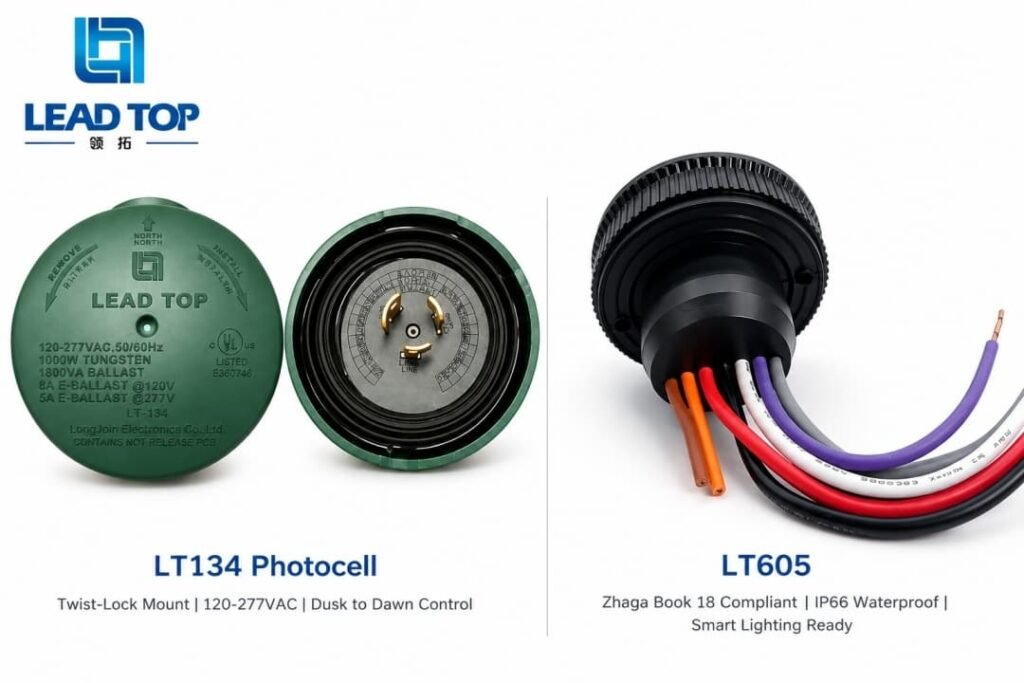
Key benefits include:
- Twist-lock installation for straightforward field replacement
- ANSI C136.41 interface for standardized control connections
- Surge protection through the LT134
- LED lighting compatibility for roadway applications
- Simpler maintenance across large lighting networks
Applications
It fits applications such as:
- Municipal street lighting
- Urban roadway upgrades
- Residential streets
- Public parks
- Large-scale LED retrofit projects
ANSI C136.41 also establishes mechanical and electrical requirements for locking-type controls and mating receptacles, supporting standardized lighting-control interfaces.
Should Municipalities Prepare for Smart Lighting During an LED Retrofit?
In many cases, yes. Brazil is already moving beyond basic LED conversion. Municipal projects now include remote monitoring, fault detection, and remote control of lighting networks. For example, Maceió uses telegestão to monitor public lighting in real time and identify failures remotely.
Important Considerations During an LED Retrofit
A retrofit can prepare the network for future upgrades by considering:
- Standardized receptacles for easier control-device replacement
- Dimming capability for adaptive lighting strategies
- Remote monitoring for faster fault detection
- Compatible control interfaces for future IoT integration
- Expandable infrastructure for connected lighting systems
This approach is already appearing in Brazilian municipal projects. Manaus uses telegestão across more than 80% of its lighting points, while Erechim is deploying intelligent control across more than 16,000 points.
For long-life public infrastructure, preparing for these capabilities during the initial LED retrofit can reduce the need for expensive modifications later.
Here is a comparison table of current need vs. future need.
| Lighting Requirement | Basic LED Retrofit | Future-Ready Retrofit |
| Automatic ON/OFF control | Yes | Yes |
| Standardized receptacle | Yes | Yes |
| Photocontrol replacement | Yes | Yes |
| 0–10V dimming | Not necessarily | Yes |
| DALI compatibility | Not necessarily | Yes |
| Adaptive lighting | Limited | Possible |
| Remote monitoring | Not necessarily | Possible |
| Smart-city integration | Limited | Better prepared |
Which Lighting Control Solution Can Support Future Smart Municipal Projects?
Recommended Smart-Ready Solution
For a future-ready LED network, consider the LT154E Electronic Dimming Photocontrol with the LT635 7-Pin Dimming Receptacle. This setup adds dimming capability to the standard photocontrol interface. The current ANSI C136.41 standard covers interfaces between locking-type controls and luminaires, including 0–10V and DALI dimming
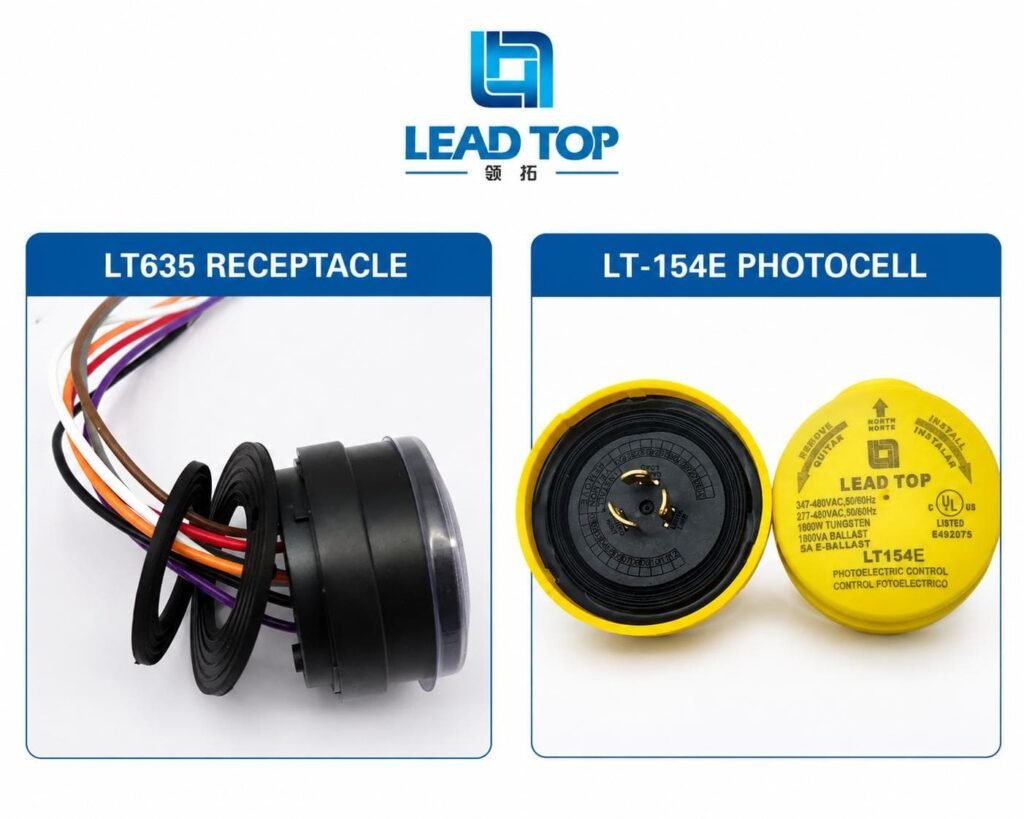
This Combination Is Suitable for Future-Ready Lighting
The combination can help municipalities prepare for more advanced control strategies without redesigning the basic luminaire interface.
Key advantages include:
- 0–10V dimming support
- DALI dimming support
- Seven-pin control interface
- Smart-ready infrastructure
- Simpler future control upgrades
ANSI C136.41 specifically establishes mechanical and electrical requirements for dimming control devices and mating receptacles.
Applications
This architecture is suitable for:
- Smart city lighting
- Adaptive street lighting
- Municipal energy-saving programs
- Connected roadway projects
- Future-ready public lighting networks
For a long-term retrofit, adding this capability early can give municipalities more flexibility as lighting-control requirements evolve.
What Should Municipal Engineers Check Before Selecting Photocontrols for a Large LED Retrofit?
Selecting a light sensor photocell switch for a large retrofit takes more than checking voltage and wattage. The control must match the luminaire, receptacle, operating conditions, and future plans. ANSI C136.41-2025 defines mechanical and electrical requirements for locking-type controls and mating receptacles, including 0–10V and DALI dimming.
1. Is the Photocontrol Compatible With the LED Driver and Luminaire?
Check the driver’s electrical requirements first. LED drivers can have different operating and inrush characteristics. NEMA specifically highlights driver compatibility and inrush as important considerations.
2. Does the Receptacle Use a Standardized Interface?
A standardized interface simplifies installation and replacement. ANSI C136.41 provides requirements for locking-type control and receptacle interfaces.
3. Can the Photosensor Deliver Reliable Long-Term Switching?
Evaluate switching performance, environmental protection, surge resistance, and expected service life. Small failure rates can create substantial maintenance work across thousands of fixtures.
4. How Easy Is the Photocontrol to Replace in the Field?
Choose a design that allows quick replacement without unnecessary rewiring. Consistent components can also simplify spare-parts management.
5. Can the Lighting Infrastructure Support Future Expansion?
Before procurement, determine whether the network may later require:
- 0–10V or DALI dimming
- Remote monitoring
- Adaptive lighting
- Smart lighting controls
- IoT integration
Planning these requirements early can prevent costly infrastructure changes later.
What Can Ponta Grossa’s LED Modernization Teach Other Brazilian Municipalities?
What can other cities learn from Ponta Grossa? Scale changes the priorities. The city has already converted 38,116 lighting points, reaching 80% coverage. Its PPP covers more than 47,000 points and includes long-term management.
The lesson is clear: municipal LED projects should plan for more than efficient luminaires. They should also prioritize:
- Reliable lighting control
- Standardized components
- Easier maintenance
- Future smart-lighting upgrades
Frequently Asked Questions About Photocontrols for Large-Scale LED Projects
1. What Should Engineers Consider When Selecting Photocontrols?
Check LED driver compatibility, switching performance, inrush current, surge protection, service life, and environmental protection. ANSI C136.10 and C136.41 provide relevant requirements for photocontrol interfaces and receptacles.
2. Why Is a Standardized Receptacle Important?
A standardized interface simplifies installation and field replacement. It also helps municipalities maintain consistent components across large networks.
3. How Can Municipalities Reduce Maintenance Costs?
Use reliable photocontrols and standardized components. Quick plug-in replacement can reduce service time and simplify spare-parts management.
4. Should Municipalities Prepare for Smart Lighting?
Yes, when future upgrades are planned. Dimming and adaptive lighting can be easier to implement when smart infrastructure is already included.
Final Words
Ponta Grossa shows that extensive LED modernization requires more than efficient luminaires. Reliable photocontrols and standardized interfaces can help municipalities manage these networks over the long term. For projects that need dependable lighting control components, Lead-Top offers NEMA photocontrols, receptacles, and smart-ready solutions for municipal and infrastructure applications.
External links
- https://cpreluz.procel.gov.br/2025/08/14/enbpar-e-mme-anunciam-mais-de-r-150-milhoes-para-modernizacao-da-iluminacao-publica-em-municipios/
- https://en.wikipedia.org/wiki/National_Institute_of_Metrology,_Standardization_and_Industrial_Quality
- https://www.ansi.org/
- https://en.wikipedia.org/wiki/0-10_V_lighting_control
- https://www.dali-alliance.org/



 English
 Portuguese (Brazil)
 Spanish
 Russian
 Dutch
Dutch Japanese
 Portuguese (Portugal)