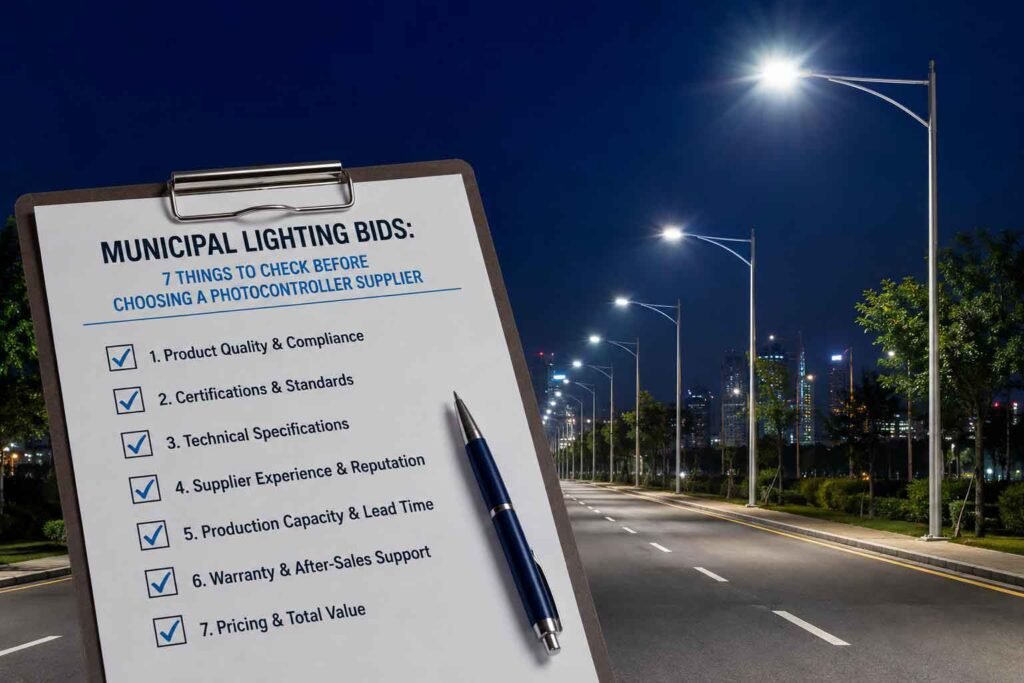
Choosing a lighting control supplier for a municipal lighting bid is not just about getting the lowest price. The wrong product can create compatibility issues and higher maintenance costs.
So, what should procurement teams check first?
- Electrical compatibility
- Certifications
- Outdoor protection
- Testing
- Production capacity
- Warranty, and
- after-sales support
All these matter. A reliable supplier should also provide samples and clear technical documentation before mass procurement. Products such as the LT134 can be considered for large-scale LED street lighting projects where reliable switching and standardized installation are important.
Why Does Photocell Switch Selection Matter in Municipal Lighting Bids?
A photocell lighting sensor may be a small component, but its failure can affect an entire streetlight installation. Municipal projects often involve thousands of luminaires. A poor match can lead to premature failures, maintenance visits, and replacement costs.
The selection should therefore cover more than the purchase price. Procurement teams should check:
- Electrical compatibility: Does it match the luminaire and driver?
- Standards: Does it meet the tender’s required standards?
- Reliability: Can it handle outdoor operating conditions?
- Maintenance: Can failed units be replaced quickly?
- Lifecycle cost: Will the product remain economical after installation?
ANSI C136.10-2023 specifically addresses the physical and electrical interchangeability and testing of locking-type photocontrols and mating receptacles. This makes compliance and compatibility important checkpoints during municipal procurement.
Have You Checked Electrical and LED Compatibility?
The light sensor photocell switch should actually work with the LED luminaire specified in the bid. Confirm before supplier approval. Check the controller’s operating voltage, load rating, switching characteristics, and compatibility with the selected LED driver.
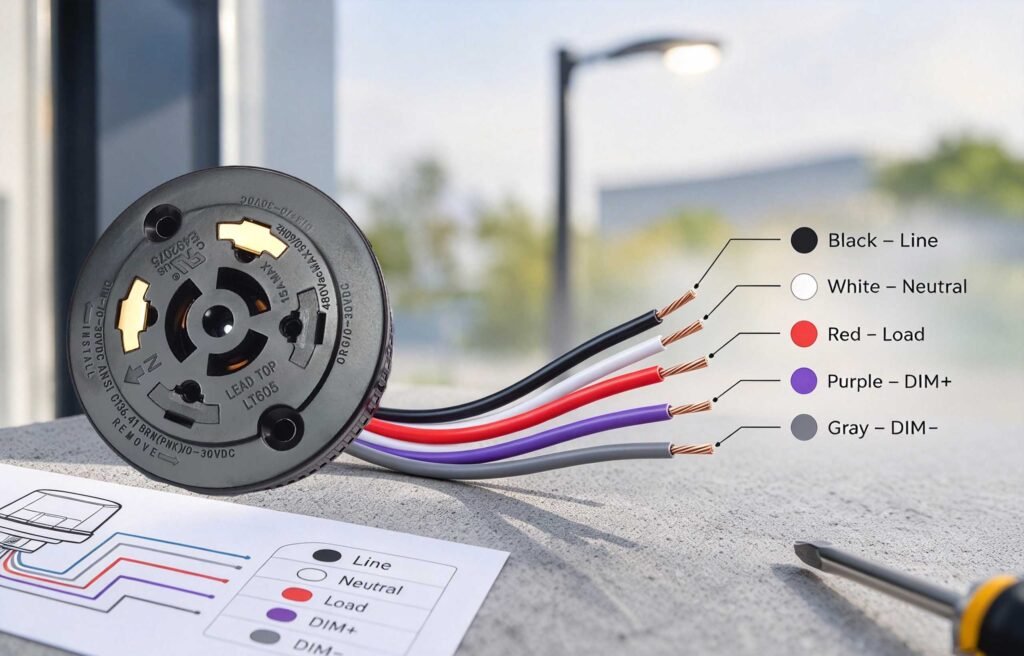
LED systems can also require attention to the control interface. For dimming applications, ANSI C136.41-2025 defines the interface between an external locking-type control and a ballast or driver for 0–10 V and DALI protocols.
A practical compatibility check should cover:
| Parameter | What to Verify |
| Voltage | Controller and luminaire operating range |
| Load | Rated load and switching requirements |
| LED Driver | Driver compatibility and control method |
| Inrush | Ability to handle the driver’s startup current |
| Receptacle | Correct mechanical and electrical interface |
Do not approve a photocontroller from its wattage rating alone. Test the sample with the actual LED luminaire and driver before mass procurement.
Has the Photocontroller Supplier Provided the Required Certifications?
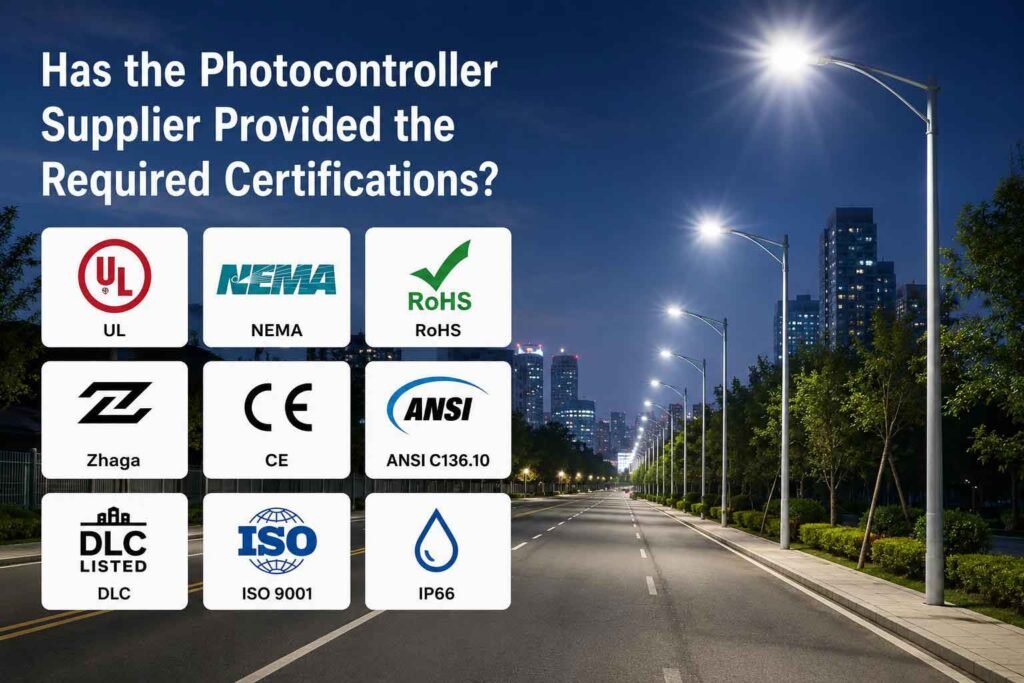
Supplier’s certification claims should be backed by documents. Confirm this before a municipal bid is approved. ANSI C136.10-2023 covers the physical and electrical interchangeability and testing of locking-type photocontrols and mating receptacles.
For plug-in locking photocontrollers, UL identifies ANSI/UL 773 as the basic standard used to investigate these products. The exact requirements should still match the tender and target market.
Ask the supplier for:
- Applicable certification or listing documents
- Product test reports
- Technical datasheets
- Declaration of conformity, where required
- Model and rating details matching the submitted product
Do not treat a logo on a datasheet as sufficient proof. Verify that the documentation applies to the exact photocontroller model being offered.
Can the Photosensor Withstand Demanding Outdoor Conditions?
A photocontroller spends years of exposure on a streetlight. Its survival depends on its construction and tested performance. Outdoor units face weather conditions and repeated switching. These factors can affect long-term reliability.
For municipal projects, check these points before approval:
| Reliability Factor | What to Check |
| Surge protection | Rated protection against electrical transients |
| Weather protection | Enclosure and sealing specification |
| Impact resistance | Stated impact rating, where required |
| Temperature | Rated operating temperature range |
| Switching life | Specified switching-cycle performance |
ANSI C136.10-2023 also establishes testing requirements for locking-type photocontrols and mating receptacles. A supplier should provide the relevant test data instead of relying only on general reliability claims.
Are You Comparing Total Cost or Just the Unit Price?
Is the cheapest photocontroller really the lowest-cost option?
Not necessarily. A lower purchase price can become expensive if units require frequent replacement or additional service visits. DOE guidance on outdoor lighting evaluates costs beyond the initial purchase, including maintenance and other lifecycle expenses.
For a municipal bid, compare the complete cost picture:
- Purchase: Unit price and initial quantity
- Installation: Labor and equipment costs
- Maintenance: Inspection and service requirements
- Replacement: Product and field labor costs
- Inventory: Spare units required for repairs
A reliable photocontroller supplier should therefore be evaluated on total cost of ownership, not simply the lowest quotation. This gives procurement teams a clearer view of the project’s long-term value.
Has the Supplier Provided Samples for Testing?
Approving thousands of light sensor switches without testing one first could have severe consequences. That creates an avoidable project risk. Municipal lighting specifications can require product samples before approval. A DOE-supported LED streetlight RFP, for example, required bench testing of luminaires and photocontrols before installation.
A practical approval process is:
Sample → Compatibility Test → Field Evaluation → Approval → Mass Procurement
Test the sample with the actual LED luminaire and driver. Check electrical operation, installation fit, switching behavior, and control performance. For locking-type systems, also verify the photocontroller and receptacle interface. ANSI C136.10 addresses their physical and electrical interchangeability.
The approved sample should also match the exact model supplied in the production order.
Can the Supplier Meet Your Production and Delivery Requirements?
The supplier should have enough capacity to ensure timely delivery. This matters when a municipal bid involves thousands of units. A supplier should prove its production capacity before the contract is awarded.
| Supplier Factor | What Procurement Teams Should Check |
| Production Capacity | Monthly output and available capacity |
| Quality Control | Batch testing and inspection procedures |
| Lead Time | Standard and project-specific lead times |
| Delivery | Ability to meet required shipment dates |
| Staged | Supply Capacity for phased project deliveries |
| Consistency | Same approved specifications across batches |
Large procurement programs can also benefit from standardized specifications and centralized purchasing. DOE resources emphasize clear product specifications for municipal LED procurement.
Ask the supplier for a realistic production schedule. Confirm it before placing the purchase order. Do not base delivery expectations on verbal promises alone.
What Warranty and After-Sales Support Does the Supplier Provide?
What happens if a photocontroller fails after installation?
The answer should be clear before the contract is signed. A warranty is useful only when its coverage and support terms are documented.
Here are some important considerations in this regard:
● Warranty period
How long is the product covered?
● Replacement
Who supplies failed units?
● Technical support
Is troubleshooting assistance available?
● Documentation
Are installation and technical guides provided?
● Claims process
How quickly are warranty claims handled?
● Spare units
Can replacement stock be supplied when needed?
Municipal lighting specifications commonly include written warranty requirements and product documentation as part of supplier submittals. DOE guidance also treats warranty details and controls as relevant procurement considerations for LED street lighting.
A strong photocontroller supplier should support the project beyond the initial delivery.
Which Photocontroller and Receptacle Combination Is Suitable for Municipal Bidding Projects?
A municipal bid needs a photoelectric sensor that fits the electrical and mechanical requirements of the lighting system. The combination of LT134 along with the LT615 receptacle is recommended.
About LT134
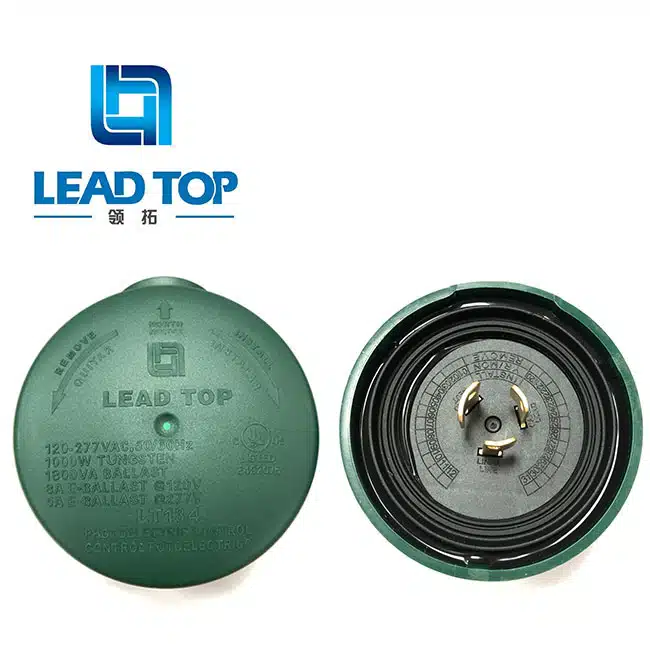
The LT134 Long-Life Twist-Lock Photocontrol is designed for municipal tender applications. It supports 120–277V operation, with an applicable range of 105–305V. It also uses zero-crossing switching and provides surge protection up to 1,425J. Its rated switching life exceeds 15,000 operations.
About the LT615 Receptacle
- The LT615 is a 3-pin NEMA receptacle.
- It is rated up to 480V and 15A.
- The product is designed for twist-lock photocontrol installations.
- It complies with ANSI C136.10 and UL 773.

Why This Combination Works?
The LT134 provides automatic dusk-to-dawn control. The LT615 provides the standardized mounting interface. Together, they offer a practical setup for municipal street lighting and easier field replacement.
What Should Be on Your Municipal Photocontroller Supplier Evaluation Checklist?
Do not compare quotations alone. Check the technical documents, samples, certifications, and delivery capability before making a decision.
Use this checklist during municipal lighting procurement:
| Evaluation Area | What to Verify |
| Technical Compliance | Voltage, load, LED compatibility |
| Certification | ANSI, UL, CE, or tender-specific requirements |
| Sample Testing | Compatibility with the actual luminaire |
| Reliability | Surge protection and switching life |
| Production | Capacity and batch consistency |
| Delivery | Lead time and shipment schedule |
| Warranty | Coverage and replacement terms |
| Support | Technical assistance and documentation |
A supplier that meets these points presents less procurement risk. It also gives the project team a clearer basis for comparing photocontrollers on performance, compliance, and long-term support.
FAQ
Should photocontrollers be selected based on price alone?
No. Compare price with compatibility, certifications, switching life, warranty, and maintenance costs. The lowest unit price may not provide the lowest lifecycle cost.
Should suppliers provide samples before a large municipal order?
Yes. Test samples with the actual LED luminaire and driver before mass procurement. This helps confirm electrical and mechanical compatibility before thousands of units are installed.
What documents should a photocontroller supplier provide?
- Datasheet
- Applicable certifications
- Test reports
- Warranty terms
- Installation information
The documents should match the exact model offered.
Why is supplier production capacity important for municipal lighting projects?
Large municipal projects can require thousands of photocontrollers. The supplier must maintain consistent quality and meet the agreed delivery schedule across every production batch.
Final Words
Choosing a photocontroller supplier requires more than comparing prices. Check product details and long-term support before approving a bid. Lead-Top offers municipal-grade photocontrollers such as the LT134, with documented standards, outdoor protection, and long switching life for large-scale projects. If you are preparing a municipal lighting bid, contact Lead-Top to discuss your requirements and evaluate suitable samples.


 English
 Portuguese (Brazil)
 Spanish
 Russian
 Dutch
Dutch Japanese
 Portuguese (Portugal)