Having trouble with your outdoor light switching at the wrong time?
The photocell switch may not be faulty. There are multiple other factors that can cause similar problems. Proper installation of lighting controls helps prevent these issues and keeps outdoor lighting reliable.
This guide covers 10 common light sensor problems and explains how to avoid them.
Why Does Incorrect Photocontrol Orientation Cause Problems?
Poor orientation can prevent the sensor from detecting day and night conditions. Buildings and other objects, like trees, may block the sensor. Manufacturer guidance recommends positioning photocontrols toward natural daylight and away from the controlled light source.
Good installation position
- Clear view of ambient daylight.
- Away from nearby artificial light.
- No obstruction around the sensing area.
Poor installation position
- Facing the controlled lamp.
- Blocked by the fixture or nearby structure.
- Exposed to strong reflected or artificial light.
How Can Incorrect Wiring Affect Photocell Operation?
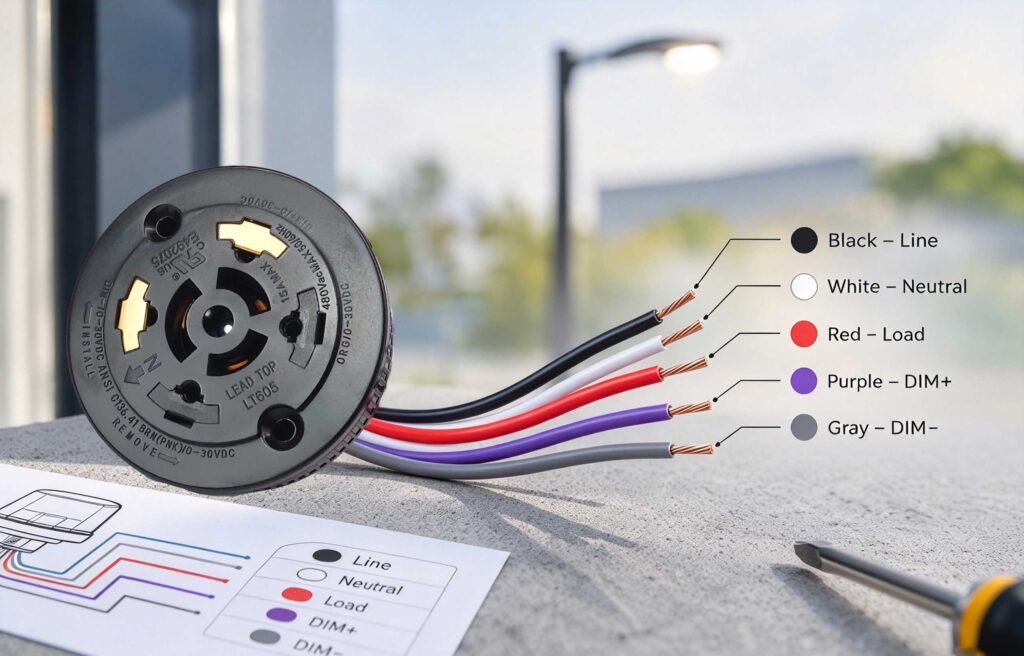
Light sensor wiring must match the specific model. A typical voltage photoelectric sensor may have separate line, neutral, and load connections. However, configurations can differ between products. Manufacturer instructions should always identify each connection before power is applied.
Incorrect wiring can cause abnormal operation. For example, Intermatic notes that daytime cycling can occur when LINE and LOAD connections are reversed. Before installation, check the product wiring diagram and verify each connection. Never assume two photocells use the same wiring arrangement. For Lead-Top products, use the wiring diagram supplied for the specific model.
Why Do Wrong Voltage or Load Ratings Create Installation Problems?
A photocontrol receptacle must match the luminaire’s electrical requirements. Here are some important checks before installation.
- Input voltage: Match the photocell to the supply voltage.
- Load rating: Confirm the connected load stays within the rated limit.
- LED driver: Check compatibility with the driver and its electrical characteristics.
- Inrush current: Consider startup current, especially with LED loads.
Lead-Top LT124 is rated for 120–277V and 50/60Hz. Its listed load rating is 1000W/1800VA, with a 5A E-ballast rating. Do not select a photocell just by appearance but by electrical specifications.
How Do Incompatible Photocells and Receptacles Cause Problems?
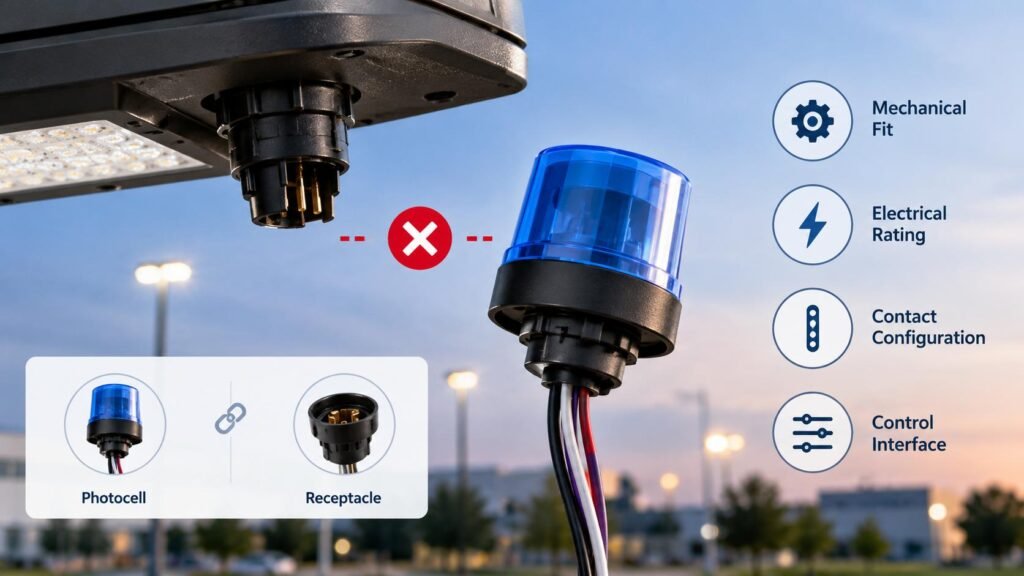
For reliable operation, the entire lighting system should be in complete harmony. Mechanical fit alone is not enough. ANSI C136.10 is a global standard in this regard.
It covers the physical and electrical interchangeability of photocontrols and mating receptacles. For dimming systems, this addresses all the compatibility issues.
What Should You Confirm?
● Mechanical fit
Check the locking connection.
● Electrical rating
Match the operating requirements.
● Contact configuration
Confirm the available contacts.
● Dimming interface
Check 0–10V or DALI requirements where applicable.
● Standard
Verify the applicable ANSI specification.
Lead-Top LT605/LT605R are examples of ANSI dimming receptacles. Confirm both component specifications before installation.
How Can Nearby Artificial Light Affect a Photocell Switch Sensor?
Lighting controls respond to the light reaching their sensing area. If it faces the controlled lamp or another bright source, it may detect excess ambient light and switch incorrectly. Intermatic identifies nighttime cycling as a possible result of this light feedback. It recommends facing the photocontrol toward natural daylight rather than the controlled light source.
Common sources include:
- Nearby street or security lights
- Building lights
- Advertising signs
- Reflected light
How Can Moisture Damage an Outdoor Photocell Connection?
It can happen when:
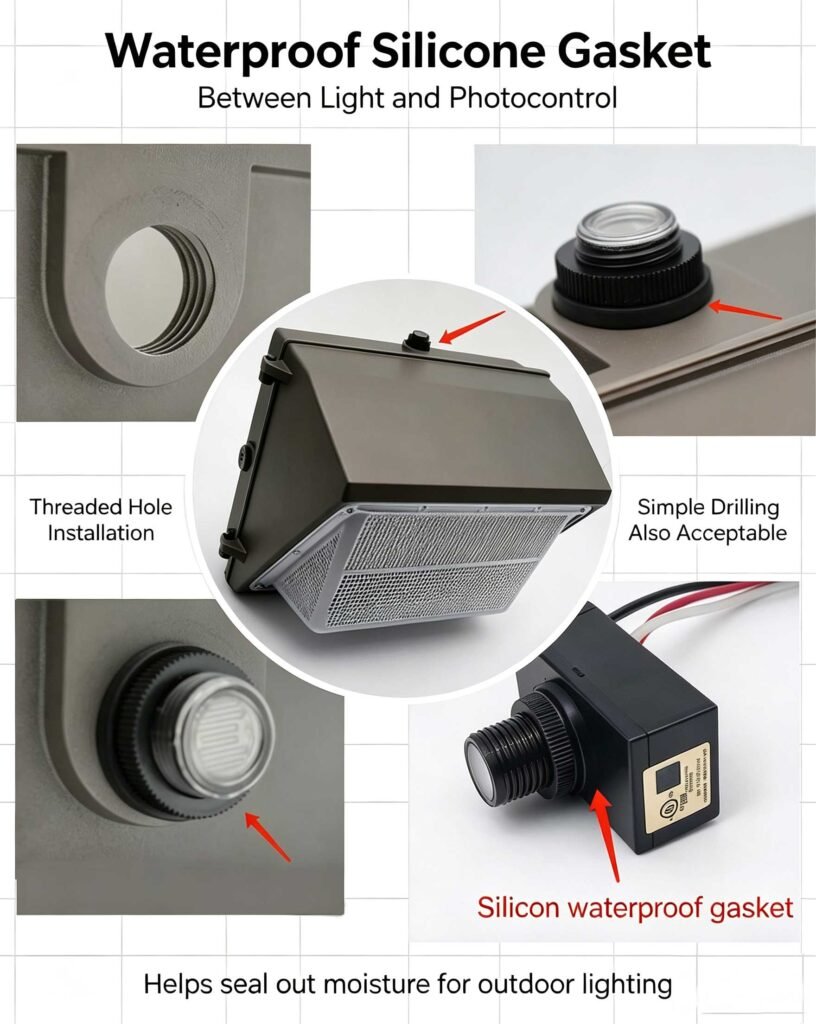
- Seals are damaged
- Connectors are not fully engaged
- The housing is not properly protected
Rain can expose the connection to water that affects its functioning. Checking every component’s IP rating during installation is advised.
Before installation, check:
- Gasket condition
- Proper connector engagement
- Housing condition
- Sealing around the connection
- Required IP protection
The Lead-Top LT600 specifies IP66 and IK09 protection.
Why Do Poor Electrical Connections Cause Intermittent Photocell Problems?
Loose connections make a photocontrol operate unpredictably. A weak contact may interrupt resistance at the connection point. Damaged wires and incorrect wire preparation can cause similar issues. These problems may appear as flickering and unexpected switching behavior.
What To Check
- Connection
- Confirm each wire is correctly connected.
- Tightness
- Inspect terminals and contacts for secure engagement.
- Insulation
- Wire insulation should be intact.
- Power test
- Verify stable power reaches the photocell.
- Operation test
- Check the lighting response after installation.
A practical sequence is:
Connection → Tightness → Insulation → Power Test → Operation Test
This helps separate connection faults from actual photocell problems.
Why Does a Photocell Sometimes Take Time to Switch?
Many photocontrols use a time delay to prevent unwanted switching from brief changes in ambient light. Intermatic, for example, lists delay features on its outdoor photocontrols to prevent unwanted OFF switching.
Lead-Top products in your supplied documentation also specify delays. LT124 uses a 3–10 second delay, while LT6001 specifies a 3–10 second turn-off delay.
This delay can help:
- Reduce false switching.
- Ignore brief light changes.
- Improve operating stability.
Always check the product specification before treating a delay as a fault.
Which Environmental Conditions Should You Consider During Photocell Installation?

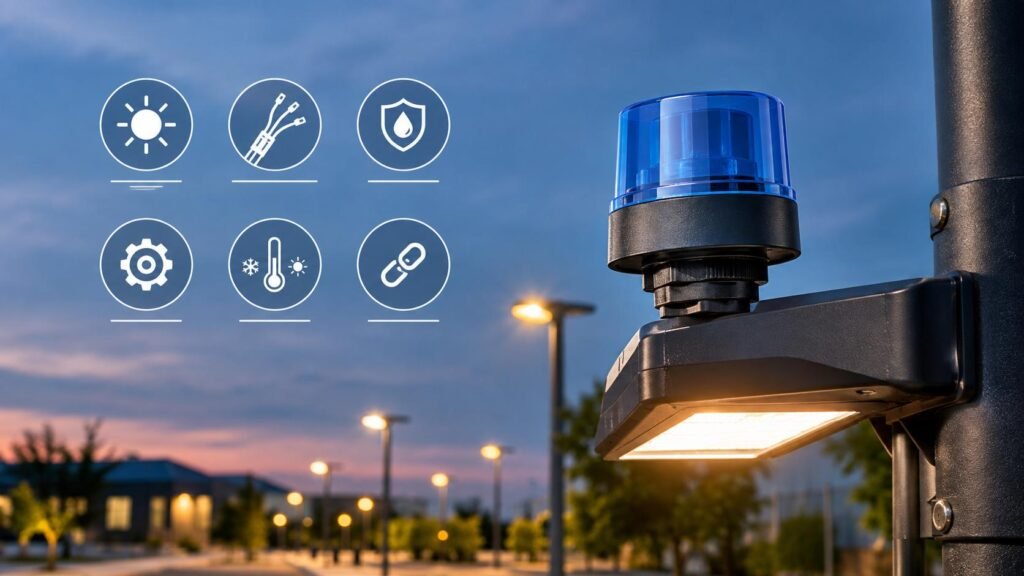
Outdoor photo switch sensors face extreme weather and mechanical impact. The product must be rated for the actual installation environment. For example, Lead-Top LT124 documentation specifies −40°C to +70°C, an anti-UV polycarbonate cover, PBT base, and IP66 protection, with optional IP67 and surge protection options.
Similar outdoor photocontrols are also specified with IP66 protection and −40°C to +70°C operating temperatures.
Before installation, check:
- Operating temperature range
- UV and weather protection
- IP rating
- Moisture exposure
- Mechanical impact requirements
- Surge protection
The LT600 also uses a PBT housing and silicone gasket, with IP66 and IK09 protection.
How Can an Incompatible Control Interface Affect LED Lighting?
Needs are different for modern lighting. They may use more than simple automation. The controller must match the control interface supported by the LED driver. Common interfaces include:
- ON/OFF
- 0–10V
- DALI
- Zhaga based systems
ANSI C136.41 specifically addresses control between external locking photocontrols and dimmable drivers. Think of the system as:
Photocell/Controller → Control Interface → LED Driver → LED Luminaire
Before installation, check:
- What control signal does the driver support?
- Does the controller provide that signal?
- Are the required contacts available?
- Does the receptacle match the control interface?
Mechanical fit alone does not confirm functional compatibility. The controller and LED driver should be checked as one system.
How Can You Use a Photocontrol Receptacle Installation Checklist?
A simple checklist can solve multiple issues even before they escalate. Lead Top recommends three-stage checks. Here are the details.
Checks Before Installation
- Voltage and load rating.
- Photocell and receptacle compatibility.
- LED driver and control interface.
- Environmental requirements.
Checks During Installation
- Model-specific wiring diagram.
- Sensor position.
- Connection security.
- Gasket and sealing.
- Problematic light sources.
Checks After Installation
- Test the power supply.
- Check ON/OFF response.
- Allow for the specified time delay.
- Observe operation under actual ambient-light conditions.
This three-stage check helps verify the installation from selection through final operation.
Which Lead-Top Photocell Solutions Fit Different Outdoor Lighting Applications?
Different lighting systems need different photocontrol features. Lead-Top offers twist-lock, dimming, and Zhaga-based options for various outdoor applications.
Standard Outdoor ON/OFF Control
LT124 is designed for 120–277V applications. It provides a 10–16 lux turn-on level, 3–10 second delay, 320J surge protection, and more than 10,000 switching operations. Its listed applications include:
- Street lighting
- Outdoor LED lighting
- Highways
- Parking lots
- Public areas
Heavy-Duty Outdoor Lighting
LT134 and LT154 are listed for higher-specification outdoor control applications. Lead-Top identifies these models with surge protection and long-life features for demanding lighting systems.
Zhaga-Based Smart Lighting
For modular systems, Lead-Top offers the LT600 Zhaga receptacle, LT6001 lighting controller, and LT6002 sensor. These products support Zhaga-based outdoor lighting architectures.

Final Words
Reliable photocell lighting starts with correct installation and suitable environmental protection. For dependable outdoor lighting control, Lead-Top offers photocontrollers and lighting interfaces designed for different applications. With the right photocell solution from Lead-Top, you can build a more reliable and consistent outdoor lighting system.

 English
 Portuguese (Brazil)
 Spanish
 Russian
 Dutch
 Japanese
 Portuguese (Portugal)