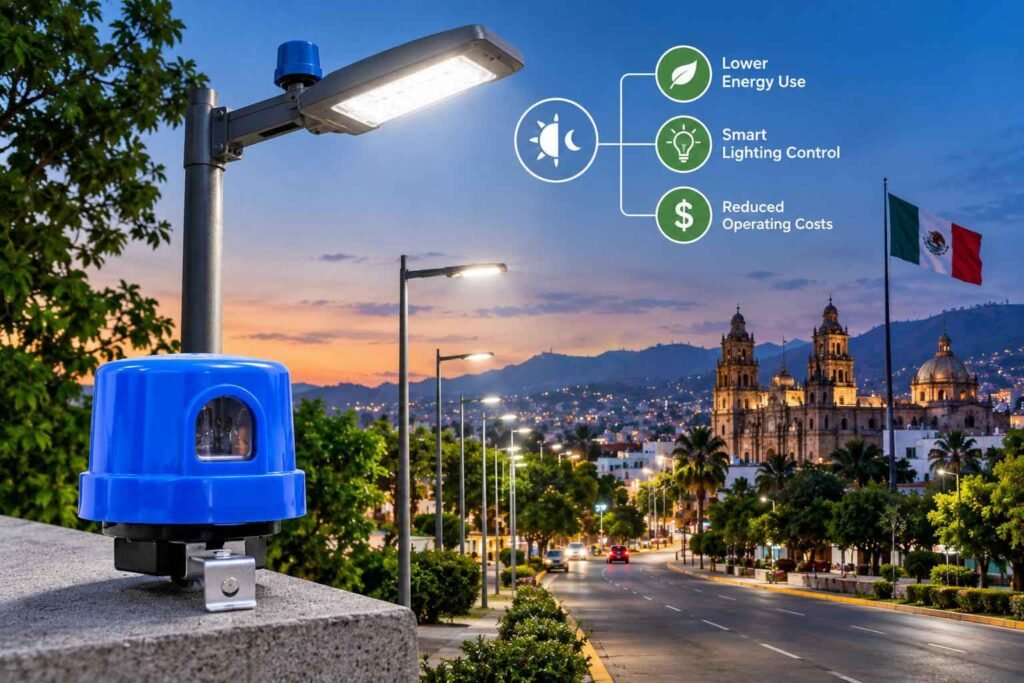
Mexico’s municipalities are upgrading street lighting to improve efficiency and reduce operating costs. LED street lights can lower energy use, but they still consume electricity when left on during daylight. This is where an outdoor light sensor switch becomes important.
A street light photocell detects ambient light and automatically switches the light accordingly. When combined with LED lighting, it helps control operating hours and avoid unnecessary energy use.
For large municipal networks, this simple control can support more consistent, energy-efficient street lighting while reducing avoidable daytime operation.
Why Does Energy Efficiency Matter in Mexico’s Street Lighting Systems?
Public lighting is a major municipal expense, and inefficient systems can increase electricity costs across thousands of lighting points. CONUEE has identified potential electricity savings of 20% to 89% across more than 475 public lighting projects in Mexico.
Mexico has already demonstrated the impact of efficient lighting upgrades. A World Bank-supported program improved street lighting across more than 5,000 km of streets in 20 municipalities and is expected to save over 575,000 MWh during the installations’ lifetime.
This makes energy efficiency a system-level priority. Municipalities need efficient LED luminaires and reliable lighting controls to avoid unnecessary operation.
How Does Combining LED Street Lights With Photosensors Improve Energy Efficiency?
LED luminaires are already a major efficiency upgrade for municipal lighting. CONUEE lists LED as an efficient public-lighting technology, with an average efficacy of about 85 lm/W and a typical life of 35,000–150,000 hours.
But efficient hardware is only part of the equation. A street light can still consume electricity when it operates outside the required lighting period.
How Does a Photocell Switch Control Street Light Operating Hours?
A light sensor photocell switch detects ambient light and controls the luminaire automatically. It can switch the light on as daylight fades and switch it off after daylight returns.
This helps reduce unnecessary daytime operation. It also supports consistent automatic switching without relying on manual switching.
Why Do LED and Photocell Controls Work Better Together?
Think of the system this way:
| Component | Main efficiency role |
| LED luminaire | Uses less energy to produce light |
| Photocell | Controls when the light operates |
| LED + photocell | Improves energy use and operating control |
CONUEE notes that well-designed municipal lighting systems should use efficient technology while consuming the minimum electricity needed for the required lighting level.
What Should Municipalities Consider When Selecting a Photocell for LED Street Lights?

Start with the electrical requirements. Check:
- Operating voltage and load rating.
- LED driver compatibility.
- Switching characteristics.
- LED inrush current.
- AC/DC requirements, where applicable.
Can the Photocell Provide Reliable Lighting Control?
The control should provide stable dusk-to-dawn switching. A suitable time delay can also help prevent unwanted switching caused by brief changes in ambient light.
Can the Photocell Withstand Mexico’s Outdoor Environment?
Street-light controls face rain, humidity, dust, heat, and UV exposure. Appropriate IP protection and weather resistance are therefore important for long-term outdoor operation.
Does the Photocell Use a Standardised Connection?
For municipal projects, standardised connections can simplify installation and replacement. NEMA photocontrol sockets can also make field maintenance more manageable.
Which Lead-Top Photocell and Receptacle Combination Can Support These Requirements?
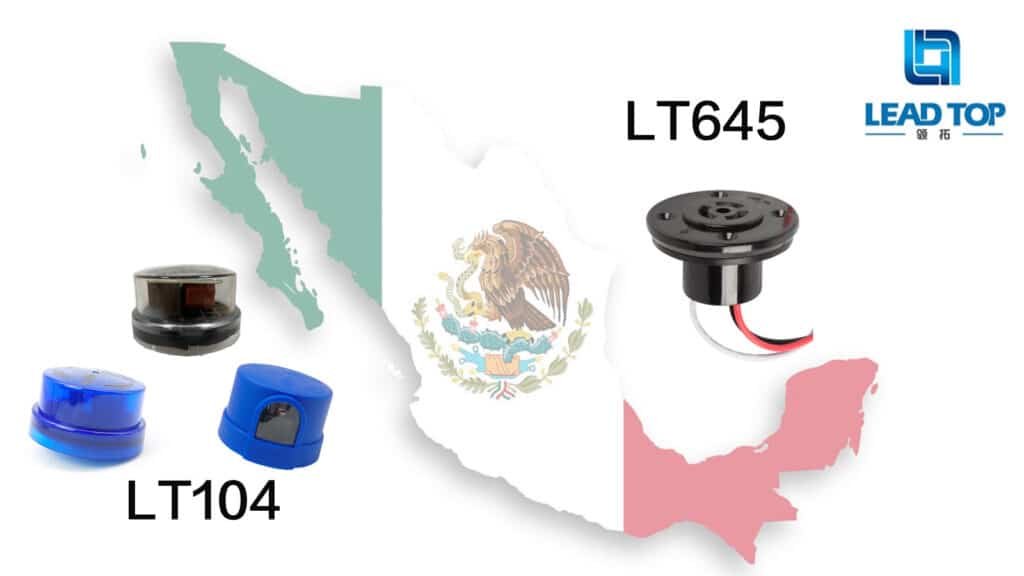
LT104 Photo Controller
- AC 120–277V and DC 12/24V.
- 3–10-second delay.
- MOV surge protection up to 160J.
- IP65 protection, with optional IP66/IP67 configurations.
- ANSI C136.24 and UL773A compliant.
LT645 / LT645B Receptacle
The LT645/LT645B provides a compatible socket connection for the photocontroller. Its weather-resistant design supports outdoor installations and routine replacement.
Why Does the LT104 + LT645/LT645B Combination Make Sense?
This is a practical control setup for large outdoor lighting networks. The key is matching the photocell, receptacle, luminaire, and electrical system before installation.
CONUEE also recommends evaluating existing electrical installations, equipment quantities, technologies, and proposed replacement equipment during municipal lighting projects.
Where Can Photocells Improve Energy Efficiency in Mexico’s Municipal Lighting Networks?
Can Photocells Be Used for Urban and Residential Street Lighting?
Yes. Photo sensors can support lighting both on residential streets and in public spaces. They automate switching based on ambient light. This reduces reliance on manual schedules and helps avoid unnecessary daytime operation.
How Can Photocells Support Mexico’s LED Street Light Retrofit Projects?
A retrofit is a good time to review the complete lighting system. CONUEE recommends assessing existing equipment, power ratings, electrical installations, and proposed efficient technologies before replacement.
Photocells can be upgraded alongside LED luminaires to improve automatic control.
Why Are Standardised Photocells Useful for Large Municipal Lighting Networks?
Standardisation simplifies replacement, maintenance, and inventory. It also helps crews work with consistent components across many lighting points.
How Can Mexican Municipalities Improve Street Lighting Energy Efficiency Step by Step?
A practical approach is to treat the project as a system upgrade, not simply a lamp replacement. CONUEE’s guidance calls for a detailed assessment before selecting replacement equipment.
| Step | What to Check |
| 1. Evaluate | Technology, wattage, circuits, operating condition |
| 2. Upgrade | Select efficient LED luminaires |
| 3. Review controls | Check existing photocell compatibility |
| 4. Standardise | Use compatible photocells and receptacles |
| 5. Measure | Track energy use, reliability, and maintenance |
This approach aligns with Mexico’s municipal efficiency programs, which focus on replacing inefficient systems with efficient technologies and verifying expected energy savings.
FAQs
How does a photocell improve street lighting energy efficiency?
A photosensor detects ambient light and automates switching based on daylight. This helps prevent unnecessary operating hours and electricity use.
Do LED street lights need photocells?
LED street lights do not always require photocells, but they can benefit from automatic lighting control. The combination helps municipalities control when efficient luminaires actually consume electricity.
What should I consider when selecting a photocell for LED street lights?
Check voltage, load capacity, LED driver compatibility, switching characteristics, surge protection, IP rating, and socket compatibility. The photocell should also suit the project’s outdoor conditions.
Can photocells be used in municipal LED retrofit projects?
Yes. Photocontrols can be reviewed or replaced during an LED retrofit. CONUEE recommends evaluating the luminaires, drivers, controls, electrical system, and other project components during municipal lighting upgrades.
How does LED + photocell improve street lighting efficiency?
LEDs reduce the energy needed to provide illumination, while photocells control operating hours. Together, they address both how efficiently a light operates and when it operates.
What photocell is suitable for Mexico’s outdoor lighting applications?
A suitable photocell should match the luminaire’s electrical requirements and withstand outdoor exposure. For municipal applications, the Lead-Top LT104 with LT645/LT645B receptacle is one practical option based on the specifications discussed in this article.
How Can Photocells Support More Energy-Efficient Street Lighting in Mexico?
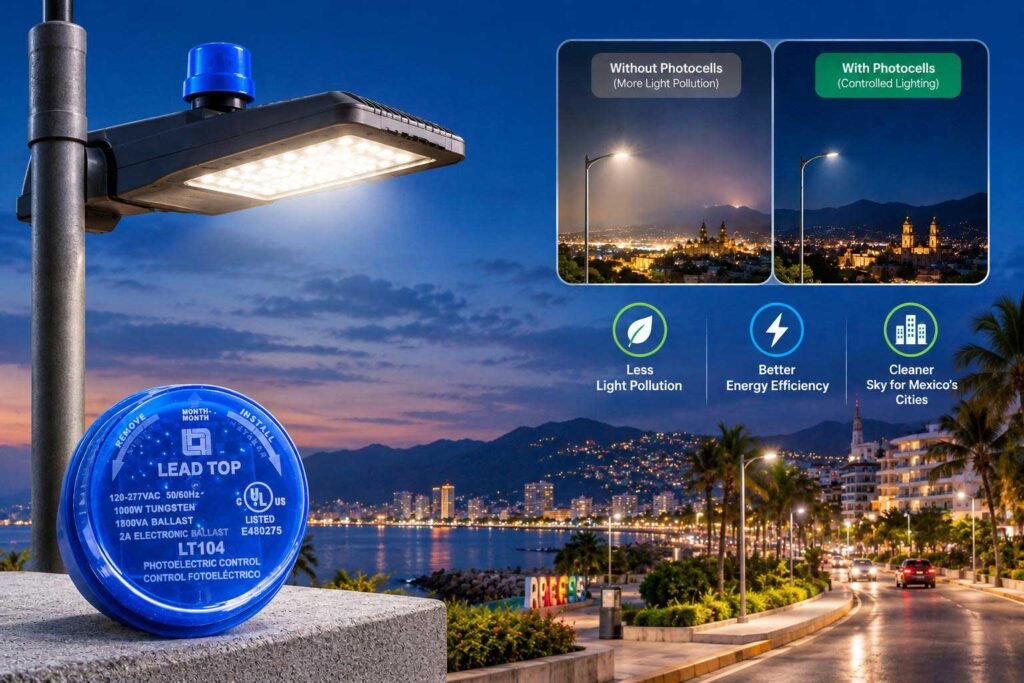
Photocells help control when street lights operate, reducing unnecessary daytime operation.
Mexico’s CONUEE states that efficient public lighting should provide adequate illumination while consuming as little electricity as possible. Its municipal efficiency program also focuses on replacing inefficient lighting systems with efficient technologies.
For municipalities, the goal is therefore broader than replacing luminaires. LEDs, reliable photocells, and compatible receptacles can work together to create a more controlled and energy-efficient street lighting system.
Final Words
Efficient street lighting requires more than LED upgrades. Reliable photocells help control operating hours and prevent unnecessary energy use. For dependable photocontrols and compatible NEMA receptacles, Lead-Top offers practical solutions for municipal lighting projects. Explore the right combination for your Mexico street lighting application.



 English
  Portuguese (Brazil)
  Spanish
  Russian
  Dutch
Dutch  Japanese
  Portuguese (Portugal)