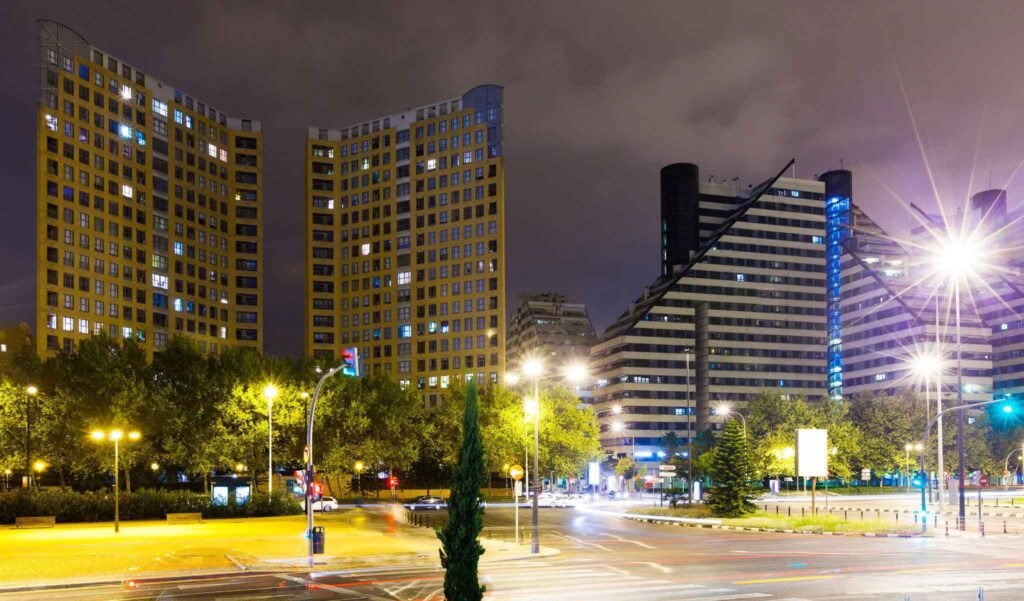
In Argentina, many municipalities are upgrading their streets with LED luminaires. Installations along Avenida Juan Muzzio in Puerto Madryn are a recent example.
However, efficient lighting requires more than modern fixtures. It also needs reliable controls to prevent unnecessary daytime operation. Light photocell sensors offer a practical solution by switching compatible streetlights according to ambient light levels.
They can also simplify installation and maintenance when paired with compatible locking connectors and NEMA receptacles. For municipalities and contractors, choosing the right photocontrol is an important step toward reliable outdoor lighting.

Why Does LED Street Lighting Modernization Require Better Lighting Control?
Urban areas increasingly need outdoor lighting that is both efficient and operationally reliable. However, relying entirely on manual switching has clear limitations:
- Staff availability at the right time, every day, across potentially many fixtures is critical.
- It doesn’t adjust automatically for seasonal changes in day timing.
- Lights not switched properly lead to energy waste and compromise safety.
Photo switch sensors address this by automatically switching lighting according to natural light conditions. This removes the need for manual intervention and adjusts naturally as day length changes through the year.
Typical Application Scenarios
- Urban roads and avenues
- School zones and pedestrian crossings
- Bus stops and taxi stands
- Public squares and community spaces
- Parking areas and security lighting
How Does a Normal-Voltage Photocontrol Work with LED Streetlights?
They sense ambient light levels and switch connected streetlights accordingly. This behavior supports fully automatic outdoor lighting operation without a timer or manual schedule to maintain.
Main Selection Criteria
| Criteria | Why It Matters |
| Rated voltage and frequency | Must match the supply voltage of the streetlight system |
| LED driver load and switching requirements | LED drivers can draw inrush current at switch-on, which the photocontrol’s rating must accommodate |
| Turn-on light level and time delay | Determines how the control responds to dusk/dawn conditions and brief changes in ambient light |
| Surge protection requirements | Affects resilience against grid voltage spikes and lightning-related surges |
| Operating temperature and ingress protection | Determines suitability for the local climate and outdoor exposure conditions |
The photo switch sensor must match the luminaire’s electrical specifications and installation requirements — a mismatch in any of these areas can result in unreliable switching or premature component failure.
Why Choose a Twist-Lock Photocontrol and NEMA Receptacle Combination?
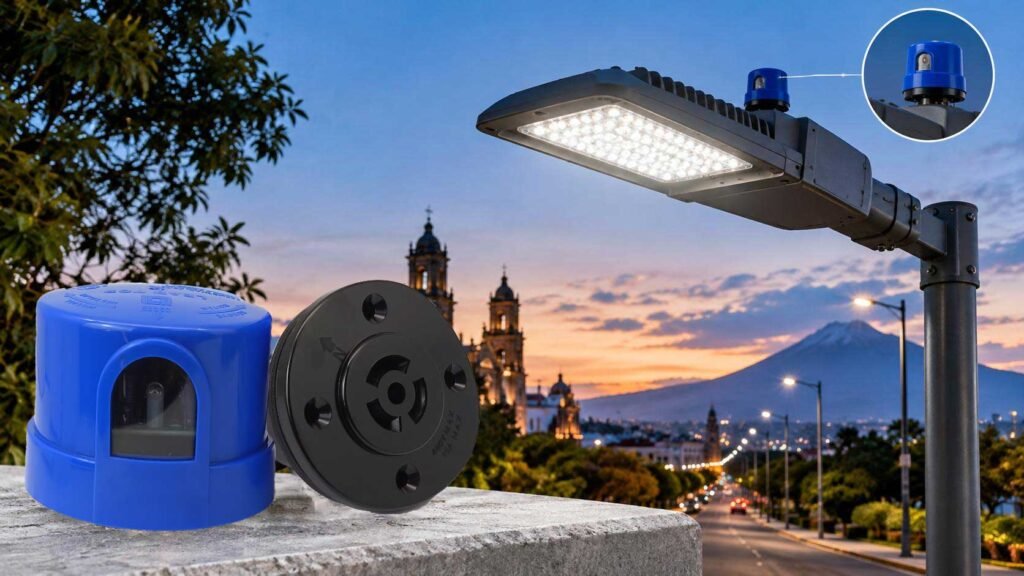
A twist-lock light sensor control is designed to plug into a matching NEMA receptacle mounted on the luminaire and lock in place with a quarter turn, rather than being hard-wired directly into the fixture.
This modular interface can simplify photocontrol replacement and routine maintenance, since a worn or faulty unit can generally be unplugged and swapped without disturbing the luminaire’s internal wiring — provided the replacement matches the receptacle’s configuration.
Benefits of a Compatible Interface
- Convenient installation and replacement — no rewiring required for a matching twist-lock unit
- More standardized mounting arrangements — consistent hardware across a large fixture base
- Easier maintenance of compatible luminaires — field crews can service more fixtures with fewer unique parts
Before selecting a combination, buyers must verify:
- The receptacle configuration
- Contact arrangement
- Voltage rating
- Applicable standards such as ANSI C136.10
How Should Contractors Select an Automatic Light Sensor for Different Outdoor Lighting Projects?

Different projects call for different photocontrol designs, depending on budget, electrical requirements, and the switching technology preferred.
| Product Model | Recommended Application Focus | Key Features to Discuss |
| LT104 | Cost-conscious outdoor lighting projects | Cost-effective electronic twist-lock photocontrol |
| LT110 Series | Applications requiring thermal-type photocontrols | Thermal switching design |
| LT124 | General-purpose LED street lighting | Standard electronic design and zero-crossing detection |
| LT134 | Projects prioritizing long-life design | Long-life features and higher electronic ballast load rating |
| LT154 | Heavy-duty outdoor lighting | Heavy-duty design and high-inrush-current protection |
| LT164 | Applications requiring electromagnetic photocontrols | Electromagnetic switching design |
Product selection should be based on rated voltage, load compatibility, installation requirements, and project specifications — not on price or product category alone.
A contractor should confirm the exact electrical ratings and switching design of any model against the specific luminaire and application before standardizing on it for a project.
Where Can Twist-Lock Photocontrols Be Used Beyond Main Roads?
While street lighting on major avenues is the most visible application, normal-voltage street light controllers support a range of outdoor lighting applications when the electrical ratings and mounting interfaces are compatible:
- Residential streets and neighborhood roads
- Public parking lots
- Commercial building exteriors
- Industrial facilities and perimeter lighting
- Parks and public spaces
- Outdoor security lighting
In each case, match the photocontrol’s:
- Voltage rating
- Load capacity
- Receptacle interface
They need to be compatible with the fixture and installation it’s paired with.

Product Recommendation
1. LT104 — Cost-Effective Twist-Lock Photocontrol
The LT104 is positioned as an economical option for compatible outdoor lighting applications. Catalog specifications include a 120–277V rated voltage, a 10–16 lux turn-on light level, and IP66 ingress protection.
It’s worth considering for cost-conscious street lighting projects where a straightforward, budget-friendly photocontrol fits the scope.
2. LT124 — Standard Zero-Crossing Twist-Lock Photocontrol
The LT124 is suited to general-purpose LED street lighting applications. It features zero-crossing detection, a 2–5-second time delay, and available surge protection options depending on configuration.
Electrical compatibility and the required protection configuration should be verified before ordering, since surge protection levels and exact load ratings can vary by variant.
3. LT500 Series — 3-Pin NEMA Mounting Receptacle
These products serve as a mounting and electrical interface for compatible locking photocontrols. This helps field crews to swap a photocontrol without modifying the fixture’s wiring.
FAQ
1. Why do LED streetlights need a photocontrol?
A photocontrol automatically switches compatible LED streetlights based on ambient light levels. This reduces unnecessary daytime operation.
2. What is the advantage of a twist-lock photocontrol?
It allows convenient installation and replacement through a compatible receptacle. This simplifies routine maintenance of outdoor lighting systems.
3. Can any photocontrol work with any LED streetlight?
No. The photocontrol must match the streetlight’s
- Voltage
- LED driver load
- Mounting interface
- Switching requirements
- Environmental conditions
4. Which Lead-Top photocontrol is suitable for street lighting?
The LT104 is for low-budget projects. The LT124 offers zero-crossing detection for general applications. The LT134 and LT154 may suit projects requiring their specific design features.
5. Can a NEMA receptacle be used with every twist-lock photocontrol?
No. The receptacle and photocell must have compatible:
- Mounting interfaces
- Contact configurations
- Electrical ratings
- Applicable standards
The Bottom Line
Lead Top offers normal-voltage twist-lock photocontrols and compatible NEMA receptacles for a range of outdoor lighting applications. Contact our team to discuss your rated voltage, LED driver load, mounting interface, and project requirements.

 English
 Portuguese (Brazil)
 Spanish
 Russian
 Dutch
 Japanese
 Portuguese (Portugal)