Puebla’s municipal government has reported progress on Puebla Brilla. This lighting program has installed more than 41,000 luminaires across streets and outlying communities in Puebla Capital. The program’s stated goal is to modernize public lighting and improve outdoor visibility for residents.
Projects of this scale illustrate a point that often gets overlooked in LED modernization: replacing the light source is only part of the job. Selecting suitable control components — the parts that turn a streetlight on at dusk and off at dawn — is just as important to how reliably the system performs over its service life.
This article looks at why LED streetlights still need photocell sensors, how twist-lock photocontrols and NEMA receptacles work together, and what to review when selecting compatible control components for an LED modernization project.

Image Courtesy: Expedia
What LED Modernization Means for Public Lighting Systems?
A program covering tens of thousands of luminaires across a city, as the one reported for Puebla, involves considerable coordination — different streets, different fixture ages, and installation work carried out over an extended timeframe.
A few points generally apply to projects of this scale:
Compatibility Check
It’s important to consider:
- Luminaire specifications
- Electrical infrastructure
- Control components
These all need to be checked together. A new LED fixture paired with an incompatible control component can undermine the reliability the upgrade was meant to deliver.
Weather Resistance
Extended operation depends on planning for inspection and replacement, not just initial installation. Control components experience years of outdoor exposure and eventually need servicing, regardless of how new the luminaire is.
Real Outcomes
LED conversion alone does not eliminate the need for lighting controls. The light source change reduces energy use per fixture, but actual results depend on the full system — including how reliably the lights switch on only when needed.
Why LED Streetlights Still Need Photocontrol Switches?
LED technology does not automatically provide automatic switching. An LED luminaire is still simply a light source. It’s something else in the circuit that senses ambient light and decides when to switch the fixture on and off.
That’s the role a photocontrol plays:
- It uses a light sensor to detect ambient light levels.
- When light falls below a set threshold, it closes the circuit and switches the connected lighting load on; at dawn, it reverses the process.
- Electronic photocontrols — as opposed to older thermal or electromechanical designs — can generally be considered for suitable LED applications, since they typically offer more stable switching behavior.
One detail matters more with LED fixtures than it did with older lighting technologies: inrush current. LED drivers can draw a brief surge of current at switch-on, and a photocontrol’s ratings need to account for this, not just the steady-state wattage of the fixture.
Matching photocontrol ratings to the LED driver’s characteristics and inrush current is a basic compatibility check for any LED modernization project.
How Twist-Lock Photocontrols Integrate with NEMA Receptacles?
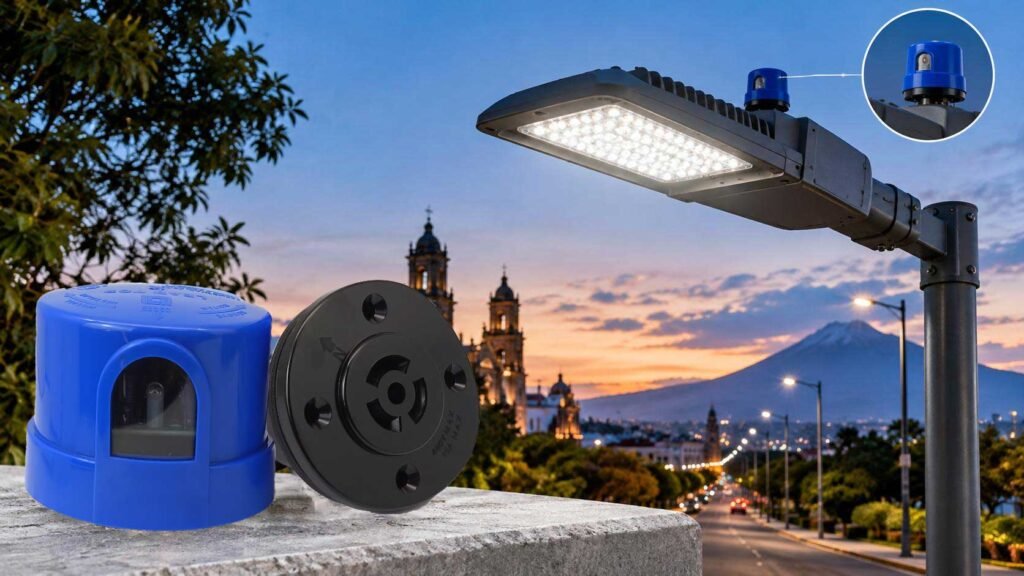
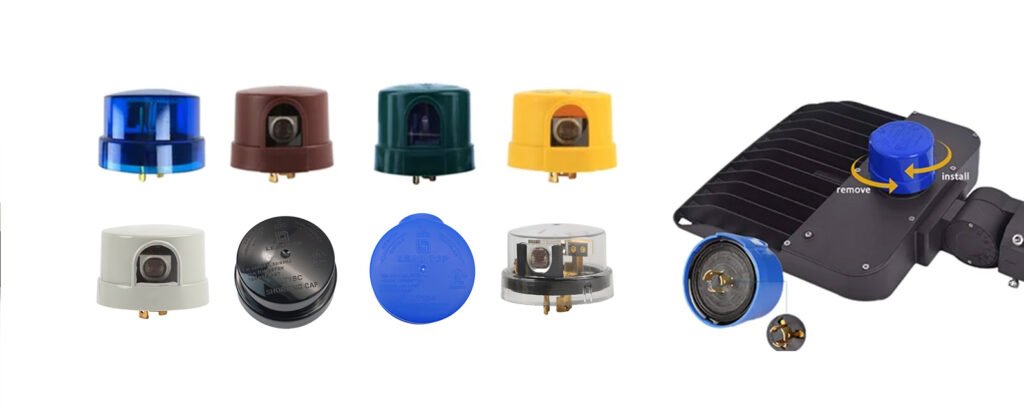
A twist-lock photocell switch is designed to plug into a matching receptacle on the luminaire and lock in place with a quarter turn, rather than being hard-wired into the fixture. This interface has two sides:
| Component | Role |
| Twist-lock photocontrol | Senses ambient light and switches the connected circuit automatically |
| NEMA receptacle | The luminaire-side connection point that the photocontrol plugs into |
This design can make replacement and maintenance more straightforward in the field. A faulty photocell lighting sensor can generally be unplugged and replaced without disturbing the fixture’s internal wiring.
Further, it’s important to confirm the receptacle configuration at the luminaire specification stage, not left for later. Getting this wrong after installation means either sourcing a different photocontrol format or modifying the fixture.
Standard 3-Pin vs. 5-Pin or 7-Pin Receptacles
Not all NEMA receptacles serve the same function:
- 3-pin receptacles provide a basic switching interface — line, load, and neutral. They comply with ANSI C136.10.
- 5-pin and 7-pin receptacles add contacts for dimming and signaling functions. This supports more advanced lighting control. They comply with ANSI C136.41.
A standard on/off light sensor photocell switch is built for the 3-pin interface. If a project requires dimming or communications functionality, it needs a receptacle and controller designed for that purpose — the two interface types are not interchangeable.
How to Select a Photocontrol for an LED Streetlight Upgrade?
A few specification points are worth reviewing before standardizing on a photocontrol for an LED modernization project:
● Voltage
Confirm whether the system operates at 120V, 208–277V, or another supported voltage range.
● LED load
Review the driver’s rated load and inrush-current characteristics.
● Switching performance
Compare the light threshold, time delay, and switching design (such as zero-crossing detection) between candidate products.
● Environmental protection
Consider the IP rating and operating temperature range for the local climate.
● Maintenance
Consider how standardizing on a consistent receptacle and photocontrol format simplifies future replacement across a large fixture base.
● Interface
Confirm whether the project needs basic 3-pin switching or an advanced dimming interface.
Product Recommendation
For compatible LED streetlighting systems, the following options are worth reviewing.
| Model | Positioning | Notes |
| LT124 + compatible 3-pin NEMA receptacle | Standard zero-crossing electronic photocontrol for suitable 120–277V applications | 5A E-Ballast rating, 2–5 second time delay, IP66 protection (IP67 optional) |
| LT134 + compatible 3-pin NEMA receptacle | Long-life electronic photocontrol | Stated 8A E-Ballast rating at both 120V and 277V; a candidate where that electrical capacity is required |
| LT154 + compatible 3-pin | NEMA receptacle Heavy-duty electronic photocontrol | High-inrush-current protection and zero-crossing detection; consider after verifying load and operating requirements |
| LT605 or LT605R 5-pin/7-pin receptacle | For ANSI C136.41 dimming interfaces | Use when the project requires dimming rather than a standard on/off interface; confirm compatibility with the chosen photocontrol, luminaire, and dimming system |
Selection note
A standard on/off photocontrol should not be used as a substitute for a dimming controller when the project requires dimming or communications functionality — the two serve different control requirements.
How Lead Top Photocontrols Fit into LED Modernization Projects?
Locking light sensor switches play a straightforward but essential role in compatible LED luminaires: sensing ambient light and switching the fixture automatically, without requiring manual operation.
Lead Top’s product range is diverse. Each photosensor is suited to different combinations of budget and operating conditions:
- Economical options suit projects where cost and straightforward replacement are the priority.
- Standard options (such as LT124) suit typical 120–277V LED applications with moderate load requirements.
- Long-life options (such as LT134) suit projects needing higher-rated electrical capacity.
- Heavy-duty options (such as LT154) suit higher-load or harsher-environment applications.
Compatible NEMA receptacle products — in both standard 3-pin on/off and 5-pin/7-pin dimming configurations — are also available to match these photocontrol options.
For any large-scale modernization project, project teams should verify specifications against their specific luminaire, voltage, and load requirements before standardizing components across a fleet of fixtures.
FAQ
Do LED streetlights need photocontrols?
LED streetlights need a suitable control method if automatic dusk-to-dawn operation is required. A compatible photocontrol is one option for providing that function.
What is the difference between a 3-pin and a 5-pin or 7-pin NEMA receptacle?
A standard 3-pin interface is generally used for on/off control. ANSI C136.41 5-pin and 7-pin interfaces add contacts for dimming or signaling functions.
Which Lead Top photocontrol is suitable for LED streetlights?
LT124, LT134, and LT154 are potential options for compatible normal-voltage systems. The appropriate choice depends on:
- Rated voltage
- Driver load
- Inrush current
- The specific requirements of the project
Can an LED streetlight modernization project reuse its existing NEMA receptacles?
Potentially, provided the existing receptacles are in suitable condition and are compatible with the new photocontrol and the complete lighting system.
Final Words
Explore Lead Top‘s electronic twist-lock photocontrols and NEMA receptacles for outdoor LED lighting. Contact our team to discuss product specifications and component matching for your next modernization project.

 English
 Portuguese (Brazil)
 Spanish
 Russian
 Dutch
 Japanese
 Portuguese (Portugal)