Outline
- Introduction
- Why Does Mexico City Need Reliable Street Lighting for Public Safety?
- How Has Mexico City Expanded and Modernized Its Street Lighting Infrastructure?
- Does More Street Lighting Always Mean Better Public Safety?
- What Are the Energy and Environmental Challenges of Extended Street Lighting?
- Why Does Mexico City Need Better Outdoor Lighting Control?
- How Can Photocell Switches Improve Mexico City Street Lighting?
- Which Lead-Top Photocell and NEMA Receptacle Combination Fits Municipal Lighting Upgrades?
- FAQs
- Final Words
Mexico City Street Lighting: From Public Safety to Sustainable Urban Lighting
Reliable street lighting is critical for safer roads and nighttime mobility. But modern urban lighting involves more than adding new fixtures. The city also needs to manage energy use, reduce unnecessary lighting, and limit light pollution. This is where LED modernization and better lighting control become important.
LED street lighting can reduce energy demand, while photocells can help ensure lights operate only when needed. From public safety to sustainability, Mexico City’s lighting evolution shows why efficient infrastructure and automatic control must work together.

Why Does Mexico City Need Reliable Street Lighting for Public Safety?
Efficient lighting is closely tied to how people use roads and public spaces after dark. In Mexico City, local governments are treating lighting as part of public safety and public space recovery efforts. In Cuauhtémoc, the Brilla Cuauhtémoc program has targeted streets and other poorly lit areas to improve visibility and security.
The need is not limited to major roads. Lighting, if not managed well, can discourage nighttime activity. Conversely, better lighting can help boost people’s confidence and economic activities.
Recent projects show this safety focus clearly. The Cuauhtémoc 2025 program is a related example where more than 8,000 new luminaires have been installed across its neighborhoods. The initiative has specifically linked new lighting with safer streets and improved mobility.
How Has Mexico City Expanded and Modernized Its Street Lighting Infrastructure?
Mexico City is moving beyond simple fixture replacement. Current projects combine expanded coverage with LED modernization. A related project in Álamos City was announced in September 2025 and aimed to add more than 1,900 new LED luminaires for streets and public spaces.
The modernization is also reaching major urban areas. Government procurement records show LED infrastructure renewal projects in several sections of the Historic Center under the Ciudad Iluminada, Comunidad Segura program. These projects began in November 2025 and continued into March 2026.
| Modernisation focus | Current direction |
| Street coverage | New luminaires in roads and public spaces |
| Technology | Increasing use of LED |
| Public safety | Better visibility in underserved areas |
| Infrastructure | Renewal of existing lighting networks |
| Efficiency | Lower-energy lighting technology |
This shift matters because LED Street Lighting Mexico projects are changing both the hardware and the operating efficiency of municipal lighting networks.
Does More Street Lighting Always Mean Better Public Safety?
Not necessarily. Lighting must be placed where it improves visibility and supports nighttime activity. In Cuauhtémoc, the Brilla Cuauhtémoc program targets streets, parks, and areas with poor visibility. Its projects are explicitly linked to public-space recovery and crime prevention.
The bigger issue is how efficiently that light is used. A sustainable system should consider:
- Where lighting is needed.
- How much illumination is appropriate.
- When lights should operate.
- How light is distributed.
This matters because excessive or poorly directed light can create glare without improving visibility. Mexico’s LED lighting standard also addresses light distribution and glare limits for public outdoor luminaires.
What Are the Energy and Environmental Challenges of Extended Street Lighting?

Large municipal lighting networks can create substantial electricity demand. That makes efficiency important even when cities are switching to LED. Mexico’s NOM-031-ENER-2019 establishes minimum efficiency requirements for LED luminaires used on public roads and outdoor areas. The standard is designed to promote more efficient lighting equipment.
Mexico City projects show the potential impact. Cuauhtémoc reported that its LED program could reduce energy spending by 50–70% and cut about 1,400 tonnes of CO₂ emissions.
But energy is only part of the challenge. Mexico City’s environmental authority defines light pollution as excessive or poorly directed artificial light that alters natural nighttime conditions and can affect human rest.
Why Does Mexico City Need Better Outdoor Lighting Control?
Mexico City’s lighting network is becoming more efficient, but efficient luminaires still need proper operating control. NOM-031-ENER-2019 sets energy-efficiency requirements for LED luminaires used on public roads and outdoor areas. But the standard focuses on the luminaire itself. Municipalities also need to control when those luminaires operate.
Better Outdoor Lighting Control can help municipalities:
- Prevent unnecessary daytime operation.
- Maintain consistent dusk-to-dawn switching.
- Reduce avoidable operating hours.
- Support more efficient LED installations.
- Simplify control across large lighting networks.
This becomes especially important during large-scale LED modernization. Replacing thousands of fixtures improves the hardware. Reliable automatic control improves how that hardware is used.
How Can Photocell Switches Improve Mexico City Street Lighting?
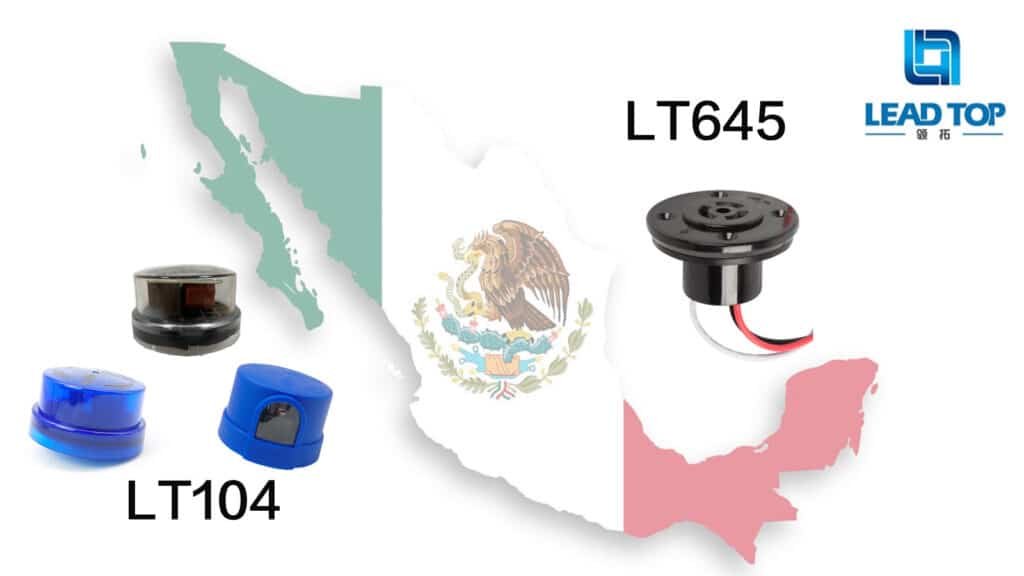
A Street Light Photocell adds automatic light-based control to individual lighting points. It responds to ambient conditions instead of relying on manual switching. Locking-type photocontrols and their mating receptacles are covered by ANSI C136.10, which establishes physical and electrical interchangeability requirements for these components.
Photocontrol Receptacle Provides Automatic Street Light Control
Yes, they automate lighting based on the availability of daylight. This supports dependable Dusk-to-Dawn Photocell operation.
Photocells Improve Street Lighting Energy Efficiency
The main benefit is operational. Lights do not need to remain energized during daylight. This can help reduce unnecessary operating hours across municipal networks.
Twist-Lock Photocells Simplify Municipal Maintenance
A locking-type light sensor control can be removed and replaced at the lighting point. The standardized receptacle interface supports practical field maintenance.
Photocells Support LED Street Lighting Retrofits
Yes. An outdoor light sensor switch can be incorporated into an LED retrofit where the luminaire uses a compatible receptacle. This allows municipalities to upgrade both lighting technology and automatic control as part of the same modernization effort.
Which Lead-Top Photocell and NEMA Receptacle Combination Fits Municipal Lighting Upgrades?
The LT134 Standard Zero-Crossing Twist-Lock Photo Control paired with the LT625 ANSI C136.10 3-Pin Receptacle provides a straightforward control setup for outdoor lighting. ANSI C136.10 covers locking-type photocontrols and their mating receptacles for roadway and area lighting.

This combination works for Municipal Lighting
The combination supports a standardized twist-lock installation. The LT134 provides automatic lighting control, while the LT625 provides the matching receptacle interface.
| Component | Main role |
| LT134 | Automatic dusk-to-dawn photocontrol |
| LT625 | ANSI C136.10 3-pin receptacle |
Applications
It can fit:
- Municipal street lighting
- Roadway lighting
- Public-space lighting
- LED retrofit projects
- Outdoor lighting upgrades
This diversity of use makes the combination practical for projects requiring repeatable installation and easier field replacement.
FAQs
1. Why is street lighting important in Mexico City?
It’s obvious that efficient lighting improves visibility on roads and public spaces after dark. With Mexico’s aim to offer a better living environment for its residents, reliable lighting can help to achieve this goal.
2. How is Mexico City modernizing its street lighting infrastructure?
The city is expanding lighting coverage while upgrading existing infrastructure. Recent projects include major interventions in the Historic Center and continued LED adoption for outdoor lighting.
3. How can a photocell improve street lighting efficiency?
A light sensor can automatically switch lights. This helps prevent unnecessary daytime operation, reducing power consumption.
4. Can photocells be used with LED street lights?
Yes. Photocells can be used with compatible LED street-lighting systems and standardized receptacles. They can therefore be incorporated into LED retrofit and municipal lighting projects.
5. Can photocells help reduce light pollution?
Yes, indirectly. By switching lights off when daylight is sufficient, photocells can reduce unnecessary artificial lighting. However, reducing light pollution also requires proper fixture design, light distribution, and appropriate operating levels.
Final Words
Mexico City’s lighting goals now go beyond adding more fixtures. Efficient LEDs need reliable control to reduce unnecessary operation and support sustainable urban lighting.
For municipal upgrades, Lead-Top offers photocontrollers and NEMA receptacles designed for outdoor and street-lighting applications, including the LT134 twist-lock photocontrol.
If you are planning a lighting project in Mexico, Lead-Top can help you select the right photocontrol solution for your application.
External Links
- https://cuauhtemoc.cdmx.gob.mx/2025/10/10/brilla-cuauhtemoc-iluminan-10-kilometros-para-tener-mas-seguridad-en-la-condesa/
- https://www.iea.org/policies/11641-nom-031-ener-2019-energy-efficiency-of-led-luminaires-for-roads-and-public-outdoor-areas-specifications-and-testing-methods
- https://www.ansi.org/
- https://www.nema.org


 English
  Portuguese (Brazil)
  Spanish
  Russian
  Dutch
Dutch  Japanese
  Portuguese (Portugal)