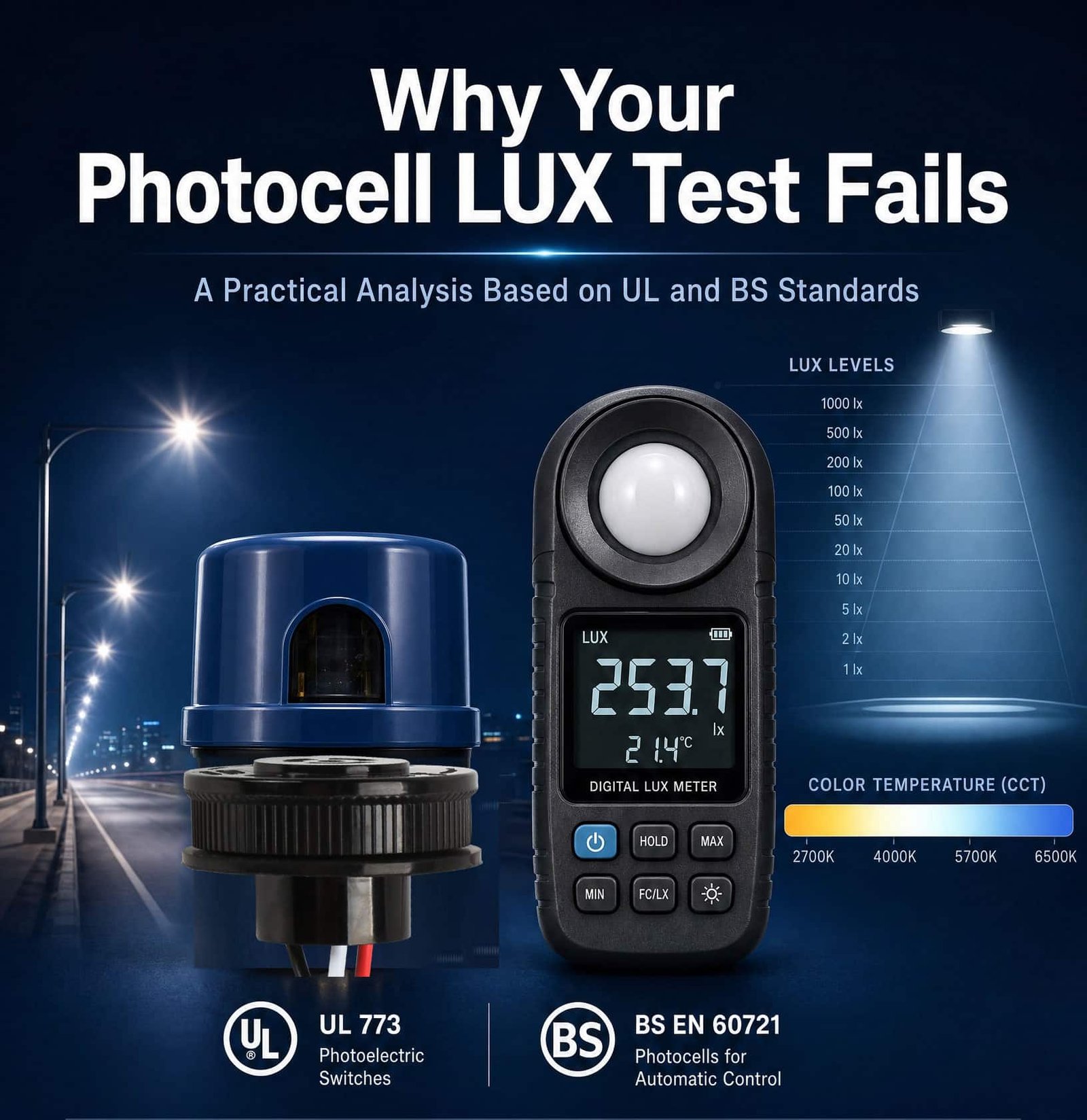
Introducción: ¿Por qué son tan importantes los ajustes de LUX en las aplicaciones de fotocélulas?
En los sistemas de iluminación exterior contemporáneos, los ajustes LUX (iluminancia) controlan cuándo una célula fotoeléctrica Enciende o apaga las luces. Estos umbrales influyen directamente en la eficiencia energética, la seguridad y la fiabilidad del sistema.
Sin embargo, surgen numerosos problemas en los proyectos cuando los valores de LUX medidos durante las pruebas no coinciden con las expectativas. Esto suele provocar malentendidos, conflictos entre compradores y contratistas, y el rechazo innecesario del producto.
En realidad, la mayoría de estos problemas no se deben a productos defectuosos, sino a confusiones relacionadas con los requisitos del estándar de lux de las fotocélulas y las condiciones de prueba. Los valores de lux no son absolutos; varían según la fuente de luz, la atmósfera y el método de medición.
Comprender este principio es importante para evitar errores en la medición de lux y garantizar una evaluación exacta.
¿Cuáles son los principales estándares de lux para fotocélulas que se utilizan a nivel mundial?
La industria internacional de la iluminación se rige principalmente por dos normas: UL773 y BS. Estas normas describen cómo se debe probar y evaluar el rendimiento de las fotocélulas.
¿Por qué existen diferentes estándares?
Dado que las distintas zonas utilizan diferentes tecnologías de iluminación y presentan condiciones ambientales diversas, cada norma se adapta a las necesidades locales y a las circunstancias de uso práctico.
Esto da lugar a una diferencia común en las pruebas de lux con fotocélulas al comparar los resultados entre diferentes áreas.
¿Qué es el estándar UL773 de lux para fotocélulas?
El estándar UL773 para la medición de la intensidad luminosa de las fotocélulas se utiliza ampliamente en Norteamérica, principalmente para fotocélulas enchufables.
¿Cuáles son los requisitos de la fuente de luz?
- Temperatura de color: 2800 K–3000 K (blanco cálido)
- Espectro típicamente incandescente o equivalente
- Simula las condiciones de alumbrado público de antaño.
¿Cuáles son los requisitos de LUX para la conmutación?
- Encendido: 16 ± 6 lux (aproximadamente 10–22 lux)
- Apagar: Menos de 65 lux
¿Cómo funciona la relación de encendido/apagado?
UL773 Necesita histéresis para evitar la conmutación recurrente.
La relación típica de encendido/apagado oscila entre 1:2 y 1:4.
¿Cuáles son las características de las pruebas?
- El sensor apunta directamente hacia la fuente de luz.
- Intrusión de luz ambiental insignificante
- Control estricto de los entornos de prueba
Información clave
La norma UL773 para fotocélulas destaca por su precisión, su estrecho margen de tolerancia y su repetibilidad, lo que la convierte en una herramienta extremadamente controlada y orientada al laboratorio.
¿Qué es el? Fotocélula BS ¿Estándar?
El estándar de fotocélulas BS se utiliza habitualmente en Europa y otros mercados mundiales.
¿Cuáles son los requisitos de la fuente de luz?
- Luz blanca fría o similar a la luz del día.
- Temperatura de color: 4000 K–6500 K
- Condiciones de iluminación más cercanas a las de los LED
¿Cuáles son los requisitos de LUX para la conmutación?
- Encendido: Menos de 80 lux
- Apagar: Menos de 400 lux
¿Cómo funciona la relación de encendido/apagado?
La histéresis básica es esencial, pero el diseño es más flexible y se ajusta a la norma UL773.
¿Cuáles son las características de las pruebas?
- Más cercano a las condiciones de la vida real
- Requisitos de laboratorio menos exigentes
- Más práctico y centrado en la aplicación.
Información clave
La norma británica para fotocélulas prioriza la usabilidad en la vida real por encima de la precisión estricta.
¿Cómo se comparan las normas UL y BS?
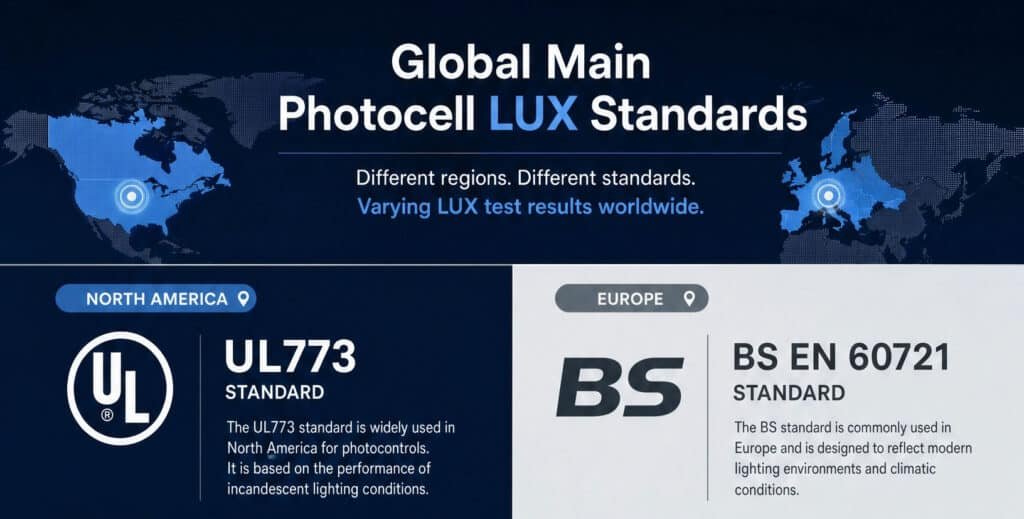
Tabla 1: Normas UL773 frente a BS para fotocélulas
| Característica | Norma UL773 | Norma BS |
| Región | América del norte | Europa / Global |
| Fuente de luz | Cálido (2800 K–3000 K) | Frío (4000 K–6500 K) |
| Enciende LUX | 10–22 Lux | < 80 Lux |
| Apague LUX | < 65 Lux | < 400 Lux |
| Entorno de prueba | Laboratorio controlado | Simulación del mundo real |
| Enfocar | Precisión | Aplicación práctica |
¿Por qué los resultados de las pruebas LUX suelen fallar o diferir?
Uno de los problemas más comunes en las pruebas de fotocélulas es la discrepancia entre los valores previstos y los medidos. Esto se debe principalmente a la diferencia en la intensidad lumínica de la fotocélula, causada por cambios en las condiciones de la prueba.
¿Qué factores influyen en los resultados de LUX?
1. Tipo de fuente de luz
Las iluminaciones incandescentes, LED y fluorescentes producen espectros diferentes, lo que altera la reacción del sensor.
2. Temperatura de color
La luz cálida (norma UL) y la luz fría (norma BS) producen diferentes lecturas de LUX.
3. Distribución del espectro de luz
Las células fotovoltaicas reaccionan de forma diferente a numerosas longitudes de onda de luz.
4. Ángulo de iluminación
La exposición directa frente a la iluminación indirecta modifica la cantidad de luz que llega al sensor.
5. Interferencia ambiental
La luz ambiental puede distorsionar los resultados, lo que provoca errores en la medición de lux.
Incluso utilizando la misma fotocélula, cambiar cualquiera de estos factores puede producir resultados considerablemente diferentes.
¿Cómo afecta el diseño de la fotocélula a la medición de LUX?

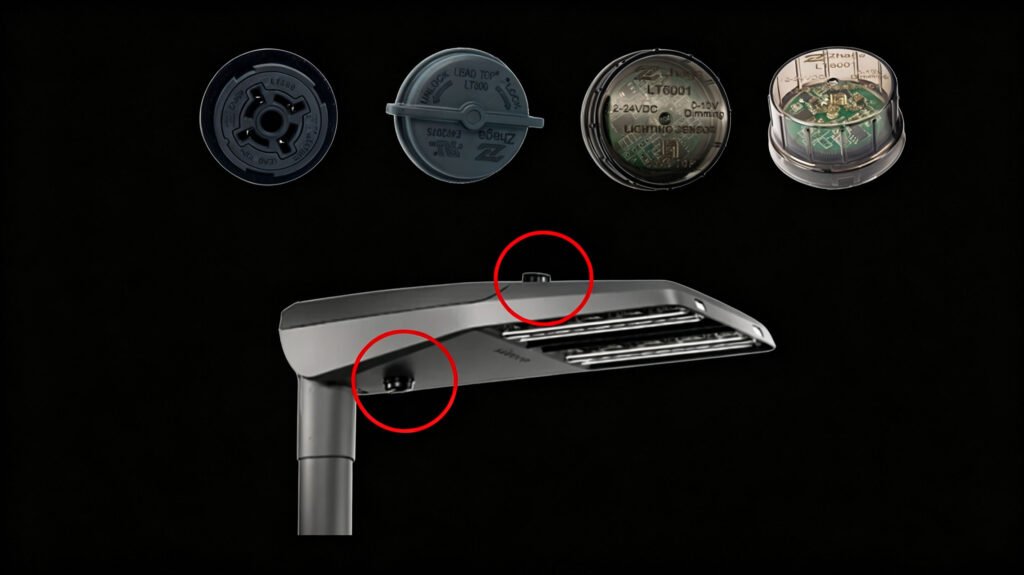
En lo que respecta a entornos externos, el diseño físico de la fotocélula también influye.
¿Qué factores estructurales son importantes?
- Tipo de carcasa (opaca o transparente)
- Diseño de ventanas ópticas
- Material y color de la carcasa
Estos aspectos controlan la cantidad de luz que llega al sensor, lo que repercute directamente en la calibración de la fotocélula y en la precisión de la medición.
¿Cuál es la causa más común de fallo en la prueba LUX?
Un problema recurrente se produce cuando se utilizan fuentes de luz no estándar durante las pruebas.
Escenario de ejemplo
En lugar de utilizar una fuente de luz que cumpla con los estándares, el comprador prueba una fotocélula con una lámpara LED cualquiera. Si los valores de lux medidos no coinciden con las especificaciones, se asume que el producto es defectuoso.
En realidad, el método de prueba no se ajusta al estándar de lux definido para la fotocélula, pero la fotocélula funciona correctamente.
¿Qué factores deben definirse antes de personalizar LUX?
Para evitar irregularidades en las pruebas, algunos parámetros deben estar claramente definidos.
Tabla 2: Factores clave para una prueba LUX precisa
| Factor | Descripción |
| Norma aplicable | UL o BS |
| Tipo de fuente de luz | Incandescente o LED |
| Temperatura de color | Luz cálida o fría |
| Entorno de instalación | Interior o exterior |
| Orientación del sensor | Exposición directa o indirecta |
| Escenario de aplicación | Calle, industrial, comercial |
Al no definirse estos factores, los valores LUX carecen de significado práctico y no pueden evaluarse con precisión.
¿Cómo puedes garantizar la precisión? LUX ¿Pruebas y validación?
Para obtener resultados fiables, es importante un enfoque de pruebas estructurado.
Las prácticas sugeridas incluyen:
- Utilice fuentes de luz que cumplan con los estándares.
- Simular entornos de instalación reales
- Minimizar la entrada de luz externa
- Unificar los métodos de prueba entre proveedor y comprador.
- Realizar la autenticación de las muestras antes de la producción en masa.
La constancia en las pruebas es importante para una correcta calibración de la fotocélula y una evaluación de su rendimiento.
¿Por qué la consistencia es más importante que los valores absolutos de LUX?
Muchos compradores se centran en conseguir valores LUX exactos, pero este enfoque puede resultar engañoso.
¿Qué es lo que realmente importa?
- Comportamiento de conmutación constante
- Rendimiento fiable en circunstancias reales.
- Aquiescencia con el verdadero estándar
Los valores absolutos de LUX son menos importantes que el rendimiento constante dentro de un estándar de lux definido para la fotocélula.
Preguntas frecuentes (FAQ)
¿Por qué los resultados de mi prueba LUX no coinciden con las especificaciones?
Esto se debe comúnmente a diferencias en las condiciones de prueba, lo que provoca errores en la medición de lux.
¿Qué norma debo utilizar: UL o BS?
Depende de tu mercado objetivo: UL para Norteamérica y BS para Europa o proyectos globales.
¿Puede una misma fotocélula cumplir con ambos estándares?
Sí, pero los entornos de prueba deben adaptarse en consecuencia.
¿Cómo puedo evitar errores en las pruebas?
Utilice fuentes de luz que cumplan con los estándares y adapte los métodos de prueba a los de su proveedor.
Conclusión: ¿Por qué fallan las pruebas LUX de las fotocélulas y cómo se pueden solucionar?
LUX no es un valor absoluto, sino un parámetro que depende de las condiciones y está influenciado por numerosos factores como la fuente de luz, el entorno y el método de prueba.
La mayoría de los fallos en las pruebas no se deben a defectos del producto, sino a irregularidades en la aplicación del estándar de lux de la fotocélula y en las circunstancias de medición.
Al comprender las diferencias entre los lux de la fotocélula UL773 y el estándar de fotocélula BS, y al aplicar las prácticas adecuadas de calibración de la fotocélula, podrá eliminar los malentendidos y obtener resultados exactos y fiables.
Llamada a la acción:
Para obtener soluciones que cumplan con los estándares y asistencia experta para reducir la diferencia en las pruebas de lux de las fotocélulas, póngase en contacto con Lead-Top hoy mismo y asegúrese de que sus productos cumplan con las expectativas de rendimiento en condiciones reales en los mercados internacionales.



 English
 Portuguese (Brazil)
 Spanish
 Russian
 Dutch
Dutch Japanese
 Portuguese (Portugal)