Guarulhos has already made major progress in modernizing its public lighting network. More than 73,000 of its existing luminaires have been converted to LED. Further, the expansion of approximately 116,871 lighting points is in progress.
That means installing thousands of new lighting points across roads, cycling paths, public spaces, and growing areas. But adding an LED fixture is only part of the job. Each new point also needs reliable control, consistent installation, easy maintenance, and room for future upgrades.
For a 30-year PPP, these choices matter. Guarulhos shows why the next phase of Brazil’s LED street lighting needs more than energy-efficient luminaires. It needs smart-ready control infrastructure from the start.

Has Guarulhos’ Lighting Challenge Changed From LED Replacement to Network Expansion?
Guarulhos is moving beyond simple LED replacement. The city has already modernized 73,734 luminaires. The new installations continue across areas that need additional coverage.
In 2025, the city added 1,987 new lighting points. Another 334 points followed between January and March 2026. These projects show a clear shift: the challenge is no longer only replacing old fixtures. It is also expanding the network with consistent infrastructure.
The distinction matters. A larger network means more installation sites, more control components, and more assets to maintain. Guarulhos’ 30-year PPP also covers expansion, operation, maintenance, and technological advances.
Why Do New LED Lighting Points Require More Than a New Fixture?
A new LED fixture does not operate in isolation. Each lighting point also needs a reliable photocell switch and outdoor-rated supporting components.
Project teams should consider:
- Automatic ON/OFF control
- Consistent installation
- Easy component replacement
- Outdoor durability
- Compatibility with future control systems
This becomes more important as the network grows. Guarulhos already uses centralized monitoring to identify lighting failures and support maintenance.
So, new points should be designed for more than today’s lighting needs. They should provide a standardized path for future smart lighting control and network upgrades.
How Can New Lighting Points Become Part of a Smarter Public Lighting Infrastructure?
Guarulhos already has centralized lighting management and fault monitoring. So, why not prepare new lighting points for the same long-term direction?
A standardized control interface can help. Zhaga Book 18 defines an interface between outdoor LED luminaires and sensing or communication modules. It covers mechanical fit, electrical pins, power, and communication aspects. This makes it easier to add or replace compatible control nodes later.
For new municipal installations, this approach can provide:
- A consistent control interface
- Easier field replacement
- A path for future sensing and communication
- Less dependence on proprietary interfaces
- Greater flexibility as lighting requirements evolve
This matters for a network expanding by thousands of points. The goal is not to install a complete smart system immediately. It is to avoid building new lighting points that become difficult to upgrade later.
Which Lead-Top Photoelectric Sensors Can Support New Smart-Ready Outdoor Lighting Points?
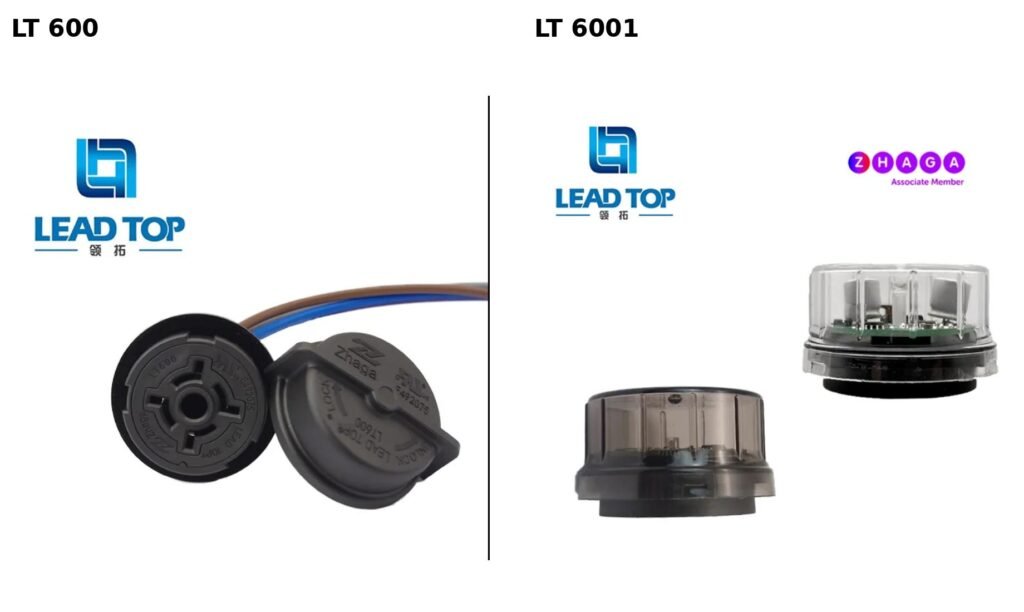
LT600 Zhaga Book 18 Connector + LT6001 Light Sensor Controller
Lead-Top offers the LT600 Zhaga connector with the LT6001 lighting controller for outdoor LED applications. The tables below outline their technical features:
| Specification | LT600 Zhaga Connector | LT6001 Light Sensor Controller |
| Primary Function | Connects the outdoor luminaire with a sensing/control module | Detects ambient light and controls lighting operation |
| Rated Voltage | 30V, 1.5A | 12–24 VDC |
| Interface / Contacts | 4-pin: 24VDC, DALI−, DALI+, General I/O | Zhaga Book 18 interface |
| Light Detection | — | IR-filtered phototransistor |
| Turn-On Light Level | — | 10–16 lux |
| Time Delay | — | 3–10 seconds |
| Protection | IP66 & IK09 | IP66 |
| Operating Temperature | — | −40°C to +70°C |
| Dielectric Withstand | 10 kV to mounting surface | — |
| Typical Applications | Street, roadway, area and outdoor LED lighting | Dusk-to-dawn control, street and area lighting, outdoor luminaires |
Applications
The combination fits applications such as:
- Roadway lighting
- Bike paths
- Parks and public spaces
- Parking areas
- Residential expansion zones
- Outdoor LED luminaires
Lead-Top specifically lists street and area lighting, outdoor fixtures, and city management systems among the LT600/LT6001 applications.
Key Benefits
| Feature | Project Value |
| Zhaga Book 18 interface | Supports a standardized control architecture |
| Ambient light sensing | Enables automatic dusk-to-dawn operation |
| IP66 protection | Suited to exposed outdoor installations |
| Compact Zhaga design | Helps simplify luminaire integration |
| Replaceable control node | Supports easier future upgrades |
What Should Guarulhos Teach Municipal Lighting Procurement Teams?

Guarulhos’ expansion offers a useful lesson for procurement teams. New lighting points should be evaluated as long-term assets. The luminaire is only one part of that decision.
Does the Solution Support Standardization
Standardized interfaces can reduce variation across a growing network. Zhaga Book 18 is designed to connect outdoor luminaires with sensing and communication modules. It can also simplify future node replacement.
Can Maintenance Teams Replace Components Efficiently
Look for components that can be serviced without complex rewiring. A replaceable control node can make future maintenance more practical.
Can the Architecture Scale With the Network
A solution should remain practical as thousands of points are added. Procurement teams should consider compatibility, supply availability, and replacement consistency.
Is the Infrastructure Smart-Ready
Smart-ready does not mean installing every smart function today. It means leaving a standardized path for future sensors, communication, or control nodes.
Long-Term Lifecycle Cost
| Procurement factor | What to evaluate |
| Standardization | Interface compatibility |
| Maintenance | Ease of replacement |
| Scalability | Suitability for large networks |
| Upgradeability | Future control options |
| Lifecycle cost | Installation and future service |
Why Should Smart-Ready Infrastructure Be Planned Before the Next Upgrade?
It’s because the better opportunity may be during today’s expansion. Outdoor luminaires can remain in service for many years. Zhaga explains that Book 18 allows sensing and communication modules to be added or changed through a standardized interface. This can help reduce the complexity of future upgrades.
For Guarulhos, this matters because the PPP has a 30-year horizon. New lighting points installed today may remain part of the network for decades.
A smart-ready approach can therefore help municipalities:
- Avoid premature proprietary lock-in.
- Simplify future control upgrades.
- Standardize new lighting points.
- Reduce future retrofit complexity.
- Keep pace with changing lighting technologies.
The goal is not to over-engineer every new point. It is to avoid making today’s installation difficult to upgrade tomorrow.
What Can Guarulhos’ Expansion Mean for the Future of Brazil’s Municipal Lighting?
Guarulhos highlights a wider shift in Brazil’s LED street lighting. Municipalities are not only replacing old fixtures. They are adding new lighting points and building larger networks.
That makes standardization more important. New installations need reliable control today and upgrade options tomorrow. Zhaga Book 18 supports this approach by defining mechanical, electrical, power, and communication interfaces for sensing and communication modules.
The practical lesson is simple. LED modernization should not end with the luminaire. New lighting points should also consider control, maintenance, compatibility, and future technology.
FAQ
Why is lighting expansion different from an LED retrofit?
An LED retrofit replaces existing fixtures. Expansion creates entirely new lighting points. It therefore adds infrastructure, control, and maintenance requirements.
Should new lighting points use standardized control interfaces?
Yes. Standardized interfaces can simplify installation, replacement, and future upgrades.
Can smart-ready components be installed before full smart lighting?
Yes. A municipality can prepare the infrastructure first and add advanced sensing or communication later. Zhaga specifically supports this upgradeable approach.
What should engineers consider when expanding thousands of lighting points?
- Compatibility
- Standardization
- Durability
- Maintenance
- Scalability
- Lifecycle cost
What is the role of Zhaga Book 18 in outdoor lighting?
It defines a standardized interface between outdoor luminaires and sensing or communication nodes. Its interoperability benefits apply when the relevant products meet the required Zhaga-D4i certification.
Final Words
Guarulhos shows that lighting expansion is about more than adding efficient LED fixtures. New points should support reliable control and future upgrades. Lead-Top offers photocontrollers and Zhaga receptacles for modern outdoor lighting applications. For municipalities planning new lighting points, Lead-Top can provide practical control solutions that help build a more flexible and future-ready lighting network.


 English
 Portuguese (Brazil)
 Spanish
 Russian
 Dutch
Dutch Japanese
 Portuguese (Portugal)