Mexico’s street lighting is changing beyond simple LED upgrades. LED luminaires provide better efficiency, but lighting control can take modernization further. Municipalities can now add:
- Automatic control
- Dimming
- Sensors
- Connectivity
- Remote monitoring
But does every project need a fully connected smart lighting system?
Not necessarily. A better approach is to build infrastructure that meets today’s needs while allowing future upgrades. This is where smart-ready lighting becomes important.
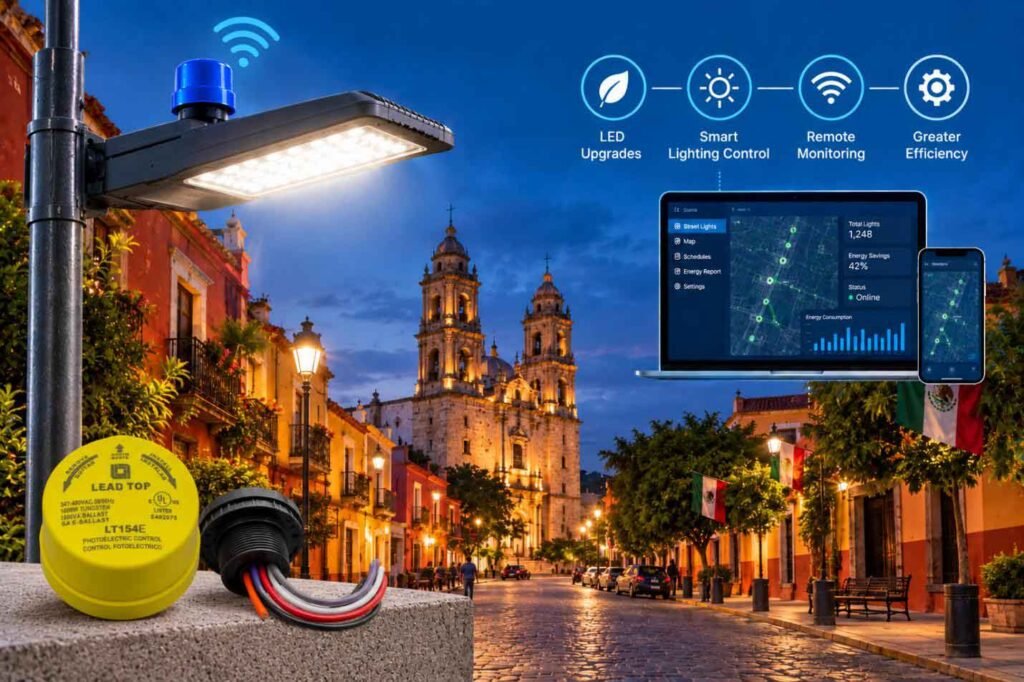
How Is Mexico Moving From LED Street Lighting to Smart Lighting?
Mexico’s street lighting modernization is moving beyond the simple replacement of old luminaires. LED has become an important foundation because it offers efficient operation and a controllable lighting platform. Mexico’s energy-efficiency programs have already supported LED street-lighting upgrades across multiple municipalities.
But what comes after the LED upgrade?
The next step is better control. Municipalities can add automatic switching, dimming, sensors, monitoring, and communication. CONUEE has already tested telemanagement on LED street-lighting systems in Ciudad Juárez, Guadalajara, and Tlaltenango de Sánchez Román.
The progression is straightforward:
- From traditional lighting to LEDs
- Addition of automatic and advanced control
- Connected lighting helping with smart city infrastructure
This allows municipalities to modernize in stages instead of adopting every smart feature at once.
Why Is Lighting Control the Next Step After an LED Upgrade?
An LED luminaire improves the light source. A photocell sensor determines how that light is operated. Basic systems can switch lights according to ambient conditions. More advanced systems can add scheduling, dimming, sensing, and remote management.
From Basic ON/OFF to Intelligent Lighting Control
Traditional photocontrol mainly answers one question: Is it dark enough to turn the light on? Smart lighting control can answer much more. It can help determine when lights operate, how brightly they operate, and what is happening across the network.
CONUEE’s telemanagement pilot showed how connected control can provide real-time operating information and energy-consumption data from LED lighting systems.
What Benefits Can Better Lighting Control Provide?
For municipalities, better control can improve several areas:
● Energy management
Adjust lighting operation to actual requirements.
● Performance monitoring
Track lighting conditions and system operation.
● Maintenance planning
Use system data to identify issues sooner.
● Operational visibility
Monitor lighting assets across larger networks.
● Future flexibility
Prepare infrastructure for additional sensors and connectivity.
The goal is simple: make municipal lighting easier to control, monitor, and manage.
What Is the Difference Between 3-Pin and 5/7-Pin Street Lighting Controls?
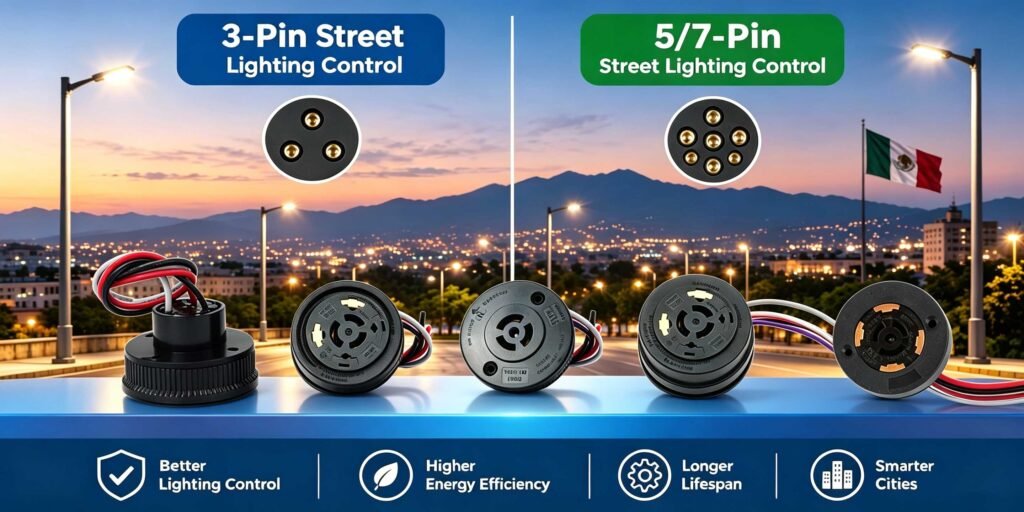
The main difference is the level of control the interface can support. A 3-pin photocell switch is generally suited to basic automatic switching. It detects ambient light and controls the luminaire accordingly. This works well when the requirement is simply dusk-to-dawn operation.
Five-pin and seven-pin interfaces provide additional electrical contacts. These can support more advanced functions, depending on the luminaire and control device. ANSI C136.41 covers interfaces used for dimming and related control functions.
| Interface | Typical role | Smart-ready potential |
| 3-pin | Basic ON/OFF control | Limited |
| 5-pin | Advanced control and dimming | Higher |
| 7-pin | Expanded control and smart-node applications | Higher |
What Is a 3-Pin Photocontrol Used For?
A 3-pin photocontrol is designed for straightforward automatic lighting control. It uses ambient light conditions to switch the street light ON or OFF.
Why Are 5-Pin and 7-Pin Systems More Flexible?
Additional contacts can support functions such as dimming and communication. The exact capability depends on the system design.
Does 5/7-Pin Automatically Mean a Street Light Is “Smart”?
No. These interfaces do not make a luminaire smart by themselves. They provide a platform for advanced controls. The actual smart functionality comes from the installed controller, sensors, communication technology, and management system.
How Can Smart-Ready Infrastructure Support Mexico’s Future Street Lighting Needs?
Smart-ready infrastructure gives municipalities more flexibility during LED modernization. Instead of designing every street light only for basic ON/OFF operation, planners can select interfaces that accommodate future control technologies.
This matters because connected lighting can require more than an LED luminaire and photocontrol. The system may also need:
- Compatible drivers
- Control nodes
- Sensors
- Communication modules
- Management software
Build for Today, Prepare for Tomorrow
Match the infrastructure to the project’s current needs while preserving upgrade options.
- Basic projects: LED + automatic photocell lighting sensor
- Advanced projects: LED + dimming + sensors
- Connected projects: Control node + communication + remote management
- Future-ready projects: Standardized interface with upgrade flexibility
Zhaga Book 18 is another example of this approach. It defines a smart interface between outdoor luminaires and sensing or communication modules.
For Mexican municipalities, the goal is not to make every street light fully connected today. It is to avoid infrastructure choices that unnecessarily limit tomorrow’s options.
Which Lead-Top Solutions Can Support Smart-Ready Street Lighting?
Smart-ready lighting needs more than an LED luminaire. The control interface must also support the project’s next stage. Lead-Top offers solutions that can fit different levels of lighting control.
How Can the LT154E and LT605-7PIN Support Advanced Lighting Control?
The LT154E Photo Controller + LT605-7PIN Receptacle combination is suited to projects that need more flexibility than basic photocontrol. The 7-pin interface can provide a pathway toward advanced control and future smart-lighting functions.
This makes the combination relevant for:
- Municipal LED street lighting
- Smart-ready lighting
- Dimming applications
- Intelligent control infrastructure
- Future connected-lighting upgrades
The key advantage is flexibility. A municipality can install suitable control infrastructure today without requiring a fully connected network from day one.

What Role Can the LT600 and LT6002 Play in Smart-Ready Lighting?
The LT600 + LT6002 combination can support projects using advanced driver-control approaches. Lead-Top’s product material identifies the LT6001 for 0–10V drivers and the LT6002 for DALI drivers.
This gives lighting designers another option when moving from basic switching toward controllable LED systems.
How Can Mexico Build a Smarter Street Lighting Network Step by Step?
Mexico does not need to make every street light fully connected at once. A staged approach can reduce complexity and match technology with actual municipal needs. CONUEE has already documented telemanagement deployments on nearly 800 LED lighting nodes across three municipalities.
| Stage | Main Upgrade | What It Adds |
| 1. LED Upgrade | LED luminaires | Higher-efficiency lighting |
| 2. Automatic Control | Outdoor photocell light sensor | Automatic ON/OFF operation |
| 3. Dimming & Sensors | Advanced controls | Adjustable lighting and sensing |
| 4. Connected Lighting | Communication nodes | Monitoring and data |
| 5. Smart City Lighting | System integration | Data-driven management |
Stage 1 — LED Upgrade
Replace inefficient luminaires with LED technology. This creates the controllable hardware foundation.
Stage 2 — Automatic Lighting Control
Add photocontrol for reliable dusk-to-dawn operation. This moves the system beyond manual switching.
Stage 3 — Dimming and Sensors
Introduce dimming and sensors where the application justifies them. Lighting levels can then respond to schedules or operating conditions.
Stage 4 — Connected Street Lighting
Add communication and management systems. CONUEE reports that telemanagement can monitor operating conditions and individual or aggregate energy consumption.
Stage 5 — Smart City Lighting
The lighting network can become part of wider municipal digital infrastructure. At this stage, lighting data can support broader operational and smart-city decisions.
What Should Mexican Municipalities Consider Before Adopting Smart Street Lighting?

Should every municipality install a fully connected lighting network?
Not necessarily. The first step is to understand the existing system. CONUEE recommends assessing the current lighting inventory, electrical circuits, poles, roadway characteristics, and equipment before modifying a public lighting system.
Municipalities should then define what they actually need from smart lighting. Key considerations include:
● Existing infrastructure
Check LED luminaires, drivers, wiring, and control interfaces.
● Control requirements
Decide whether the project needs basic switching or advanced monitoring.
● Compatibility
Ensure controllers and receptacles match the luminaires and drivers.
● Standards
Verify applicable Mexican efficiency and electrical requirements.
● Connectivity
Select communication technology based on coverage and operating needs.
● Data management
Plan how lighting data will be collected, stored, and used.
● Cybersecurity
Include security requirements when deploying connected systems.
CONUEE’s telemanagement guidance specifically addresses platforms, control nodes, communication systems, and cybersecurity.
The best strategy is not simply to add more technology. It is to choose technology that fits the municipality’s current infrastructure and future plans.
FAQs
How Is Smart Street Lighting Different From Traditional Street Lighting?
Traditional street lighting mainly provides fixed illumination with basic switching. Smart lighting can add:
- Dimming
- Sensors
- Remote monitoring
- Communication
- Energy use data
What Is the Role of Lighting Controls in Smart Street Lighting?
They manage when and how street lights operate. Advanced systems support dimming and remote management instead of relying only on automatic switching.
What Is the Difference Between 3-Pin and 5/7-Pin Street Lighting Controls?
3-pin photocells offer basic control. Five- and seven-pin interfaces provide additional contacts for advanced control, depending on the equipment and system design.
Can Existing LED Street Lights Be Upgraded to Smart Lighting?
Yes, in many cases, but compatibility must be checked first. The luminaire, driver, receptacle, controller, communication system, and management platform must work together.
Final Words
Mexico’s street lighting journey is moving from LED upgrades toward better control, sensing, and connected infrastructure. Choosing flexible photocontrols and receptacles today can help municipalities prepare for future smart-lighting needs. For reliable photocontrols, NEMA receptacles, and smart-ready lighting solutions, Lead-Top can support Mexico’s municipal lighting projects with solutions suited to different control requirements.


 English
  Portuguese (Brazil)
  Spanish
  Russian
  Dutch
Dutch  Japanese
  Portuguese (Portugal)