Mexico’s cities are expanding, and so are their outdoor lighting networks. Expanding street lighting networks can increase energy use and unwanted nighttime illumination. Better control can help address part of this problem.
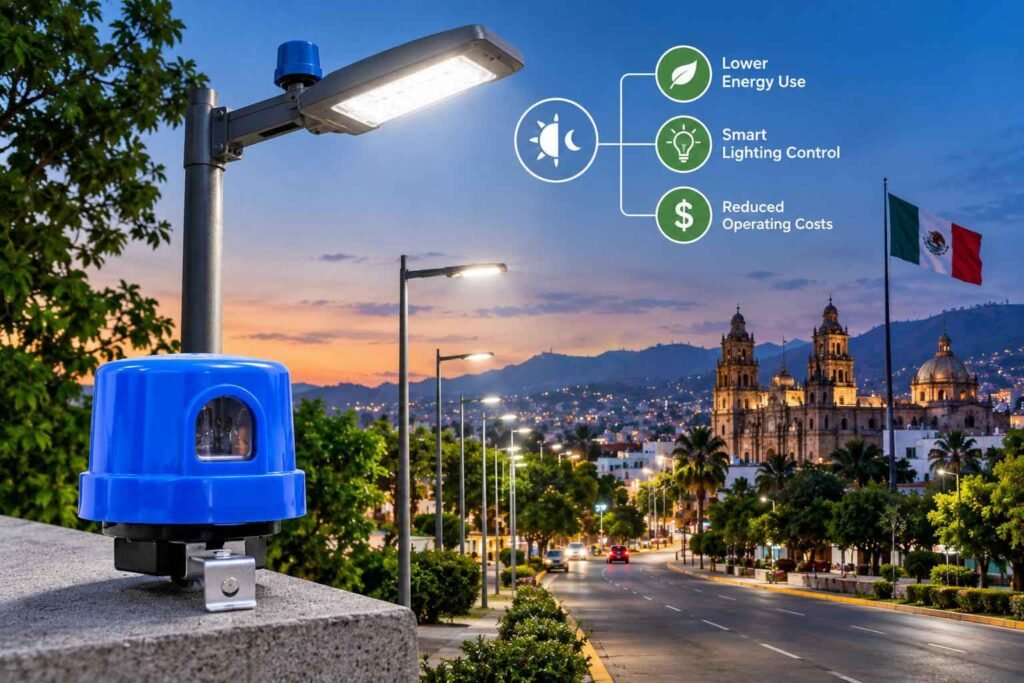
Photocontrols automatically switch outdoor lights according to ambient light levels. They can prevent unnecessary daytime operation and support consistent automation.
However, light sensors do not solve light pollution alone. They are one practical part of a broader strategy for more responsible municipal street lighting.
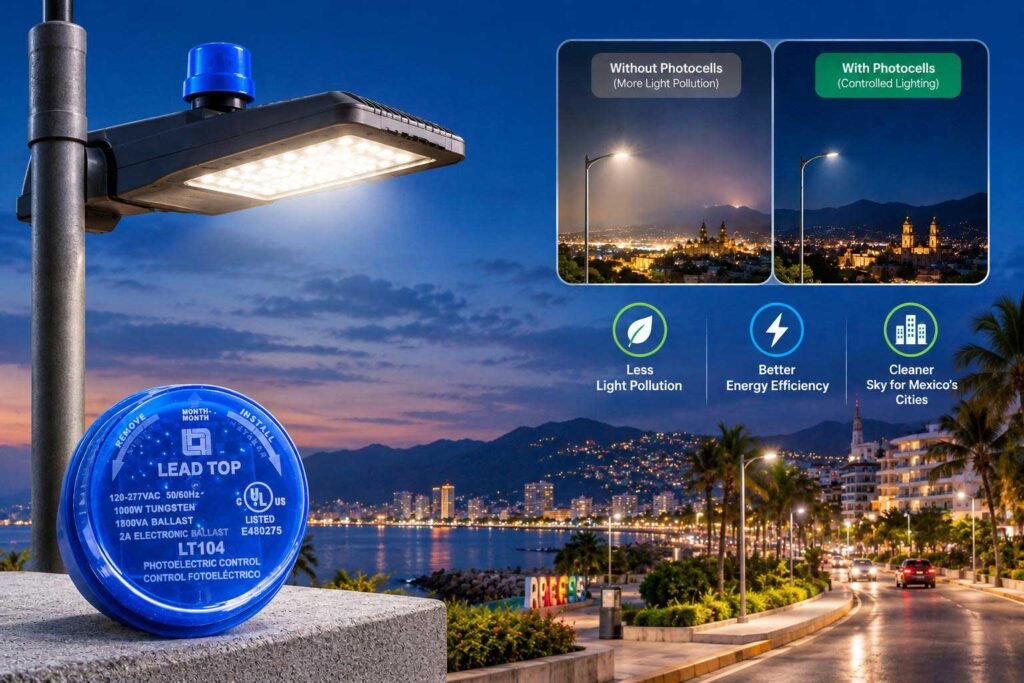
How Is Urban Growth Increasing Lighting Needs in Mexican Cities?
Mexico is becoming increasingly urban. CONAPO reports:
Around 69% of the population lived in cities in 2025.
This growth creates demand for lighting across infrastructure. Municipalities therefore manage extensive lighting networks. CONUEE, a Mexican Government office, describes public lighting as essential for safe movement on streets and public spaces. It also notes that properly designed systems can reduce electricity use while maintaining adequate illumination.
The challenge is not simply adding more lights. Municipalities must also control when those lights operate. Unnecessary operation can increase electricity consumption and add unwanted nighttime illumination.
The key question is simple: Are cities controlling their lighting as carefully as they are expanding it?
Why Does Lighting Control Matter for Municipal Street Lighting?
A municipal lighting system can be efficient only when its operation is properly controlled. CONUEE recommends assessing existing lighting systems, including equipment quantities, technologies, power ratings, and roadway characteristics, before implementing efficiency projects.
What Can Cause Outdoor Lights to Operate Unnecessarily?
Common causes include:
- Daylight operation
- Incorrect switching
- Outdated control devices
- Poorly maintained controls
- Switching systems that do not respond to actual ambient conditions
How Can Better Photocell Switches Improve Municipal Lighting?
Automatic control can help reduce unnecessary operating hours and prevent daytime operation. This matters at municipal scale. CONUEE has identified significant energy-saving potential across Mexican public-lighting projects.
What Is the Connection Between Lighting Control and Light Pollution?
Operating hours are only one part of the issue. Mexico’s environmental law specifically identifies objectives such as reducing light intrusion and using outdoor lighting efficiently while maintaining safety.
So, a photocell lighting sensor is not a complete light-pollution solution. It is one practical measure that helps municipalities control when outdoor lighting is actually needed.
How Can Photoelectric Sensor Control Outdoor Lighting Automatically?
They use ambient light levels to automate lighting based on natural light availability.
How Does a Photocell Work?
The sensor detects the available natural light. As the light level drops below its switching threshold, it turns lights ON. At dawn, increasing daylight triggers the OFF command.
This automatic response removes the need for routine manual switching.
How Can a Photocell Prevent Unnecessary Daytime Operation?
A correctly installed photocontrol receptacle can switch lights OFF when sufficient daylight returns. This helps avoid daytime operation, which wastes electricity without providing useful nighttime illumination. However, sensor placement and maintenance matter.
DOE guidance notes that weather conditions or aging sensors can cause unwanted daytime operation, sometimes called “day burning.”
Can Photocells Help Municipalities Manage Large Lighting Networks?
Yes. Light photocell sensors provide automatic control at individual luminaires or lighting points. Across a large municipal network, consistent switching can reduce unnecessary operating hours and support more efficient street lighting management.
Can LED Lighting and Photocells Work Together for More Efficient Street Lighting?
Yes. LED technology and photocells address different parts of lighting efficiency. LEDs improve the efficiency of light production, while photocells control when the lighting operates. This makes the combination useful for municipal street-lighting upgrades.
What Benefits Can LED + Photocell Provide?
| LED Lighting | Photocell Control |
| Efficient light source | Automatic ON/OFF operation |
| Lower energy use for the required light output | Helps prevent daytime operation |
| Long service life | Supports dusk-to-dawn control |
| Flexible outdoor lighting design | Consistent automatic switching |
Together, they can help municipalities reduce unnecessary electricity use and improve operating consistency. Active lighting controls are also recognized as part of responsible outdoor-lighting practice.
Does LED + Photocell Completely Solve Light Pollution?
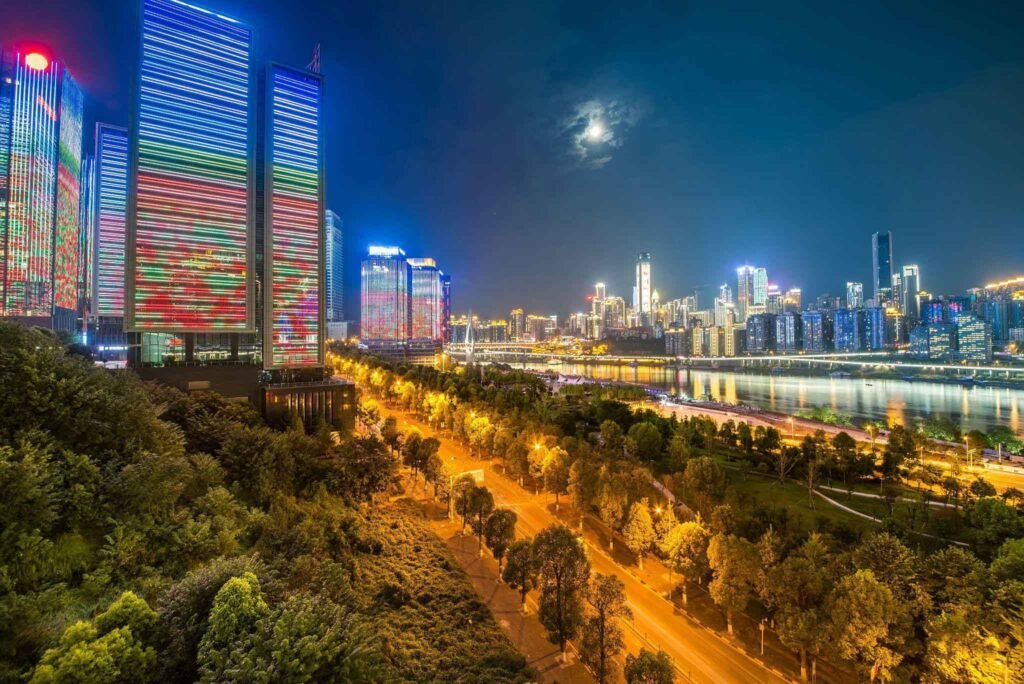
No. Light pollution depends on multiple other factors that include:
- Light distribution
- Intensity
- Shielding
- Glare
- Light trespass
DarkSky recommends using light only when and where it is needed, while controlling its direction and level. So, the combination of LED and light sensor is better viewed as one part of a broader efficient lighting strategy.
What Should Mexican Municipalities Look for in a Street Lighting Photocell?
Choosing a street lighting photocell is not only about price. Municipalities should match the controller with the electrical system, outdoor conditions, and project requirements. The right specifications can improve reliability and reduce control problems.
Which Electrical Specifications Matter?
Start with the system voltage and lighting load. The photocell should match the intended application. Compatibility with LED and other lighting technologies also matters. For large municipal projects, standard socket compatibility can simplify installation and replacement.
Which Protection Features Matter Outdoors?
Outdoor controls face rain, humidity, temperature changes, and electrical surges. Look for suitable IP protection and surge protection. These features can support reliable operation in exposed locations.
Why Do Certifications and Standards Matter?
Certifications provide a clearer basis for product selection and compliance. Standards such as ANSI and UL help define safety and performance requirements for photocontrols. UL identifies ANSI/UL 773 as the basic standard for plug-in locking-type photocontrols.
Why Is Time Delay Important?
A built-in delay helps prevent rapid switching caused by brief changes in ambient light. This can support more stable automatic lighting control.
How Can Lead-Top Photocells Support Controlled Street Lighting in Mexico?
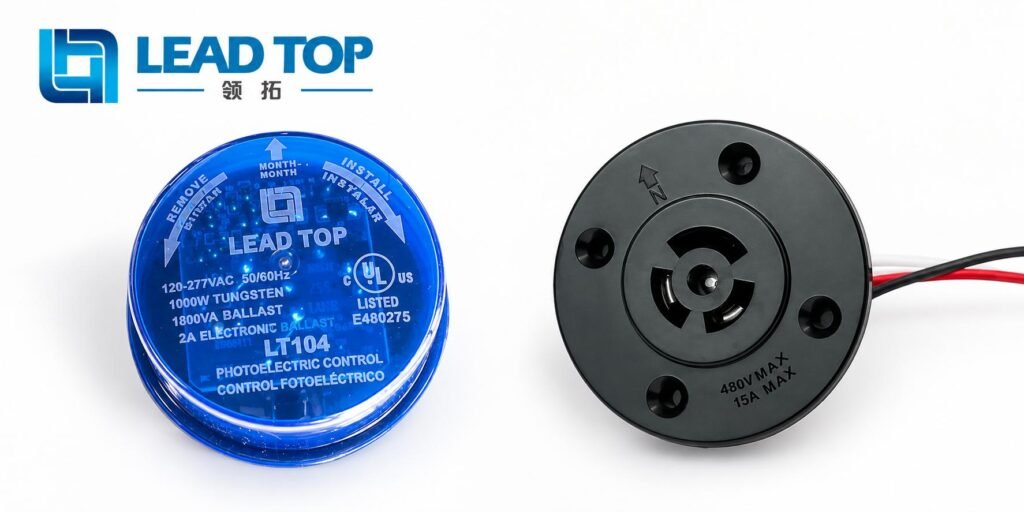
Lead-Top offers the LT104 Photo Controller for automatic outdoor lighting control. It is designed for applications where reliable ON/OFF switching is needed across municipal and outdoor lighting systems.
What Is the LT104 Designed For?
The LT104 supports automatic lighting control for LED, HID, fluorescent, and halogen applications. It can operate with 120–277V AC or 12/24V DC systems. Its automatic switching function supports dusk-to-dawn operation.
What Are the Key LT104 Specifications?
| Feature | LT104 | Feature | LT104 |
| AC voltage | 120–277V | DC voltage | 12/24V |
| Lighting compatibility | LED, HID, fluorescent, halogen | Compliance | ANSI C136.24 & UL773A |
| Time delay | 3–10 seconds | Surge protection | 160-Joule MOV |
| Standard protection | IP65 | Optional protection | IP66/IP67 |
What Role Does the LT645/LT645B Receptacle Play?
The LT645/LT645B provides the connection interface for the photocontroller. Its weather-resistant construction supports outdoor installations and simplifies control-device replacement.
Why Pair the LT104 With the LT645/LT645B?
Together, they provide a practical control setup for extended lighting needs. The combination helps automate switching and reduce unnecessary lighting operation across outdoor lighting projects.
Can Photocells Alone Solve Light Pollution in Mexican Cities?
No. They can only control when outdoor lights operate. DarkSky and the Illuminating Engineering Society identify five key principles that create light pollution. Lighting should be
- Useful
- Targeted
- Low-level
- Controlled
- Warm-colored
What Can Photocells Help With?
Photocells can help municipalities:
- Prevent unnecessary daytime operation
- Automate dusk-to-dawn switching
- Reduce unnecessary operating hours
- Keep lighting active only when natural light is insufficient
This makes automatic control one useful part of a responsible lighting strategy.
What Can Photocells Not Control?
A light sensor control does not change light direction, brightness, shielding, or color. It cannot stop uplight or light trespass caused by poor luminaire design.
What Should a Broader Strategy Include?
Mexican municipalities should combine automatic controls with:
- Properly shielded luminaires
- Appropriate light levels
- Accurate light distribution
- Suitable color temperature
- Correct installation and aiming
So, photocells can help reduce unnecessary lighting. View them as one component of a broader light-pollution strategy.
FAQs
How Can Outdoor Lighting Contribute to Light Pollution?
Poorly designed outdoor lighting can create:
- Skyglow
- Glare
- Light trespass
Lights left ON when they are not needed can also add unnecessary nighttime illumination.
Can Photocells Help Reduce Light Pollution?
Yes, but only as part of a broader strategy. Light sensors can control operating hours. This will reduce unnecessary lighting.
What Should I Consider When Selecting a Photocell for Outdoor Lighting?
Check:
- Voltage
- Load compatibility
- IP protection
- Surge protection
- Time delay
- Required certifications
The photocell should also match the lighting system and outdoor conditions.
How Can Municipalities Boost Lighting Efficiency?
Combining LEDs with photosensors is the recommended approach. Lighting should be targeted and used only when required.
The Bottom Line
Photocells cannot solve light pollution alone, but they can reduce unnecessary operation and support better-controlled municipal lighting. For reliable street-lighting control, Lead-Top offers photocontrollers and NEMA receptacles designed for outdoor and municipal applications. Talk to Lead-Top to select the right photocell and receptacle for your Mexico lighting project.
External Links
- http://www.conapo.gob.mx/
- https://www.iea.org/policies/2614-conuee-promotion-of-energy-efficiency-and-development-of-national-standards-promocion-de-la-eficiencia-energetica-y-emitir-normas-oficiales-mexicanas-de-la-materia
- https://darksky.org/
- https://en.wikipedia.org/wiki/IP_code
- https://www.ansi.org/
- https://www.ul.com/
- https://www.iec-equipment.com/new/new-31-969.html



 English
  Portuguese (Brazil)
  Spanish
  Russian
  Dutch
Dutch  Japanese
  Portuguese (Portugal)