Can a regional LED project cut energy use while also reducing long-term costs?
Eastern Macedonia and Thrace in Greece offers a clear example. The region upgraded road lighting across all five Regional Units. Annual electricity consumption fell significantly. The financial impact goes beyond lower electricity bills. The total projected economic benefit reaches approximately €30.95 million.
So, what can other municipalities learn from this project?
The key lesson is simple. LED retrofit is not only about replacing old luminaires. Lighting controls, reliable components, maintenance, and lifecycle cost can all influence the final return on investment.
Why Is Greece Looking Beyond Simple LED Replacement?
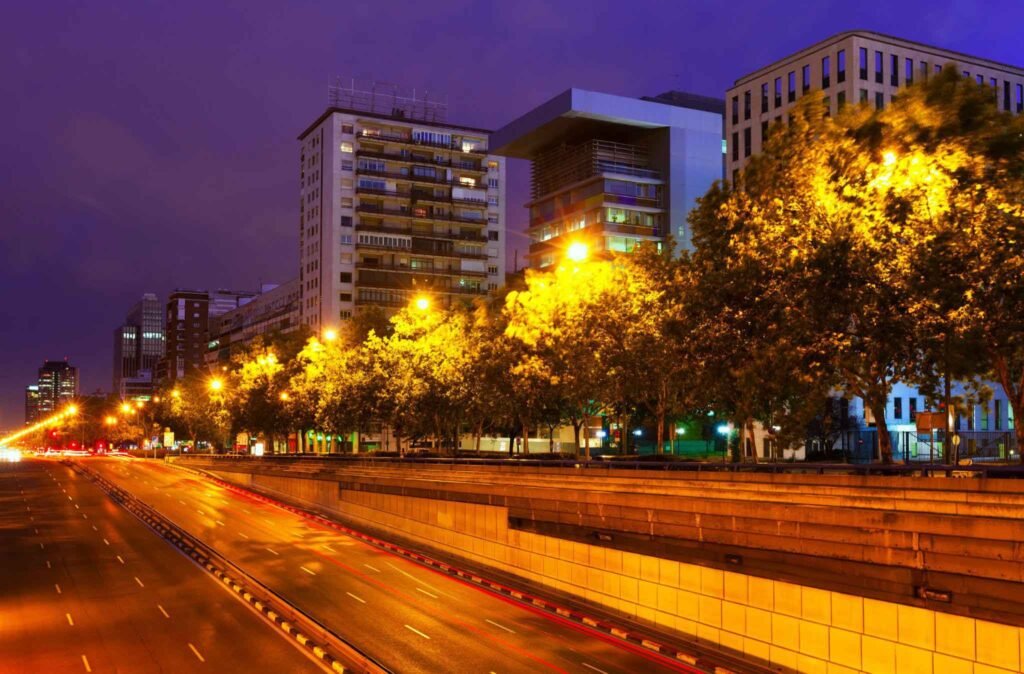
Eastern Macedonia and Thrace shows why replacing old lamps is not enough for a large road network. The region upgraded lighting across all five Regional Units. The project covers major roads, intersections, and settlement entrances. It also aims for stronger and more uniform nighttime lighting.
The upgrade addresses several costs at once:
- Lower electricity consumption
- Reduced maintenance needs
- Better lighting performance
- More efficient regional infrastructure
How Does LED Road Lighting Generate Value Beyond Lower Electricity Consumption?
The project shows three clear value layers.
● Lower energy use
Annual consumption falls from 17.92 million kWh to 6.28 million kWh.
● Lower maintenance
Annual maintenance costs were about €1 million before the project. The plan projects €10 million in maintenance savings through 2036.
● Better lighting
The upgrade also improves nighttime visibility and lighting uniformity across the road network.
What Does the Eastern Macedonia & Thrace Project’s Financial Impact Look Like?
| Project Metric | Reported Figure |
| Initial investment | €12.22 million |
| Previous annual electricity consumption | 17.92 million kWh |
| New annual electricity consumption | 6.28 million kWh |
| Average energy saving | ~65% |
| Regional energy savings | 62%–69% |
| Projected energy-cost benefit through 2036 | ~€20.95 million |
| Projected maintenance benefit | ~€10 million |
| Total projected economic benefit | ~€30.95 million |
Where Do Photocontrols Fit Into an Extensive LED Energy-Saving Strategy?
LED luminaires reduce the power needed for roadway lighting. But when should those luminaires operate?
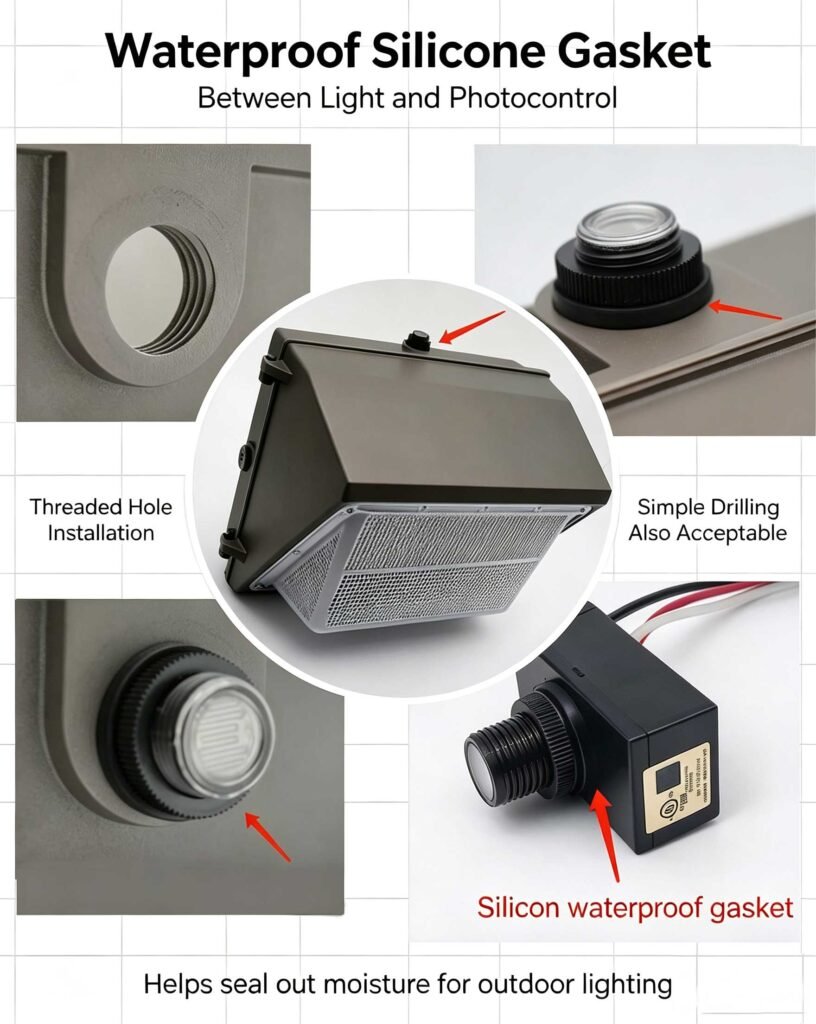
That is where a light sensor photocell switch becomes important. A reliable LED photocell responds to ambient light and controls switching. It helps prevent unnecessary daytime operation. On a large network, small operating errors can add up across many lighting points.
For municipal projects, a photocontrol can support:
- Automatic dusk-to-dawn operation
- Consistent switching
- Fewer unnecessary operating hours
- Reduced manual intervention
The U.S. Department of Energy also identifies lighting controls as a way to achieve additional energy and operating-cost savings beyond luminaire efficiency alone.
Do Lighting Controls Improve the Economics of Municipal LED Retrofits?
Yes, but the value depends on the project design. Light sensor switches can help municipalities manage when and how lighting operates. More advanced systems can also support dimming, monitoring, and adaptive operation.
For a large retrofit, procurement teams should therefore assess:
- Energy: Does the control strategy limit unnecessary operation?
- Reliability: Can components operate consistently outdoors?
- Maintenance: Can failed units be replaced quickly?
- Compatibility: Do controls work with the selected LED luminaires?
This broader approach helps protect the project’s long-term energy and maintenance objectives. DOE’s retrofit analysis framework likewise evaluates energy, maintenance savings, and lifecycle financial performance together.
What Is a Cost-Effective Control Solution for Municipal LED Road Lighting?
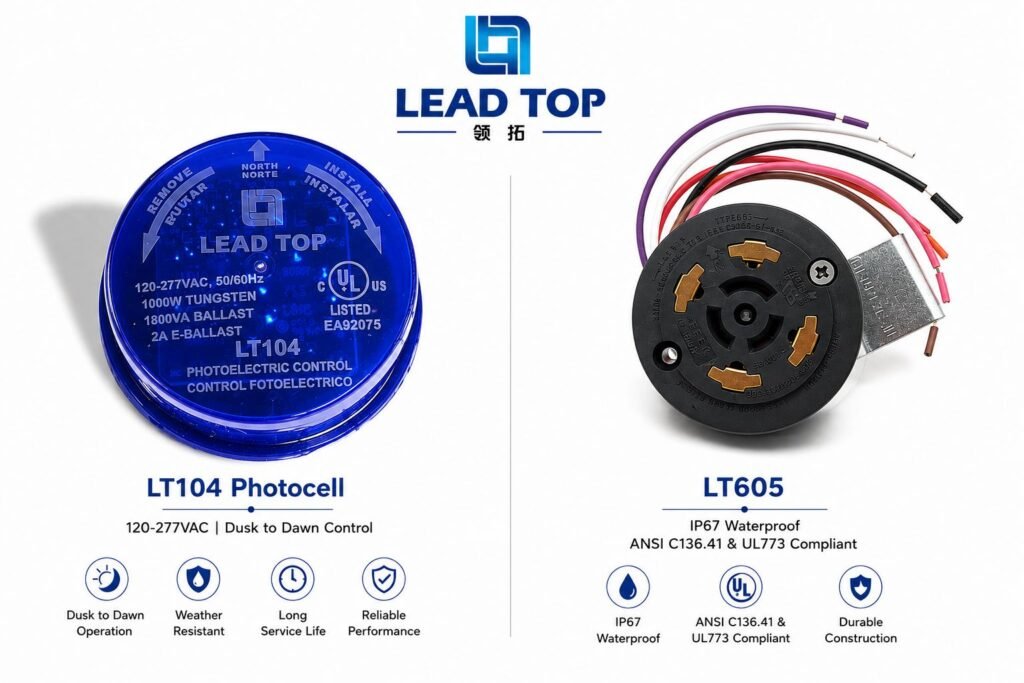
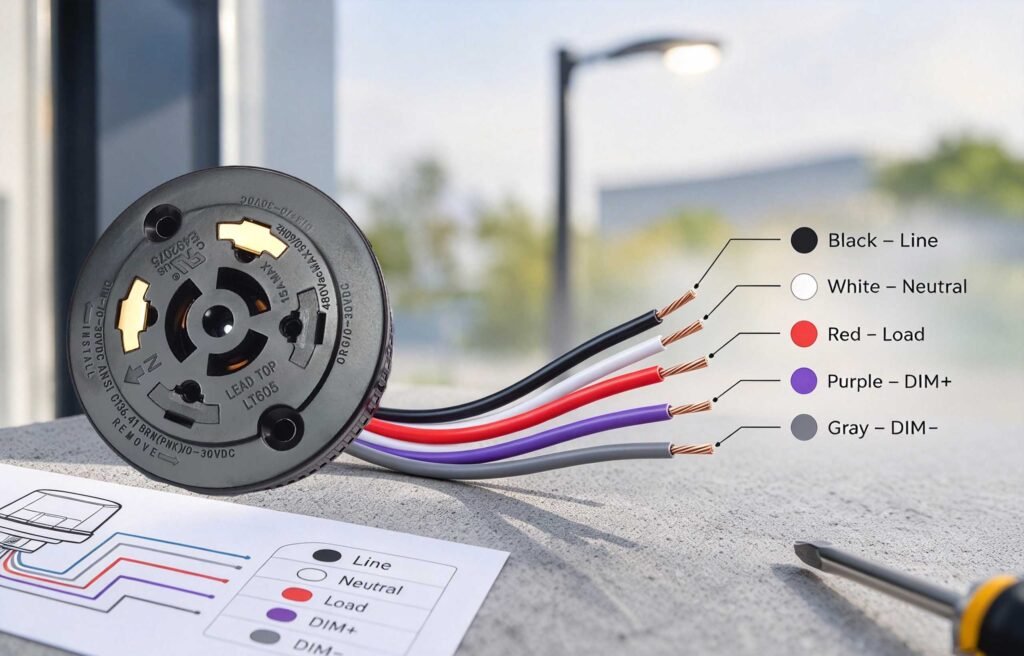
For projects that need simple automatic control, an LT104 Electronic Photocontrol + LT605 ANSI C136.41 Receptacle combination can provide a practical approach. The photoelectric sensor handles light-based switching.
The receptacle provides the standardized interface between the control device and luminaire. This keeps the architecture simple while supporting field replacement.
LT122 and LT605 Combination Makes Sense for Municipal Projects
The combination suits projects that do not yet require remote monitoring or advanced lighting management. LT605 supports ANSI C136.41 configurations with 5 or 7 positions. Its power contacts are rated up to 480V and 15A, depending on configuration.
Key advantages include:
- Automatic dusk-to-dawn control
- Standardized connection
- Simple installation
- Easier component replacement
- Compatibility with outdoor LED lighting applications
Applications
It can suit projects where dependable automatic operation is the main requirement. For example:
- Municipal road lighting
- Regional highways
- Rural roads
- Residential streets
- LED retrofit
What Can Municipalities Learn From Greece’s Projected €30.95 Million Benefit?
Greece’s project offers a clear lesson. The Eastern Macedonia and Thrace upgrade is projected to generate €20.95 million in energy savings and €10 million in maintenance savings through 2036.
Municipalities should therefore evaluate more than the luminaire’s purchase price. They should consider:
- Annual energy consumption
- Maintenance requirements
- Component reliability
- Replacement costs
- Control compatibility
- Total lifecycle value
How Should Municipalities Select Photocontrols for Large Road-Lighting Networks?
1. Electrical Compatibility
Check voltage, load, and LED-driver requirements. The control must match the luminaire and electrical system.
2. Switching Performance
Reliable switching matters across thousands of lighting points. Consistent operation helps avoid unnecessary runtime.
3. Receptacle Compatibility
Standardized interfaces simplify installation and replacement. ANSI C136.41 supports mechanical and electrical interchangeability for compatible roadway-lighting controls and receptacles.
4. Environmental Requirements
Outdoor components face weather and temperature changes. Select equipment suited to the actual installation environment.
5. Maintenance Strategy
Plan replacement procedures before deployment. Easy field replacement can reduce service time and long-term maintenance effort.
What Is the Role of Lifecycle Cost in Future LED Roadway Lighting Projects?
Municipalities should not judge an LED retrofit by its purchase price alone. Lifecycle cost includes energy, maintenance, replacement, and operating expenses. DOE’s retrofit tools specifically evaluate energy savings, maintenance savings, payback, and net present value.
For large roadway networks, procurement teams should therefore compare:
- Initial equipment cost
- Annual energy consumption
- Maintenance requirements
- Control reliability
- Expected replacement costs
This approach helps identify the solution that delivers value throughout its operating life.
FAQs
How much energy can an LED road-lighting upgrade save?
Savings vary by the existing system and project design. In Eastern Macedonia and Thrace, annual consumption is projected to fall from 17.92 million kWh to 6.28 million kWh. That equals about 65% savings.
How can municipalities reduce long-term lighting costs?
Focus on total lifecycle cost. Evaluate energy use, maintenance, equipment reliability, and control performance together.
Is a smart lighting system necessary for every LED retrofit?
No. Basic projects may only need automatic switching. Advanced controls make more sense when dimming, monitoring, or adaptive operation is required.
Why should photocontrols be considered in an LED retrofit?
Photocontrols automate switching based on ambient light. They can help prevent unnecessary operating hours and support consistent roadway lighting control.
Bottom Line
Eastern Macedonia and Thrace shows that LED retrofits can deliver more than energy savings. Lifecycle cost and maintenance also shape long-term project value. For municipalities planning similar upgrades, Lead-Top offers photocontrollers and receptacle solutions designed for reliable outdoor lighting control. Explore its solutions for your next LED roadway lighting project and build control reliability into the retrofit from the start.


 English
 Portuguese (Brazil)
 Spanish
 Russian
 Dutch
Dutch Japanese
 Portuguese (Portugal)