Introduction:
When it is about designing proficient and trustworthy illumination systems Choosing the correct photocell is an important step. If someone is working on a community project, providing illumination equipment, or managing industrial infrastructure, selecting the incorrect photocontrol switch can lead to system catastrophes, greater upkeep expenditures, and poor performance.
This photocell selection guide will assist you in understand how to select the correct model based on voltage, load type, and ecological situations. This guide elucidates the detailed match of extensively used models: LT111, LT112, LT113, and LT115, and all these models are manufactured for different applications in outdoor lighting control.

What Is a Photocell and Why Does It Matter in Outdoor Lighting?
A photocell, also known as a photocontrol switch, is an automatic device that turns illumination systems ON when there is sunset and OFF at dawning. It senses environmental light levels and make sure that illumination functions only when required.
Photocells are extensively used in:
- Street light photocell systems for freeways and metropolitan roads
- Parking areas and commercial illumination
- Lawn and passageway illumination
- Industrial and infrastructure illumination
Contemporary twist lock photocell designs make installation stress-free and more trustworthy, particularly in extensive projects. These devices improve energy proficiency, decrease physical labor, and make sure constant illumination operation.
Devoid of a proper photocell, illumination systems may work ineffectually, leading to amplified energy usage and abridged lifecycle of illumination components.
What Are the Key Factors When Choosing a Photocell?
Watchful assessment of numerous technical factors is important when Selecting the correct photocell needs. The most vital ones comprise voltage compatibility, load capability, and ecological circumstances.
Voltage Compatibility
Voltage compatibility is the first and most important factor in any photocell selection guide. Using a photocell with the incorrect voltage can harm the device or cause system letdown.
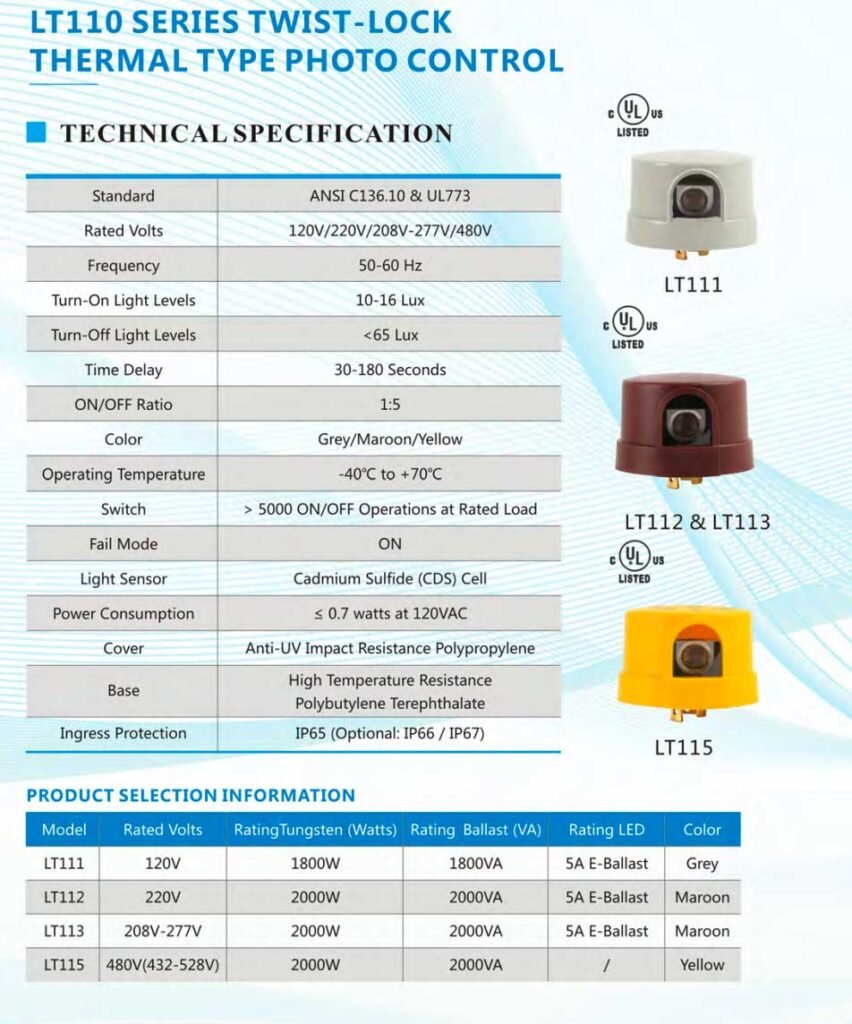
The LT110 series offers different models for numerous voltage requirements:
Table 1: Photocell Models and Voltage Applications
| Model | Voltage Range | Application Area | Key Advantage |
| LT111 | 120V | Residential / North America | Standard usage |
| LT112 | 220V | Global markets | Cost-effective |
| LT113 | 208–277V | Commercial / municipal | Handles fluctuations |
| LT115 | 480V | Industrial systems | High voltage capability |
- LT111 (120V photocell) is perfect for North America
- LT112 (220V photocell) is extensively used in emerging markets
- LT113 (120V 220V 277V photocell range) supports voltage variations
- LT115 is manufactured for heavy-duty industrial applications
Pro Tip:
If there is uneven power supply issue in the project, than in that case one should go for the LT113 model which is broadly used in such scenarios. Which is more forbearing to voltage variations.
Load Capacity
One more main factor in choosing a street light photocell is understanding load capacity. Several purchasers complicate watts (W) and volt-amperes (VA), but they serve diverse purposes.
- Watts (W) are used for resistive loads such as luminescent lamps
- VA (volt-amperes) are used for inductive loads such as LED drivers and ballasts
For contemporary outdoor lighting control, especially LED systems, VA rating is more significant than wattage.
For instance:
- A photocell rated at 2000W may perform well with old-style illumination
- But for LED systems, a 2000VA rating is more pertinent
If two photocells have the same VA rating, their LED performance will be similar.
This is why contemporary twist lock photocell designs emphasis more on VA capacity instead of just wattage.
Environmental Conditions
Outdoor illumination systems are wide-open to severe ecological settings, making resilience an important factor. A high-grade photocontrol switch must have the capacity to function dependably in thrilling weathers.
Usual environmental challenges comprise:
- High temperatures in the Middle East
- Heavy rain and moistness in Southeast Asia
- Chilly environments in Eastern Europe
The LT110 series is made to tackle these situations with:
- Working temperature range: -40°C to +70°C
- Protection rating: IP65 (optional IP66/IP67)
These aspects making sure for long-lasted trustworthiness in outdoor lighting control applications.
How Do LT111, LT112, LT113, and LT115 Compare in Real Applications?
Understanding their differences helps you make the correct choice.
Table 2: Detailed Application Comparison
| Model | Best Use Case | Strength | Limitation |
| LT111 | Residential lighting | Simple and reliable | Limited voltage range |
| LT112 | General outdoor use | Affordable and versatile | Not ideal for unstable grids |
| LT113 | Municipal projects | Wide voltage support | Slightly higher cost |
| LT115 | Industrial systems | Handles high voltage | Not for small-scale use |
Why Is LT112 the Most Popular Photocell Choice?
Among all models, LT112 is the most extensively used due to its balance of performance and cost.
Main benefits comprise:
- Compatibility with 220V systems
- High load capability (2000W / 2000VA)
- Cost-efficient pricing
In Southeast Asia, the Middle East, and Africa, where affordability and trustworthiness are equally significant this makes it perfect for projects.
LT112 In numerous street light photocell installations serves as the standard solution due to its flexibility.
Why Is LT113 the Best Option for Unstable Power Grids?
For areas with unsteady electricity supply, LT113 is the favored select.
It supports a broader voltage range (208–277V), making it appropriate for unstable grid circumstances. This decreases the risk of system letdown and make sure constant operation.
For community and infrastructure projects, this model is often suggested in any professional photocell selection guide.
When Should You Use LT115 for Industrial Applications?
The LT115 photocell is manufactured specifically for high-voltage environs (480V).
Typical applications include:
- Workshops
- Industrial plants
- Large infrastructure projects
Because of its high voltage capability, it is not appropriate for domestic or small-scale illumination systems. Though, it is important for heavy-duty outdoor lighting control in industrial settings.
Why Is the Fail ON Feature Important in Modern Photocells?
One of the most important safety features in contemporary photocontrol switches is the Fail ON mode.
Why does this matter?
- Confirms visibility in public areas
- Averts accidents caused by dark
- Decreases liability for suppliers
For community and street light photocell systems, this feature is highly suggested and often required.
How Do You Choose the Right Photocell for Your Project?
To choice the best photocell, follow these steps:
- Match the voltage (120V, 220V, 277V, or 480V)
- Check load capacity (focus on VA for LED systems)
- Assess ecological situations
- Select the suitable model (LT111–LT115)
- Confirm features like Fail ON for safety
By following this structured photocell selection guide, you can make sure best performance and long-lasted dependability.
Conclusion: What Is the Best Strategy for Photocell Selection?
Only technical specifications does not means selection of correct photocell — guaranteeing security, proficiency, and permanency in your illumination system are the key aspects.
Whether you are working with 120V 220V 277V photocell systems, handling community illumination, or designing industrial infrastructure, choosing the right model is important.
The LT110 series provides flexible solutions for numerous applications, from domestic to industrial. In order to balance performance, cost, and long-lasted stability, Trustworthy producers like Lead-top Controls offer high-grade twist lock photocell solutions that.


 English
 Portuguese (Brazil)
 Spanish
 Russian
 Dutch
Dutch Japanese
 Portuguese (Portugal)