Introdução: Por que é importante comparar o Livro 18 de Zhaga e o NEMA?
Nos sistemas de iluminação exterior contemporâneos, selecionar a opção correta é fundamental. fotocélula A padronização é importante para confirmar o desempenho, a escalabilidade e a eficiência a longo prazo. Dois dos critérios mais utilizados atualmente na indústria são o Zhaga Book 18 e as fotocélulas NEMA.
Ambas as tecnologias têm o mesmo objetivo central — regular roboticamente a iluminação de acordo com a luz ambiente — mas apresentam diferenças consideráveis em termos de filosofia de design, conectividade e âmbito de aplicação.
Compreender essas diferenças é importante para:
- desenvolvedores de cidades inteligentes
- Engenheiros urbanos
- Designers de iluminação
- Supervisores de projetos de infraestrutura
A escolha de um sistema adequado pode impactar os custos de instalação e também influenciar a flexibilidade de expansão, a eficácia da manutenção e a economia de energia no futuro.

O que é o Zhaga Book 18 e por que ele é usado em iluminação inteligente?
Como o livro 18 da Zhaga aprimora os sistemas de iluminação pública em LED?
O Zhaga Book 18 é um padrão internacionalmente reconhecido que descreve uma interface modular para componentes de iluminação LED, principalmente em sistemas de iluminação pública e externa. Foi industrializado para atender à crescente demanda por infraestrutura de cidades inteligentes e soluções de iluminação conectadas.
A principal vantagem do Zhaga Book 18 é a sua modularidade. Em vez de substituir todo o sistema de iluminação, apenas alguns componentes, como:
- Fotocélulas
- Sensores
- Módulos de comunicação
Pode ser facilmente substituído ou aprimorado.
Isso diminui consideravelmente:
- Custos de manutenção
- Tempo de inatividade
- Despesas operacionais de longa duração
Por que o Zhaga Book 18 é ideal para aplicações em cidades inteligentes?

As fotocélulas Zhaga Book 18 são especialmente fabricadas para ambientes de iluminação em rede. Esses sistemas geralmente contêm:
- Capacidades de monitoramento remoto
- funções de escurecimento automático
- Integração com plataformas de IoT
- Monitoramento do consumo de energia
Devido a essas características, os sistemas baseados em Zhaga são amplamente utilizados em:
- metrópoles inteligentes
- Projetos de infraestrutura metropolitana
- Sistemas inteligentes de iluminação de rodovias
A aptidão para incorporar inúmeras funções inteligentes torna Zhaga Uma solução à prova de futuro para metrópoles que planejam a renovação digital.
O que são fotocélulas NEMA e por que ainda são amplamente utilizadas?
Como funcionam as fotocélulas NEMA em sistemas de iluminação tradicionais?
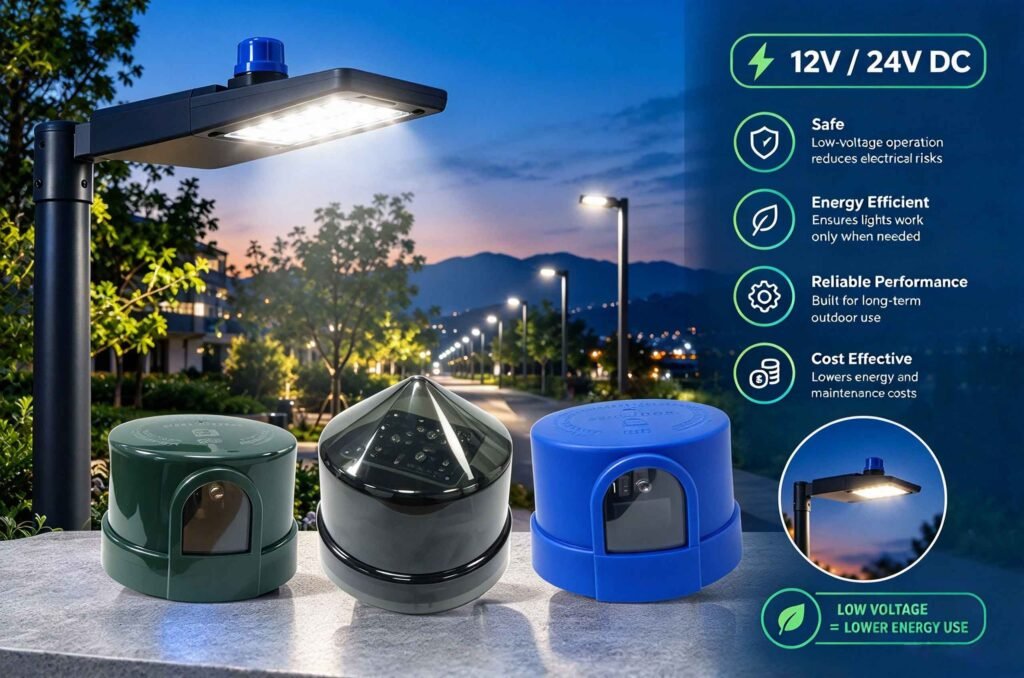
As fotocélulas NEMA são baseadas em padrões estabelecidos pela National Electrical Manufacturers Association (NEMA) e são utilizadas há anos em sistemas de iluminação pública.
Normalmente utilizam um mecanismo de encaixe por torção, permitindo instalação e substituição rápidas sem a necessidade de ferramentas específicas.
As principais características das fotocélulas NEMA incluem:
- Confiabilidade comprovada
- Design simples
- Compatibilidade generalizada
Essas características fazem delas uma escolha preferencial para sistemas de iluminação convencionais.
Por que as fotocélulas NEMA são populares em projetos de retrofit?
Apesar do crescimento das tecnologias de iluminação inteligente, as fotocélulas NEMA continuam sendo de grande importância, principalmente em:
- Projetos de retrofit
- Avanços atuais na infraestrutura
- Instalações domésticas e urbanas de pequeno porte
Os seus benefícios incluem:
- Substituição sem estresse
- Menor custo inicial
- Compatível com lâmpadas LED e lâmpadas convencionais.
Para projetos que não necessitam de redes progressivas ou controle inteligente, NEMA Oferece uma solução eficaz e com boa relação custo-benefício.
Quais são as principais diferenças entre o Livro 18 de Zhaga e o NEMA?
Considerando as principais diferenças entre esses dois padrões, é muito importante tomar a decisão correta ao selecionar a opção mais adequada, levando em conta as necessidades do projeto.
Tabela 1: Principais diferenças entre o Livro 18 de Zhaga e o NEMA
| Recurso | Livro 18 de Zhaga | NEMA |
| Tipo padrão | Interface modular Zhaga | Padrão NEMA de encaixe por torção |
| Aplicação principal | Iluminação LED e urbana inteligente | Iluminação pública convencional |
| Conectividade | Interface inteligente modular e plug-and-play | Conexão mecânica com trava giratória |
| Recursos inteligentes | Compatível com IoT, controle de intensidade luminosa e monitoramento remoto. | Controle limitado ou externo necessário |
| Flexibilidade de atualização | Alto (substituição modular) | Moderado (substituir a unidade inteira) |
Tanto as fotocélulas Zhaga Book 18 quanto as NEMA são compatíveis com iluminação LED. No entanto, sua compatibilidade difere quando se trata de integração ao sistema.
A Zhaga foi especialmente desenvolvida para ecossistemas de LED contemporâneos, permitindo a integração perfeita com drivers e sensores inteligentes.
A NEMA, por outro lado, apoia:
- Lâmpadas LED
- Lâmpadas HID
- Outras tecnologias de iluminação usuais
Isso declara o NEMA como uma opção mais versátil para sistemas mistos ou legados.
Tabela 2: Comparação de Compatibilidade e Desempenho
| Critérios | Livro 18 de Zhaga | NEMA |
| Compatibilidade com LED | Excelente | Excelente |
| Suporte de lâmpada tradicional | Limitado | Forte |
| Integração de controle inteligente | Suporte integrado | Requer sistemas externos |
| Abordagem de manutenção | Substituição de componentes modulares | Substituição da unidade completa |
| Melhor caso de uso | Cidade inteligente e iluminação IoT | Iluminação de adaptação e convencional |
Qual você deve escolher para o seu projeto?
Você deve escolher o Zhaga Book 18 para projetos de iluminação inteligente?
Se o seu projeto incluir:
- Infraestrutura metropolitana inteligente
- sistemas de iluminação habilitados para IoT
- Monitoramento remoto e informatização
- Escalabilidade de longa duração
Nesse caso, o Zhaga Book 18 é a melhor escolha. Seu design modular permite atualizações fáceis e integração com tecnologias futuras.
Quando a NEMA é a melhor opção?
As fotocélulas NEMA são perfeitas para:
- Projetos de retrofit
- Instalações com restrições orçamentárias
- Zonas com infraestrutura NEMA atual
- Sistemas de iluminação simples, sem necessidade de controle inteligente.
Essas normas oferecem soluções confiáveis e econômicas para diferentes projetos, mesmo quando recursos inovadores não são necessários.
Que fatores você deve considerar antes de tomar uma decisão?
Ao escolher entre Zhaga e NEMA, considere o seguinte:
- Escala e complexidade do projeto
- Requisito para controle inteligente e interconexão de redes
- Compatibilidade com a infraestrutura atual
- Estratégia de preservação
- Restrições orçamentárias
A avaliação desses fatores certifica que o sistema selecionado está alinhado com os requisitos de projetos existentes e futuros.
Perguntas frequentes
As fotocélulas Zhaga podem substituir os sistemas NEMA?
Sim, mas apenas se o sistema de iluminação for compatível com drivers de LED modulares e interfaces Zhaga. A adaptação pode exigir alterações nas luminárias.
As fotocélulas NEMA são compatíveis com iluminação LED?
Sim. A maioria das fotocélulas NEMA modernas são totalmente compatíveis com lâmpadas e drivers de LED.
Um único fabricante pode fornecer fotocélulas Zhaga e NEMA?
Sim. A Lead Top fabrica fotocélulas Zhaga Book 18 e NEMA, atendendo a pedidos OEM, de atacado e personalizados.
Quais certificações estão disponíveis para essas fotocélulas?
As fotocélulas geralmente estão disponíveis com certificações globais, tais como:
- UL
- CE
- ANSI
Essas certificações garantem a conformidade com os padrões de segurança e desempenho.
Conclusão: Qual padrão de fotocélula é melhor para o futuro?
Não existe uma resposta única para todos os casos quando se trata de relacionar o padrão Zhaga Book 18 com as fotocélulas NEMA. Ambos os padrões servem a propósitos diferentes na indústria de iluminação.
O livro Zhaga 18 representa a perspectiva de sistemas de iluminação inteligentes e conectados, propondo modularidade, tratabilidade e capacidades de controle progressivas.
A norma NEMA, por sua vez, continua sendo uma solução verificada e confiável para aplicações de iluminação convencionais e de adaptação.
A escolha ideal depende dos objetivos do seu projeto. Para infraestruturas inteligentes e avançadas, o sistema Zhaga é a opção preferida. Já para simplicidade e custo-benefício, o sistema NEMA continua sendo uma escolha sólida e confiável.
Chamada para ação (CTA)
- Obtenha uma amostra grátis – Teste as fotocélulas Zhaga ou NEMA antes de comprar no atacado.
- Contate o responsável principal – Discuta soluções de iluminação OEM, atacado ou personalizadas.
- Solicite a lista de preços – Explore opções para projetos públicos, comerciais ou de varejo.


 English
 Portuguese (Brazil)
 Spanish
 Russian
 Dutch
Dutch Japanese
 Portuguese (Portugal)