A indústria internacional de iluminação está entrando em uma nova fase crucial em 2025. O que antes era um mercado impulsionado principalmente pela eficiência das luminárias e pelo custo inicial está se transformando em uma indústria de infraestrutura digital centrada em dados. A combinação de inteligência artificial, sensores inovadores, comunicação sem fio, diretrizes de sustentabilidade e plataformas digitais urbanas está redesenhando a forma como os sistemas de iluminação são projetados, posicionados e gerenciados.
Essa revolução é mais visível na rápida ascensão das tendências de iluminação inteligente para 2025, onde os equipamentos de iluminação deixam de ser dispositivos passivos e passam a operar como nós conectados e inteligentes dentro de ambientes de iluminação urbana inteligentes mais amplos.

Quais são as 10 principais tendências de iluminação inteligente para 2025?
Tendência 1: Iluminação adaptativa impulsionada por IA
A inteligência artificial tem um enorme impacto no funcionamento dos sistemas de iluminação atualmente. Ela ajuda a obter dados contínuos e em tempo real sobre métricas importantes, como o fluxo de tráfego em diferentes horários do dia, os padrões de movimento de pedestres e as condições climáticas da região. Isso significa que, em vez de seguir uma programação fixa, a iluminação pode ser ajustada de acordo com as necessidades em tempo real.
Esse processo permite a iluminação adaptativa a partir do solo, melhorando a visibilidade e a segurança, ao mesmo tempo que reduz o desperdício de energia. Diversas cidades já registraram economias de energia de até 60%.
Tendência 2: Adoção global do Zhaga-D4i
O padrão Zhaga-D4i está sendo adotado como padrão principal em todo o mundo. Zhaga-O D4i homogeneiza as interfaces mecânicas, elétricas e de dados entre luminárias e dispositivos de controle, garantindo uniformidade e intercambialidade.
Em 2025, o Zhaga-D4i será cada vez mais obrigatório em licitações públicas, pois permite verdadeira modularidade. Sensores, nós de comunicação e controladores podem ser adicionados ou substituídos sem a necessidade de trocar a própria luminária, possibilitando sistemas de iluminação conectados de longa duração e reduzindo o custo total de propriedade.
Tendência 3: Arquitetura de nó duplo (NEMA + Zhaga) Torna-se padrão
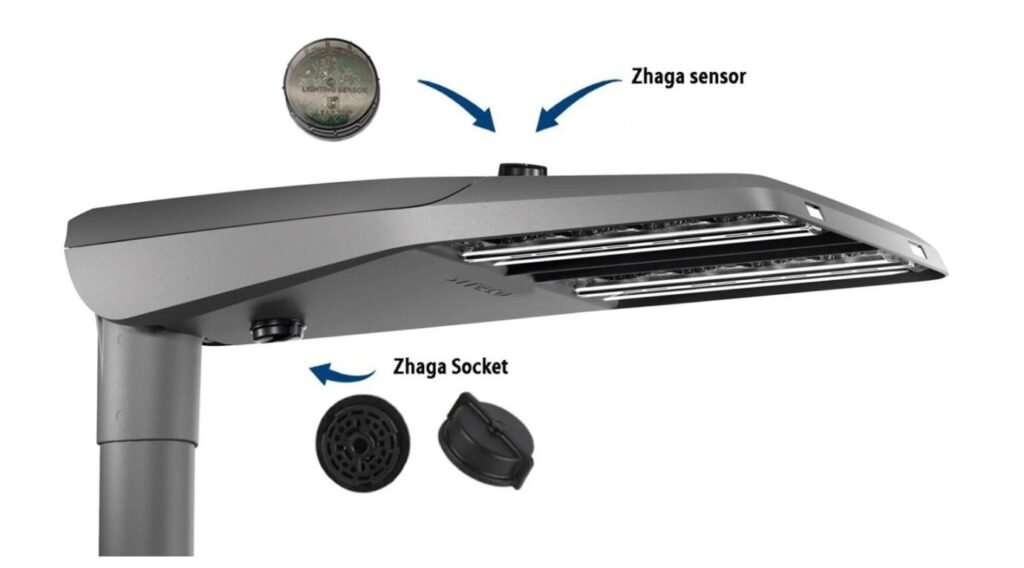
Uma característica importante da iluminação inteligente para exteriores em 2025 é o crescimento da arquitetura de dois nós. Este design normalmente compreende:
- Uma fotocélula NEMA (7 pinos) montada na parte superior da luminária.
- Um sensor ou nó de comunicação Zhaga-D4i montado na lateral
Essa conformação híbrida garante a retrocompatibilidade com a infraestrutura existente, ao mesmo tempo que permite a futura expansão para a IoT.
Tendência 4: Sustentabilidade torna-se obrigatória
Hoje, a sustentabilidade não é apenas uma opção. Tornou-se um requisito obrigatório para as empresas líderes de mercado. Passaportes Digitais de Produto, Avaliação do Ciclo de Vida, Declarações Ambientais de Produto e programas como o DLC LUNA estão remodelando as expectativas.
Essas mudanças em todo o mundo estão tornando a iluminação energeticamente eficiente mais desejável e fortalecendo ainda mais o papel da digitalização da iluminação para atingir as metas de sustentabilidade.
Tendência 5: Iluminação pública solar e híbrida
Os sistemas solares e híbridos deixaram de ser soluções de nicho. Os avanços na química das baterias, nos controladores MPPT e na integração dos sistemas permitiram uma ampla disseminação pela África, Oriente Médio, América Latina e Sudeste Asiático.
Quando integradas a sistemas de iluminação conectados, as luminárias solares de rua podem ser monitoradas e otimizadas remotamente, mesmo em ambientes isolados da rede elétrica. Essa tendência amplia consideravelmente o acesso à iluminação urbana inteligente em locais onde a infraestrutura da rede elétrica é limitada ou pouco confiável.
Tendência 6: Integração de Iluminação e Segurança
Em 2025, os postes de iluminação serão progressivamente projetados como ativos multifuncionais da cidade. Os postes inteligentes agora integram:
| Função integrada | Tecnologia Embarcada | Objetivo principal | Valor Urbano | Benefício operacional |
| CFTV e análise de vídeo | Câmeras de alta definição, análise de IA | Vigilância e detecção de eventos | Melhora a segurança pública e combate o crime. | Resposta mais rápida e custos de controle reduzidos |
| Cabines telefônicas de emergência | Módulos de comunicação bidirecional | ajuda pública de emergência | Aumenta a proteção e a confiança dos cidadãos. | Conexão direta com os serviços de emergência |
| Sensores ambientais e meteorológicos | Sensores de qualidade do ar, temperatura, umidade e ruído. | Monitoramento ecológico | Apoia estratégias de saúde, meio ambiente e poluição. | Coleta de dados ambientais reais |
| Análise de tráfego | Câmeras, radares ou sensores LiDAR | Verificação do fluxo de automóveis | Diminui o gargalo e aumenta a mobilidade. | Gestão de tráfego orientada por dados |
| Análise de multidões | Visão artificial e sensores de presença | Análise da densidade de pedestres | Apoia a segurança de eventos e o planejamento urbano. | Evita congestionamentos e aumenta o aproveitamento do espaço. |
| Plataforma de poste inteligente | Energia, rede e controle unificados | Hospedagem multisserviços | Maximiza a utilização da infraestrutura | Reduz os custos de implantação e manutenção. |
Essa integração transforma a iluminação inteligente externa em uma camada fundamental para a proteção da cidade e o conhecimento do ambiente ao redor. A infraestrutura de iluminação se torna um meio eficiente em termos de custos para serviços digitais, reduzindo a duplicação de equipamentos urbanos.
Tendência 7: 5G privado + LoRaWAN expandem redes de iluminação inteligente
Os sistemas contemporâneos de iluminação pública IoT não dependem mais de uma única tecnologia de comunicação. Em vez disso, eles suportam diversos protocolos, como... LoRaWAN, NB-IoT, Wi-Fi 6 e 5G privado.
Os postes de iluminação pública se transformam em nós de IoT distribuídos, capazes de suportar diversas aplicações urbanas, acelerando a digitalização da iluminação em ambientes metropolitanos.
Tendência 8: A queda nos custos dos sensores possibilita a instalação em massa.
Um dos principais fatores que impulsionam as tendências de iluminação inteligente em 2025 é a rápida redução no custo dos sensores. Sensores de movimento, radar, estacionamento, CO₂ e qualidade do ar agora têm preços acessíveis o suficiente para serem instalados individualmente em cada luminária.
Essa redução de custos permite que as metrópoles passem de pequenos projetos-piloto para redes de sensores que abrangem toda a cidade.
Tendência 9: Iluminação modular plug-and-play
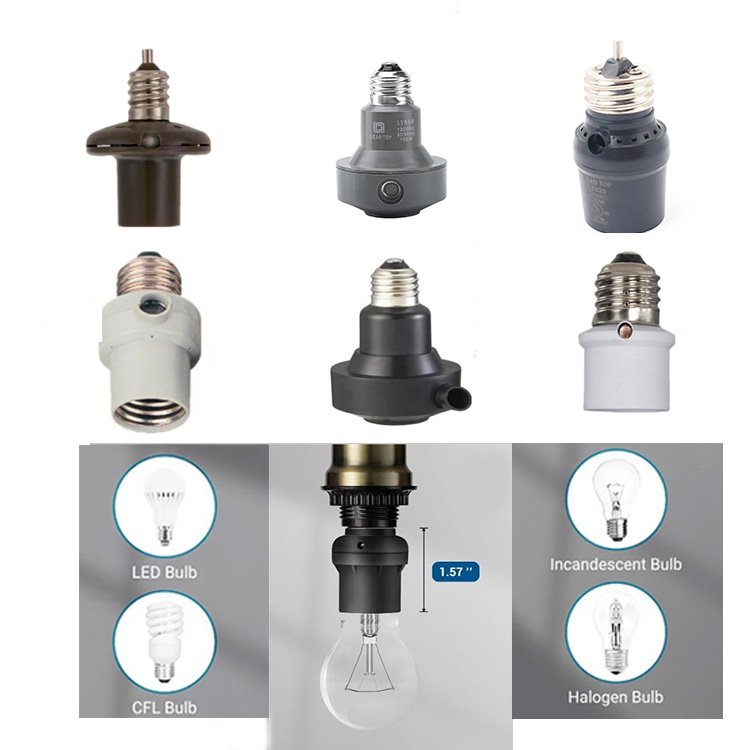
A eficiência na manutenção é uma importância crescente para as metrópoles. Como resultado, a indústria está migrando para projetos modulares plug-and-play que utilizam componentes homogêneos, como soquetes NEMA, conectores Zhaga, drivers descartáveis e módulos de encaixe.
Essa modularidade reduz as interrupções, agiliza os avanços e prolonga o ciclo de vida dos ativos — benefícios essenciais para investimentos de longo prazo em iluminação urbana inteligente e projetos gerenciados por empresas de engenharia, aquisição e construção (EPC).
Tendência 10: O controle de um nó por lâmpada torna-se o novo padrão.
O controle centralizado de iluminação está sendo rapidamente substituído pela inteligência individual de cada luminária. Cada luminária agora funciona como um nó autônomo e endereçável, capaz de monitorar o consumo de energia, erros e condições ambientais.
Essa metodologia aprimora a iluminação adaptativa, melhora o planejamento da manutenção e aproveita ao máximo a eficiência do trabalho.
Quais são as perguntas mais frequentes dos compradores estrangeiros em 2025?
Vocês têm distribuidores ou agentes locais?
Sim. A disponibilidade varia conforme a região, com cobertura consolidada no Oriente Médio, África, Sudeste Asiático e América Latina.
Os produtos de iluminação inteligente podem ser personalizados?
Sim. Oferecemos amplo suporte à personalização OEM/ODM, incluindo CCT, potência, óptica, fotocélula NEMA, interfaces Zhaga-D4i, etiquetagem e embalagem.
Quais certificações você possui?
As certificações típicas incluem UL, CE, CB, RoHS, ANSI, Zhaga-D4i, IP66/67, e IK08, dependendo do tipo de produto e do mercado.
As amostras e os prazos de entrega são flexíveis?
As amostras são preparadas regularmente em 3 a 5 dias. Os prazos de entrega padrão variam de 10 a 20 dias para pedidos de 100 a 5.000 unidades, dependendo da configuração e da capacidade de produção.
Conclusão:
O ano de 2025 marca uma virada global. A iluminação inteligente não se define mais apenas pela iluminação em si, mas também pela conectividade, sensores, dados e sustentabilidade.
| Dimensão | Iluminação tradicional (antes de 2025) | Iluminação inteligente em 2025 | Impressão Estratégica |
| Função fundamental | Iluminação básica (ligar/desligar) | Iluminação inteligente e conectada | A iluminação se torna um ativo de infraestrutura digital. |
| Conectividade | Autônomo ou controlado fisicamente | Conectados por meio de plataformas de IoT | Permite o controle remoto e aprimoramento de todo o sistema. |
| Capacidade de detecção | Nenhuma ou nominal | Sensores unificados de movimento, luz ambiente e ambientais. | A iluminação funciona como um nó de coleta de dados. |
| Método de controle | Horários fixos ou mudanças que exigem muita mão de obra | Controle adaptativo, automático e baseado em IA | Aumenta a proficiência e a experiência do usuário. |
| Geração de dados | Sem saída de dados | Dados operacionais e ambientais constantes | Suporta análises, planejamento e manutenção preditiva. |
| Proficiência em Energia | Proficiência construída exclusivamente com base no desempenho de LEDs. | Aumento real de energia | Redução substancial no consumo de energia. |
| Modelo de manutenção | Responsivo (corrige após falha) | Preditivo e baseado em condições | Menores custos de manutenção e menos interrupções. |
| Integração de Sistemas | Isolado de outros sistemas | Em consonância com plataformas de cidades inteligentes e edifícios. | Permite inteligência entre sistemas |
| Papel da Sustentabilidade | Restrito a um menor consumo de energia | Apoia vigorosamente as metas de redução de carbono. | Alinhar a iluminação com as políticas ESG e ambientais. |
| Valor do ciclo de vida | Com foco em hardware | Software, dados e serviços orientados | Retorno sobre o investimento (ROI) mais elevado e duradouro, além de escalabilidade do sistema. |
A incorporação do controle de iluminação por IA, iluminação pública IoT, iluminação adaptativa e digitalização da iluminação posiciona a infraestrutura de iluminação como o pilar das futuras cidades inteligentes.
Como especialista em fotocélulas, interfaces de fotocélulas NEMA, soquetes Zhaga-D4i e componentes de controle inteligentes, a Lead-Top Electrical se dedica a apoiar parceiros internacionais, fornecendo infraestrutura confiável, homogênea e preparada para o futuro.


 Portuguese (Portugal)
  English
  Portuguese (Brazil)
  Spanish
  Russian
  Dutch
Dutch  Japanese