Choosing the right outdoor photocell light sensor for a municipal project can be tricky. Large lighting projects need products that meet the required standards. But which certifications really matter?
Requirements can vary by country and application. ANSI and UL are commonly relevant to North American street lighting, while in European markets, demands are different. Buyers should also verify test reports and supplier qualifications.
This guide explains the key certifications to check and shows how they fit into municipal lighting procurement.
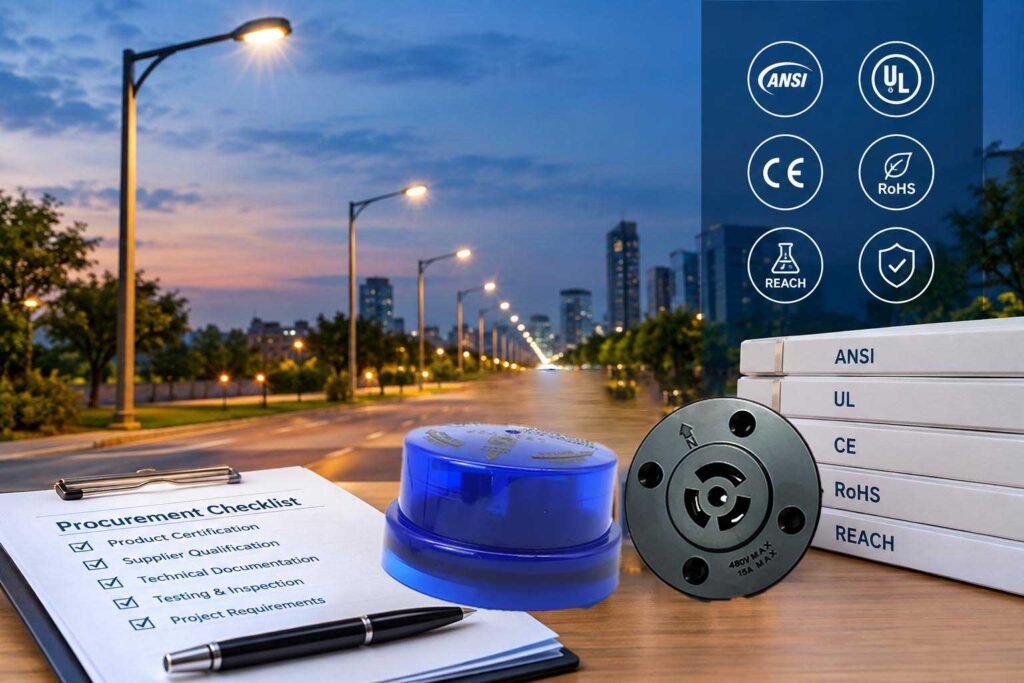
What Certification Requirements Apply to Municipal Light Sensor Switches in Different Markets?
Certification needs can change with the target market.
United States and Canada
Here, municipal buyers commonly encounter ANSI C136.10 for photocontrols and mating receptacles. The current ANSI edition is C136.10-2023. UL 773 covers plug-in locking-type light sensor photocell switch for area lighting.
European Union
Here, requirements follow applicable EU legislation. CE marking applies when the product falls under rules that require it. RoHS restricts certain hazardous substances in electrical and electronic equipment. REACH can create additional substance-related obligations.
For other markets, buyers should check the country, tender, and project specification before procurement.
Where Do Photocell Certifications Fit Into a Municipal Lighting Tender?
Certification documents can appear at several points in a municipal lighting tender. Buyers may first review them during the technical evaluation. They may then check the same documents during supplier qualification and product approval.
A typical process looks like this:
Tender → Technical Review → Supplier Qualification → Product Approval → Mass Production → Inspection
The technical review can confirm whether the proposed photo sensor meets the required standard. Product approval can verify the submitted model and supporting reports. Before mass production, buyers may also require approved samples or documentation.
During production, inspection helps confirm that delivered products remain consistent with the approved specification. This makes certification part of the wider procurement process, not just a document submitted with the bid.
| Procurement Stage | Typical Buyer Action | Useful Supplier Documents |
| Tender Preparation | Define technical requirements | Product standards and specification references |
| Bid Submission | Review proposed products | Datasheet, certificates, test reports |
| Technical Evaluation | Compare compliance | Model-specific certificates and declarations |
| Sample Approval | Inspect the proposed product | Sample, datasheet, test documentation |
| Purchase Order | Confirm approved specification | Approved model and purchase specification |
| Incoming Inspection | Check delivered products | Inspection records and batch information |
What Is the Difference Between Product Certification and Supplier Qualification?
What Does Product Certification Tell a Municipal Buyer?
Product certification shows that a specific product has been assessed against defined requirements. For locking-type photocontrols, ANSI C136.10-2023 covers physical and electrical interchangeability and testing. UL also identifies plug-in locking-type photocontrols under its applicable safety certification program.
What Should Buyers Check About the Supplier?
Supplier qualification looks beyond one product. Buyers should review
- The manufacturer’s quality system
- Testing process
- Production capability
- Documentation control
To further ensure an excellent quality management system, ask for ISO 9001.
Why Do Both Matter?
A certified product addresses product-level requirements. Supplier qualification helps assess whether the manufacturer can produce that approved product consistently at project scale.
What Should Be on a Municipal Light Sensor Supplier Checklist?

Which Photocell Switch Specifications Should Buyers Verify?
Start with the specifications stated in the tender. Check:
- Rated voltage
- Load rating
- Operating temperature
- IP protection
- Surge protection
- Interface compatibility
For NEMA-style installations, verify that the photocontroller and mating receptacle meet the required interface standard. ANSI specifically addresses locking-type photocontrols and mating receptacles.
Which Certification Documents Should Buyers Request?
Ask for certificates and test reports that identify the exact model being offered. For EU projects, check the applicable CE documentation and EU Declaration of Conformity. EU guidance states that manufacturers must maintain supporting technical documentation for applicable CE-marked products.
A practical checklist includes:
- Product datasheet
- Applicable certificates
- Test reports
- Declaration of Conformity
- Quality-management certification
- Model and revision details
Which Photocontroller Solutions Fit Different Municipal Lighting Applications?
When Should Municipal Buyers Choose NEMA Photocontrols?
NEMA light sensor switches suit conventional outdoor lighting with locking-type interfaces. ANSI C136.10-2023 covers locking-type photocontrol devices and their mating receptacles. These products are common in roadway and area-lighting applications where standard twist-lock interfaces are specified.
When Are NEMA Receptacles Needed?
A NEMA receptacle provides the mating interface for a compatible locking-type photocontrol. Buyers should verify the receptacle and photocontrol as a matched system. The required interface should follow the luminaire design and tender specification.
When Should Buyers Consider Zhaga Solutions?
Zhaga Book 18 is designed for outdoor luminaires and sensing or communication modules. It defines mechanical, power, and communication interfaces. This makes Zhaga suitable for smart-lighting projects that require modular control or sensing.
| Lighting Project | Control Approach | Typical Interface | Buyer Consideration |
| Conventional Street Lighting | Dusk-to-dawn photocontrol | NEMA twist-lock | Check existing receptacle compatibility |
| Roadway LED Retrofit | Automatic light-level control | NEMA photocontrol | Confirm electrical and mechanical compatibility |
| Municipal Area Lighting | Automatic switching | NEMA interface | Consider environmental protection and surge conditions |
| Smart Street Lighting | Sensor and communication module | Zhaga Book 18 | Check power and communication requirements |
| Connected LED Infrastructure | Modular sensing/control | Zhaga or project-specific interface | Consider future control-system integration |
What Questions Should Municipal Buyers Ask a Photocontroller Supplier?

Municipal buyers should ask specific questions before approving a supplier. Start with the product. Ask which standards and certifications apply to the exact model. Request current certificates, test reports, and technical datasheets.
Then check production capability. Can the supplier support the required quantity? What inspections are performed during production? Can samples be provided before mass production? These questions help connect product approval with large-scale delivery.
Buyers should also ask about technical support and documentation. Useful questions include:
- What certifications does this exact model hold?
- Can you provide the relevant test reports?
- What is the production capacity?
- How is batch quality checked?
- Can you support project-specific requirements?
- What technical support is available?
What Common Certification Mistakes Should Municipal Lighting Buyers Avoid?
Certification checks can fail when buyers focus only on the certificate name. One common mistake is accepting documentation without confirming the exact photoelectric sensor model. Product identification should match the offered unit and its technical specifications. EU technical documentation, for example, should identify the product and applicable conformity requirements.
Another mistake is treating one certification as proof of every requirement. Buyers should match each document with the tender specification and target market. For NEMA locking-type products, ANSI C136.10 covers the photocontrol and mating receptacle interface.
Before approval, check:
- Exact model and revision
- Applicable standard
- Certificate or test-report scope
- Rated specifications
- Current supporting documents
- Compliance with the tender requirements
FAQs
What certifications should a municipal photocontroller supplier have?
Requirements depend on the market and tender. Common requirements include ANSI and UL for applicable North American products, plus CE, RoHS, or REACH where applicable in the EU.
What certification is important for street lighting in the USA?
ANSI C136.10 is important for locking-type photocontrols and mating receptacles, while UL 773 covers applicable plug-in locking-type photocontrols.
What documents should be included in a lighting tender?
Typical documents include:
- Product datasheets
- Applicable certificates
- Test reports
- Declarations of conformity
Why should buyers verify the exact model on a certificate?
A certificate may apply only to specific models or configurations. Buyers should confirm that the certified model matches the product offered for the project.
Final words
Municipal lighting buyers should verify product certifications, technical documents, testing, and supplier capability before procurement. Lead-Top supports these requirements with NEMA photocontrols, NEMA receptacles, and Zhaga solutions for different lighting projects. For project-specific documentation or requirements, municipal contractors and distributors can contact Lead-Top for technical support.
Suggested links:
External Links
- https://www.ansi.org/
- https://www.ul.com/
- https://www.iec-equipment.com/new/new-31-969.html
- https://single-market-economy.ec.europa.eu/single-market/goods/ce-marking_en
- https://en.wikipedia.org/wiki/RoHS
- https://en.wikipedia.org/wiki/Registration,_Evaluation,_Authorisation_and_Restriction_of_Chemicals
- https://www.iec.ch/ip-ratings
- https://www.nema.org/
- https://www.zhagastandard.org/?view=article&id=64%3Abook-18&catid=10

 English
 Portuguese (Brazil)
 Spanish
 Russian
 Dutch
Dutch Japanese
 Portuguese (Portugal)